The Journey (1959), directed by Anatole Litvak, is a political-sexual triangle set
against the backdrop of the failed Hungarian revolution of 1956. Litvak,
who was known in film circles for his anti-establishment politics, wasted no
time translating this story to the big screen. The picture came out in
1959, when the events depicted were still relatively fresh in viewers'
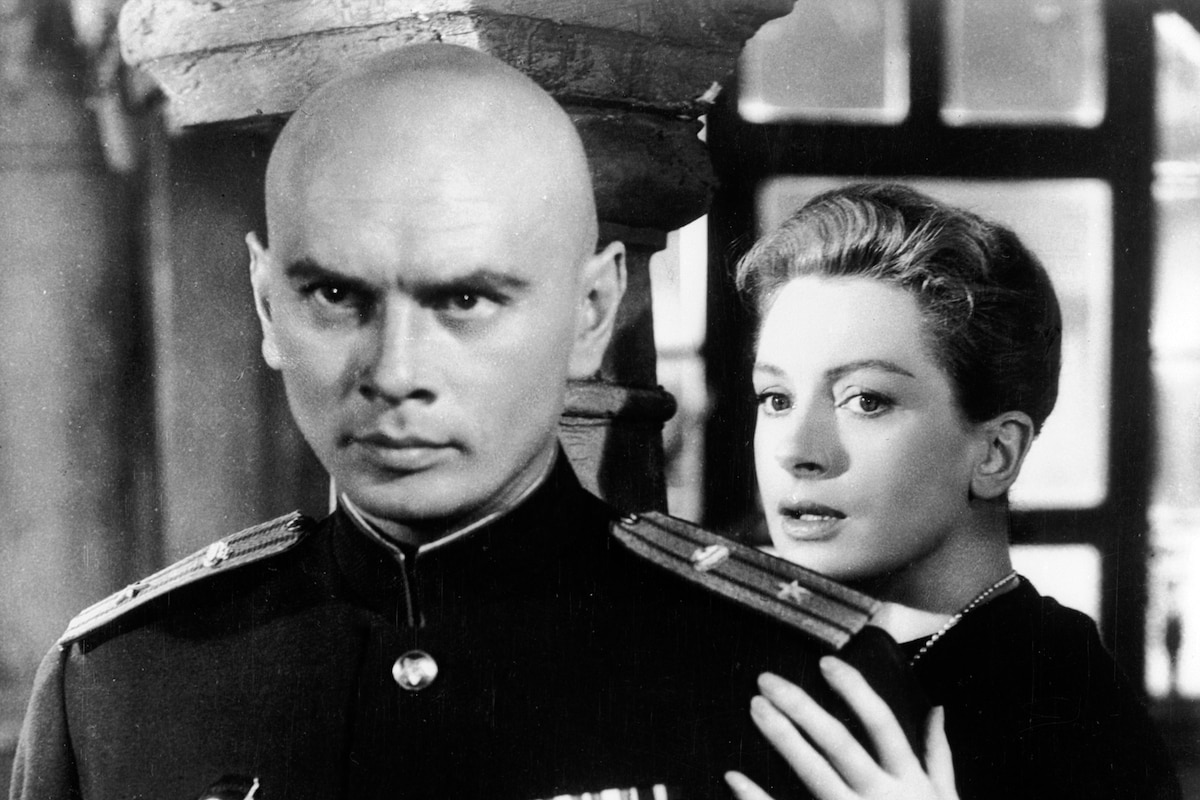
minds. Litvak also loaded the deck in his favor by casting Yul Brynner as a
Russian checkpoint commander who falls for a beautiful Westerner (Deborah
Kerr). Brynner was a sex symbol at the time, due mainly to his
Oscar-winning performance, also opposite Kerr, in The King and I
(1956.)
George Tabori's screenplay is a mixture of revolution and romance. A group
of passengers from a variety of countries (such as the U.S., Britain, Israel,
and France) are stranded at the Budapest airport during the Hungarian uprising. The
Russian Army has grounded all civilian planes, so the passengers are forced
to journey by bus to the Austrian frontier, a distance of about 100 miles.
At the last checkpoint on the Russian border, Major Surov (Brynner) stops
the party.
Initially, it seems Surov is only checking their passports and exit permits,
but it soon becomes clear that he has other motives. A man named Paul Kedes
(Jason Robards, in his film debut; child actor Ronny Howard also
makes his second big screen appearance here) is traveling with Lady Diana Ashmore (Kerr.) Surov suspects Kedes of being a Hungarian rebel, and he's also developing feelings
for Ashmore. Before it's over, he'll have to reconsider his politics to
save the woman he loves.
The evocative settings of The Journey can be traced directly to Litvak's visual expertise. His films were never as iconoclastic as his personal worldview, but he did
insist on an almost documentary-like shooting style years before the
approach became popular in commercial cinema. Even in the 1930s, he
utilized realistic sound effects and street noises. He used them, he said,
as "support for a film's images, heightening their pictorial values,
underscoring their visual beauty." He also favored tracking shots that
maintained continuity throughout a scene.
Litvak had an interesting background, although, like Brynner, he was apt to
invent his biography anew when asked for details. Little is known, for
instance, about his early life in Russia, except that he fled to Berlin in
1925. (He claimed to have been one of the many editors on Abel Gance's
legendary epic, Napoleon (1927), although this has never been
confirmed.) He left for Paris when Hitler rose to power in the 1930s, then
landed in Hollywood, where he directed The Woman I Love in
1937.
That's a treasure trove of verifiable information compared to Brynner's
"story." Depending on what article you read, he was either a full-blooded
gypsy or the illegitimate son of a gypsy and a wealthy Russian. He also
claimed to have studied philosophy at the Sorbonne in Paris. Other times, he
claimed to have worked as a gypsy singer, or as a trapeze artist in a
circus. Not surprisingly, he seldom pointed out that, in 1950, he was the
director of a children's television puppet show called Life With
Snarky. Renegade gypsy singer-trapeze artists don't direct puppet
shows, especially on local TV.
Directed by: Anatole Litvak
Screenplay: George Tabori
Produced by: Anatole Litvak
Art Direction: Isabella Schlichting and Werner Schlichting
Cinematography: Jack Hildyard
Editing: Dorothy Spencer
Music: Georges Auric
Principal Cast: Deborah Kerr (Lady Diana Ashmore), Yul Brynner (Major
Surov), Jason Robards (Paul Kedes), Robert Morley (Hugh Deverill), E.G.
Marshall (Harold Rhinelander), Anne Jackson (Margie Rhinelander), Ronny
Howard (Billy Rhinelander), Anouk Aimee (Eva).
C-126m. Letterboxed. Closed captioning.
by Paul Tatara
The Journey
by Paul Tatara | May 20, 2003
SIGN UP FOR OUR NEWSLETTERS

CONNECT WITH TCM