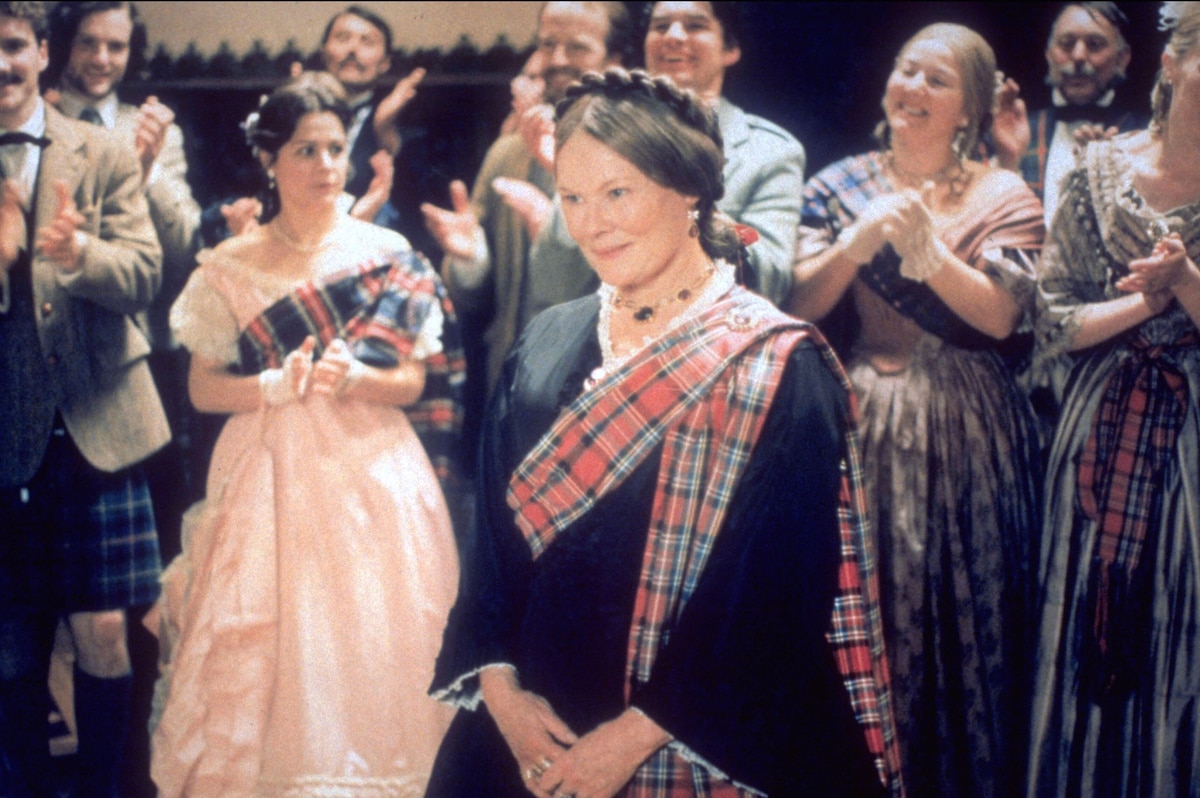
Based on true events, John Madden's 1997 drama Mrs. Brown stars Dame Judi Dench as England's Queen Victoria in a riveting Academy Award-nominated performance. The story takes place just after the death of Victoria's beloved husband, Prince Albert. The grieving Queen is inconsolable, keeping to herself and neglecting her royal duties. John Brown (Billy Connolly), a servant stationed at the Queen's Scottish estate, is called in to help. Brown's irreverent approach to the imperious Queen and blatant disregard for protocol ruffles many feathers. However, the two soon develop a strong, if unlikely, bond. Featuring first rate performances and gorgeous location scenery, Mrs. Brown is a poignant and unconventional love story.
Mrs. Brown was originally intended to be a television project for the BBC. Ecosse Films, an independent production company, pitched the idea to the BBC with Scottish comedian and actor Billy Connolly attached to star as John Brown. Ecosse Managing Director Douglas Rae sent actress Judi Dench an early draft of the screenplay written by Jeremy Brock in hopes she might be interested in playing the title role.
Dench agreed to meet with Douglas Rae and Jeremy Brock to discuss the project. According to John Miller's authorized 2000 biography Judi Dench: With a Crack in Her Voice, "Before they could open their mouths, she opened her Filofax and said, 'When do we start?' Then Douglas Rae told her, 'But I want you to know that Billy Connolly's first choice for Queen Victoria is Bob Hoskins.' Judi said, 'That's all right, it quite suits me to be Bob Hoskins' understudy.'"
Dench and Billy Connolly met for the first time over lunch to discuss the film, and the unlikely pair clicked immediately. They admired each others' work and, according to John Miller, "They shared a sense of humor and an appreciation of the absurd, which kept them, and everyone else, in a state of permanent hilarity off-set, and quite often on it, too."
Judi Dench's real life daughter Finty Williams was cast as Princess Helena, one of Queen Victoria's daughters. Rounding out the distinguished cast were Geoffrey Palmer as Henry Ponsonby, Antony Sher as Prime Minister Benjamin Disraeli and Gerard Butler, in his feature film debut, as John Brown's brother Archie.
The five week shoot for Mrs. Brown was on a tight schedule and met with several challenges. Many of the Scottish locations were difficult to reach, the weather was wildly unpredictable and the horses used in several outdoor scenes weren't always agreeable. For instance, in one pivotal scene during which Queen Victoria expresses her emotional attachment to Mr. Brown, Judi Dench was supposed to dismount from her horse. "The process of getting Judi off the horse with the voluminous skirts and underskirts," said director John Madden, "took care of about ten takes, horse-farts took care of another five, one horse bit another, and then it pushed Judi out of shot. At last we thought it had all really happened perfectly, until she walked away and her costume caught on [Connolly's] radio mike, so they were attached to each other. We went to twenty-one takes before we finally got it."
Despite the difficulties, Judi Dench was a true professional and never complained. To John Madden, Dench was a director's dream. Madden noted during the making of Mrs. Brown that he had "a very strong sense of where the scene was going to be emotionally, with the music of the lines in my head, but Judi always transcended that, particularly in the quiet moments, the moments between the lines where she is so astonishing. If you notice how her eyes move on screen, they register a fluidity of emotion, and the energy within her in every frame was so dynamic that I was never forced to cut where I didn't want to."
Co-star Billy Connolly shared Madden's admiration for Dench. Connolly, who was known primarily as a comedy star, was not a trained dramatic actor and was challenging himself to step outside of his comfort zone with Mrs. Brown. "When I read 'be real, don't get caught acting,'" said Connolly, "I thought, 'How the hell do you do that?' It wasn't until I worked with Judi that I realized what that meant. In the first scene when we met at Osborne she was remarkably real. We'd been laughing in the morning, and then she showed this grief for Albert which was so unbelievably real. She just carried me along in her slipstream. You could only react in kind."
Dench and Connolly worked well together and became friends during the shoot. When filming was complete, the two exchanged gifts. Connolly gave Dench a brooch, which writer John Miller described as "a wonderfully garish crown in colored glass." "She gave me," said Connolly, "a wee embroidered velvet cushion, which I'll treasure all my life, with 'To J.B. from V.R.' stitched onto it."
Although Mrs. Brown had been originally set to air on television, the quality of the film was so high that Miramax, the highly successful American film distributor, picked it up for a theatrical release. Its subsequent success with audiences and critics alike exceeded everyone's expectations and increased Dench's visibility to international audiences. "Dench brings her commanding stature and superb elocution to the multi-nuanced role of a strong but vulnerable woman," said the Variety review. "Though there are a number of outdoor scenes and production values are handsome, ultimately it's the narrow focus and chamber nature of the material that lends the movie its resonance and emotional power."
The New York Times said, "The role of John Brown is so robustly played by Billy Connolly, a bright-eyed, delightful Scotsman better known for stand-up comedy, that his appeal to the queen is eminently clear. And the film, directed by John Madden and written by Jeremy Brock with penetrating acuity, also sees the exquisite tension between Victoria's wishes and her obligations. That the Queen could not possibly have acted on her desires makes the film's subtlety that much more compelling."
Mrs. Brown received two Academy Award nominations: one for Best Makeup and the other for Judi Dench as Best Actress. It was her first of what was to be many Academy Award nominations. She enjoyed the chaotic whirlwind surrounding the ceremony even though she lost the Oscar® to Helen Hunt. "I didn't expect for a minute to win," she said, "and I didn't feel one single twinge of anything. The whole thing is amazingly tatty, and absurd, and we had a wonderful time, I wouldn't have missed it for anything."
Producer: Sarah Curtis
Director: John Madden
Screenplay: Jeremy Brock
Cinematography: Richard Greatrex
Art Direction: Charlotte Watts
Music: Stephen Warbeck
Film Editing: Robin Sales
Cast: Judi Dench (Queen Victoria), Billy Connolly (John Brown), Geoffrey Palmer (Henry Ponsonby), Antony Sher (Prime Minister Benjamin Disraeli), Gerard Butler (Archie Brown), Richard Pasco (Doctor Jenner), David Westhead (Prince of Wales, Bertie), Bridget McConnell (Lady Ely), Georgie Glen (Lady Churchill), Catherine O'Donnell (Lady-in-Waiting), Sara Stewart (Princess Alexandra), Finty Williams (Princess Helena).
C-105m. Letterboxed. Closed Captioning.
by Andrea Passafiume
Mrs. Brown
by Andrea Passafiume | November 10, 2009
SIGN UP FOR OUR NEWSLETTERS

CONNECT WITH TCM