The Dreamworks studio and producer-director Ridley Scott took a big risk sinking more than $100 million into Gladiator (2000), the kind of film that had long since fallen out of favor in Hollywood. What has become known as the "sword-and-sandal" epic had its heyday in the 1950s with a number of big budget American and international productions (not to mention many cheap knockoffs) set in Greek, Roman, and biblical times. Decades after the genre's popularity had waned, this drama of revenge set in the 2nd century scored big, grossing nearly four times its cost and garnering generally good reviews, not to mention numerous awards.
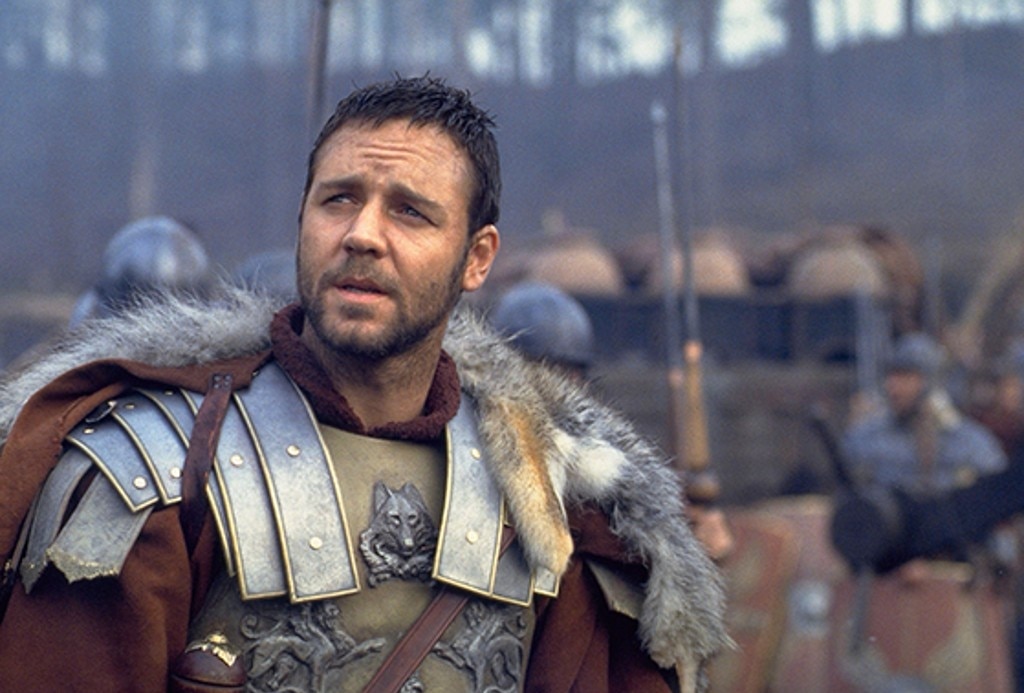
The plot of Gladiator centers on the most trusted and valiant of Emperor Marcus Aurelius' commanders, the fictional Maximus Decimus Meridias, for whom the end of a successful 12-year campaign against the barbarian tribes of Germania should have meant a return to his beloved family and farm. Upon the emperor's death, however, power is transferred to his son, Commodus, a real historical figure pictured here with a consuming jealousy over the esteem his father held for the young general. Maximus narrowly escapes being killed by Commodus' guard, but his wife and son are murdered. Falling into the hands of a slave trader, he trains as a gladiator, becoming one of the most popular and successful, all the while plotting his revenge on the evil Commodus.
In addition to elaborate action scenes on the battlefield and gladiatorial arenas and special effects that helped simulate the power and majesty of ancient Rome, Scott's venture was also greatly aided by the casting of Russell Crowe as Maximus. The role was reportedly first offered to and rejected by Mel Gibson; fellow Australian Crowe was cast after considerable acclaim for his work in L.A. Confidential (1997) and The Insider (1999). Crowe earned an Academy Award for his performance here and rose to major stardom. He and Scott have recently teamed again for another period action tale with some factual basis, Robin Hood (2010), which incorporates true historical figures and events much as Gladiator does.
Joaquin Phoenix, who gained weight to play Commodus (a role Jude Law tested for), also saw his career stakes rise considerably after Gladiator, which earned him a Best Supporting Actor Oscar® nomination. The film garnered Academy Awards for Best Picture, Sound, Visual Effects, and Costume Design, as well as six other nominations, including Best Director for Scott. The blockbuster brought in around four dozen additional awards worldwide and numerous nominations for every aspect of the production.
Gladiator was the last film role for veteran British actor (and legendary hell raiser) Oliver Reed, who died of an off-set heart attack before completing his part as gladiator trainer Proximo. In the original screenplay the character survives an assault by Commodus' Praetorian Guards, but upon Reed's death, the story was rewritten to have him die in the attack. The character's final moments on screen were created with body doubles and some very deft CGI using Reed's own face.
When Dreamworks executives first pitched the project to Scott, they didn't even show him a script, so the potential director was understandably wary of taking on a genre that had become a joke. Then they showed him the famous 1872 Gérôme painting "Pollice Verso" (translated as "Thumbs Down") depicting a gladiator receiving the sign to kill his opponent. "They really had me," Scott told Entertainment Weekly at the time of the film's May 2000 release. "I hadn't even read the script and I was sitting there begging." Crowe later said the same painting was one of the things that reversed his initial reluctance to accept the lead.
David Franzoni's early script, inspired by Daniel Mannix's history of the Roman games, Those About to Die, focused primarily on how sports heroes are slavishly worshipped by fans, and he developed an idea about commercialized gladiators making endorsements on frescoes, chariots, even jars of olive oil. Crowe found this to be a rather cynical take on life in ancient times and thought the hero was not sufficiently fleshed out. But Michael Mann, director of The Insider, urged him to jump at the chance to work with Scott, and after important script changes, including the hiring of writers who would bring more shading to Maximus and his life as a slave, Crowe was eager to play the part. One obstacle, however, needed to be surmounted; Crowe had packed on 38 pounds to play the anti-Tobacco whistle-blower in The Insider, so he began working out to get into fighting shape, a process that took much longer than he anticipated. He also trained with a sword master in Australia for nearly six months. Luckily Crowe, who owns a 560-acre ranch hours from Sydney, was already an expert horseman.
All his training notwithstanding, the actor took considerable lumps on the set. He cracked a bone in his foot, fractured a hip, had to get stitches in his cheek, seriously wrenched two bicep tendons, and cut one of his fingers so badly that by the time of the film's premier, he had still not regained the feeling in his fingertip. The physical strains were matched by those provided by the lack of a completed screenplay when production began. At some point, it was decided another act was needed, necessitating new writers being brought on board and a move to locations in Morocco, in addition to the original locations in England and Malta.
Besides using a still-intact 17th century fort in Malta, a replica of the Colosseum was built there, costing more than a million dollars and taking two and a half months to build. The final set was a reportedly breathtaking 40 percent of the full scale of the original, two tiers high as opposed to the real Colosseum's four. The rest was added digitally.
Richard Harris, who plays the aged Emperor Marcus Aurelius, had been cast many years earlier as Commodus in one of the last of the great "sword-and-sandal" epics of the time, The Fall of the Roman Empire (1964), but quit after artistic differences with director Anthony Mann.
Director: Ridley Scott
Producers: Walter F. Parkes, Laurie MacDonald, et al
Screenplay: David Franzoni, John Logan, William Nicholson
Cinematography: John Mathieson
Editing: Pietro Scalia
Production Design: Arthur Max
Original Music: Lisa Gerrard, Hans Zimmer
Cast: Russell Crowe (Maximus), Joaquin Phoenix (Commodus), Connie Nielsen (Lucilla), Oliver Reed (Proximo), Richard Harris (Marcus Aurelius), Derek Jacobi (Gracchus), Djimoun Hounsou (Juba).
C-155m. Letterboxed.
by Rob Nixon
Gladiator
by Rob Nixon | November 06, 2009
SIGN UP FOR OUR NEWSLETTERS

CONNECT WITH TCM