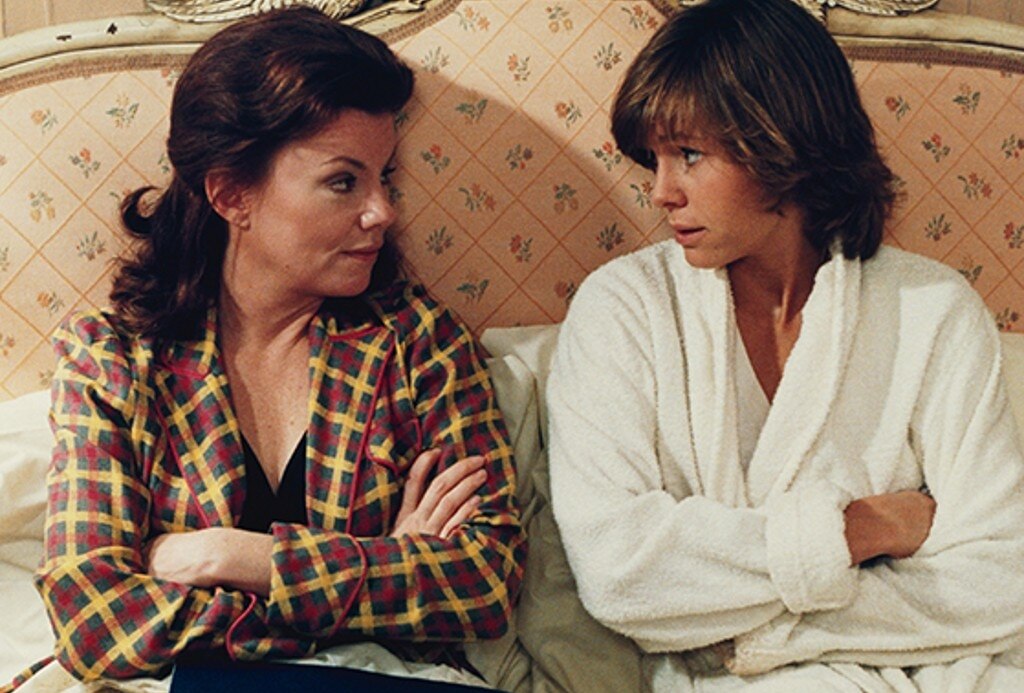
The Oscars® were frequently a family affair for Marsha Mason, who scored three of her four Best Actress nominations for films written by then-husband Neil Simon. All of their collaborations were written with her in mind. In Chapter Two (1979), she even played a character based on herself, a Broadway actress who cuts through a grieving widower's reserve to help him rediscover happiness. For their final film collaboration, Simon challenged her to step outside her comfort zone to play an aging, recovering alcoholic in the 1981 comedy-drama, Only When I Laugh.
Simon's story of a woman fighting to find her footing in life while dealing with a teenaged daughter and two loving but emotionally demanding friends had been inspired by the life of Judy Garland. He originally wrote it in 1970 as the play The Gingerbread Lady and created the leading role of Evy Meara for Maureen Stapleton, who had scored a hit in his three-play collection Plaza Suite. The first of the three plays, "Visitor from Mamaroneck," had been Simon's first attempt at a serious piece. With The Gingerbread Lady, he moved into more dramatic territory again. Though the play won raves and brought Stapleton a Tony Award for Best Actress, it ran only l93 performances, one of the shortest Broadway runs in Simon's amazingly successful career.
Eleven years later, Simon revisited the material and decided to produce the film version himself. At the time he announced, "...to avoid any of the confrontations I've had with producers in the past over casting, I've decided to do this one myself. I didn't want anyone telling me we had to have superstar names." The non-superstar name he selected to star is more obvious. Simon re-wrote the leading role for Mason, changing the leading lady from a singer to an actress and even changing the character's original Irish name to Georgia. But though he cast his wife in the lead, critics could hardly charge him with nepotism given their successful collaborations on their earlier films and the depth of her dramatic work in Cinderella Liberty (1973), the film that brought her an Oscar® nomination before she started making movies with her husband.
With his favorite director, Herbert Ross, busy on other productions, Simon turned to Glenn Jordan, an Emmy-winning television director making his big-screen debut. For the role of Mason's precocious daughter, whose desire to get to know her estranged mother helps trigger the character's crises, Simon cast one of the most respected and popular young actresses of the day, Kristy McNichol; she already had a history with Jordan, who had directed episodes of her acclaimed television series Family. James Coco, who had starred on Broadway in Simon's Last of the Red Hot Lovers, took the role of Jimmy, Georgia's gay actor friend, while Joan Hackett, a highly respected stage, screen and television actress who never made the break to stardom, played Toby, a socialite friend fighting a losing battle with aging.
Composer David Shire, who scored Only When I Laugh, wrote a title song that never made it into the movie. Nonetheless, Brenda Lee released a recording which was promoted as "From the Columbia Motion Picture," and the song was nominated for a Razzie Award for Worst Original Song from a movie.
Not surprisingly, when Only When I Laugh premiered it won its best reviews for its ensemble acting, particularly from the establishment press. Rex Reed wrote, "I rarely leave a film wanting to take the people I've just seen home to Mother, but I'd be proud to know everyone in this one." More trenchant was Roger Ebert, who awarded the film one star and slammed Simon for cardboard writing that "uses misfortunes as a way of creating characters. If he can create an 'alcoholic,' then he doesn't have to create a three-dimensional person for his film. He can just fill out the person's life with predictable crises from the disease." But even he had to acknowledge the quality of McNichol's performance.
The powerhouse cast generated considerable Oscar® buzz that was borne out when Mason, Hackett and Coco all scored nominations. Yet even though Hackett captured the Golden Globe (and McNichol won the Young Artist Award for Best Young Motion Picture Actress), their Oscar® fates were pretty much sealed. John Gielgud in Arthur and Maureen Stapleton in Reds were considered locks for the supporting awards. In Best Actress, the front-runners were Diane Keaton in Reds and Meryl Streep in The French Lieutenant's Woman. As sometimes happens when there are two equally strong contenders for the Oscar®, Keaton and Streep cancelled each other out. But the beneficiary of their splitting the votes was not Mason, but Katharine Hepburn, who won a record fourth Oscar® for On Golden Pond.
Only When I Laugh achieved one distinction in awards history. James Coco managed to score a Razzie nomination for Worst Supporting Actor, making him the only actor ever to be nominated for the Oscar® and the Razzie for the same performance. Coco lost that dubious distinction, too, as Steve Forrest claimed the award for delivering some of the year's worst dialogue in Mommie Dearest.
Producer: Roger M. Rothstein, Neil Simon
Director: Glenn Jordan
Screenplay: Neil Simon
Based on the play The Gingerbread Lady by Simon
Cinematography: David M. Walsh
Art Direction: Albert Brenner, David M. Haber
Music: David Shire
Cast: Marsha Mason (Georgia), Kristy McNichol (Polly), James Coco (Jimmy), Joan Hackett (Toby), David Dukes (David), Peter Coffield (Mr. Tarloff), Kevin Bacon (Don).
C-120m.
by Frank miller
SOURCES:
Inside Oscar® by Mason Wiley and Damien Bona
Only When I Laugh
by Frank miller | November 05, 2009
SIGN UP FOR OUR NEWSLETTERS

CONNECT WITH TCM