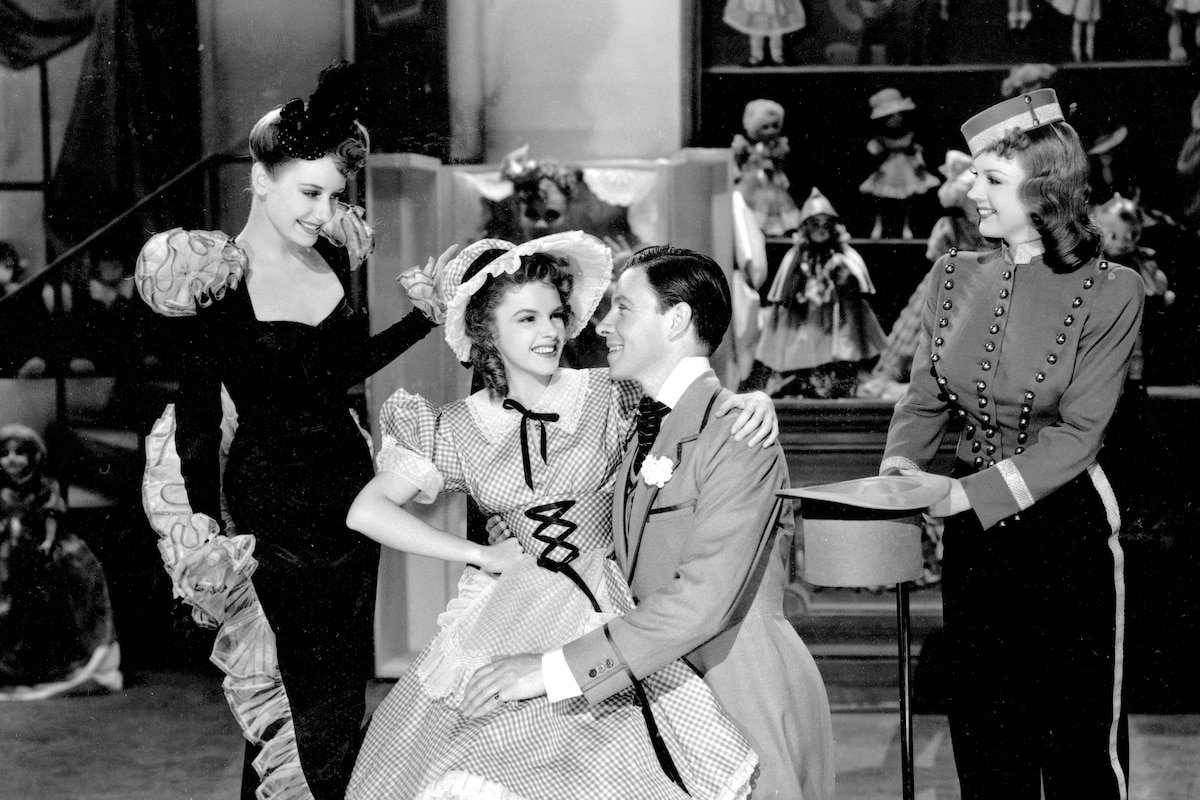
For Me and My Gal (1942) is very much the "forgotten" Judy Garland classic.
Although a big hit in 1942 (bringing in $4.8 million on an investment of
just over $800,000), it is not as often revived as films like The Wizard
of Oz (1939), Meet Me in St. Louis (1944) or even her two other pictures with Gene Kelly, The Pirate (1948) and Summer Stock (1950). Nor is it currently available on DVD. Yet it plays an important part in her career, marking
the first time she would receive billing above the title and her most
ambitious dramatic role to that time. It also gave her two numbers that
would become staples of her later concert appearances, the title song
(usually done in concerts as a sing-along) and "After You've Gone." As
icing on the cake, it marked Gene Kelly's film debut. His role as a heel
who's reformed by his love for the leading lady would become a standby for the
dancing star.
Like most of MGM's best musicals, For Me and My Gal was a product of
Arthur Freed's production unit. Often hailed as the man who brought taste
and sophistication to the film musical, Freed benefited from a strong eye
for talent and stories and his openness to the advice of others. In this
case, that openness would pay off big time. The original script, called
"The Big Time," had unscrupulous song-and-dance man Harry Palmer involved
with two women, a singer (the role intended for Garland) and a dancer, with
the latter carrying most of the dramatic scenes as the woman he marries and
betrays. At the time, legendary stage star and acting teacher Stella Adler
was working at MGM as a production assistant, and Freed asked her to review
the script. She suggested combining the two female roles and giving
Garland, whose work she had admired for years, a chance at her most
dramatic role ever. She also suggested that he cast the as-yet-unproven
Gene Kelly as the leading man. Freed ended up going with both ideas, which
meant moving contract hoofer George Murphy, originally scheduled for the
lead, into a smaller role as the vaudeville star who loses Garland to
Kelly.
Freed had actually been interested in Kelly since he'd seen him in William
Saroyan's Pulitzer Prize-winning play The Time of Your Life in 1939.
At the time, however, Kelly wanted to establish himself with stage work.
A year later, Kelly was the acclaimed star of the musical Pal Joey
and had just choreographed Best Foot Forward, and MGM came calling
again. This time Louis B. Mayer offered him a contract after seeing Pal
Joey and telling him he didn't need to do a screen test. Then through
a communications snafu, Kelly was told he would have to test, so he
declined to sign the contract. Instead, he signed with independent
producer David O. Selznick. With his limited production slate, however,
Selznick had no projects in line for Kelly, who spent his first year in
Hollywood doing nothing. When Freed pushed MGM to cast Kelly in For Me
and My Gal, over the objections of studio brass who didn't want to take
a chance on an unproven film star, Selznick simply handed over his contract
to the studio.
Garland had also pushed for Kelly in the lead, and when he started on the
film, she went to bat for him whenever he had a disagreement with director
Busby Berkeley, whom she loathed. She also helped him adjust to acting for
the camera. For her part, the role offered her a welcome chance to grow
up. Her only prior shot at an adult role had been a few scenes as a woman
who dies in childbirth in Little Nellie Kelly (1940). For the rest of the
film, she had played the woman's teenaged daughter. Now she would spend an
entire film as an adult, something she was already doing off-screen, where
she had recently married composer David Rose. Garland also loved the
film's patriotic elements. She had been touring military bases and raising
funds for the Allies even before the Pearl Harbor attack that pulled the
U.S. into World War II. Now she got to entertain the troops on screen in a
series of classic pop numbers including "When You Wore a Tulip" and "Pack
Up Your Trouble."
The biggest problem with the film, however, was the characterization of the
leading man, who not only betrays his wife, but injures his hand to avoid
service in World War I. Even before the U.S. entered the war, using a
draft dodger as a romantic lead was questionable. After the start of the
war effort, it seemed almost deluded. During production, Berkeley added a
scene in which Garland sends her brother (future director Richard Quine)
off to war to the tune of "Till We Meet Again," but that only underlined
Harry's cowardice. When the film previewed, audiences overwhelmingly
expressed their disapproval of Kelly's character, saying that Garland
should have ended up with Murphy at the film's conclusion. Mayer blamed
Murphy for being too likable and even told him, "You spoiled the picture."
He ordered three weeks of re-takes that would give Kelly more of a
conscience and cut down on Murphy's presence. He even had the finale
re-shot, without Murphy (the original footage is lost, though the
soundtrack is available on CD). As disappointed as Murphy was, For Me
and My Gal became a hit, clearly establishing Kelly as a film star and paving
the way for more ambitious roles for Garland.
Producer: Arthur Freed
Director: Busby Berkeley
Screenplay: Richard Sherman, Fred Finklehoffe, Sid Silvers
Based on the story "The Big Time" by Howard Emmett Rogers
Cinematography: William Daniels
Art Direction: Cedric Gibbons, Gabriel Scognamillo
Music: George E. Stoll
Principal Cast: Judy Garland (Jo Hayden), George Murphy (Jimmy K. Metcalf),
Gene Kelly (Harry Palmer), Marta Eggerth (Eve Minard), Ben Blue (Sid
Simms), Richard Quine (Danny Hayden), Keenan Wynn (Eddie Milton), Horace
[Stephen] McNally (Mr. Waring).
BW-104m. Closed captioning.
by Frank Miller
For Me and My Gal
by Frank Miller | May 16, 2003
SIGN UP FOR OUR NEWSLETTERS

CONNECT WITH TCM