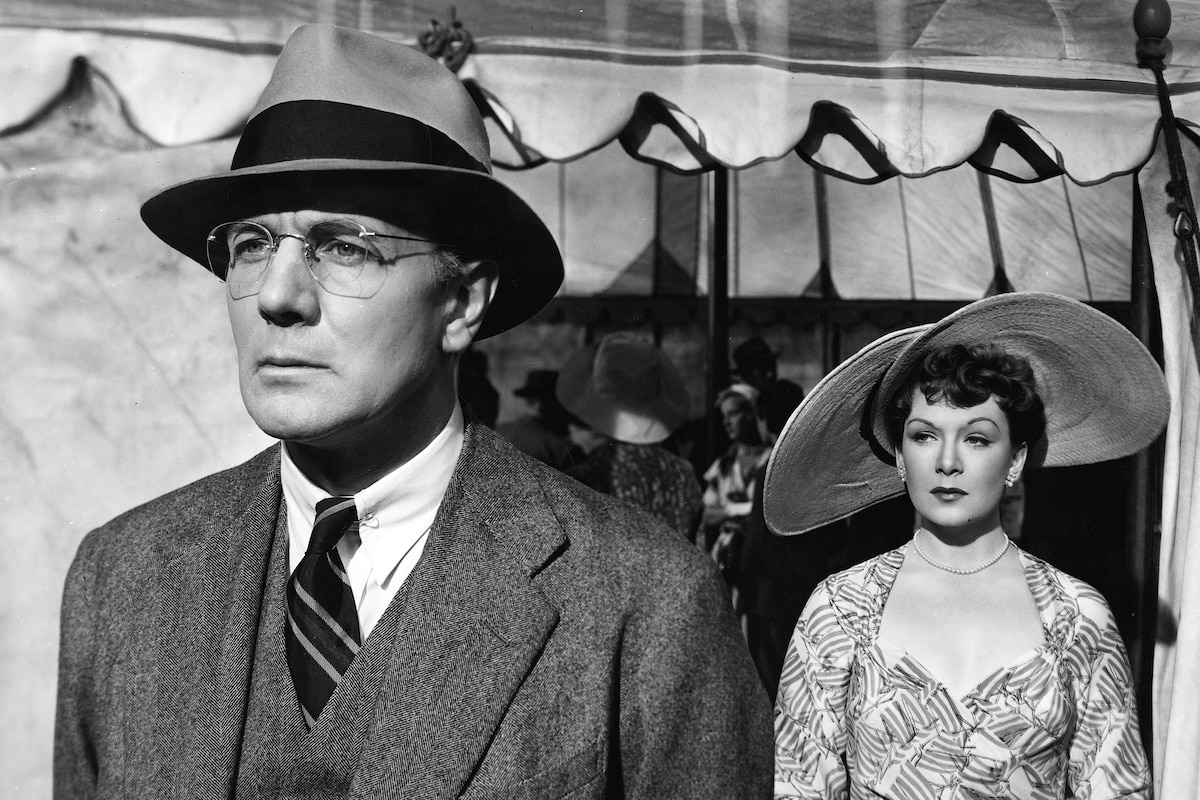
The next time you catch yourself complaining about getting older, consider the case of Andrew Crocker-Harris, whose midlife crisis includes forced retirement without a pension, a cheating wife and the hatred of his students and colleagues. In real life, knowing somebody in that situation would be enough to drive almost anybody to drink. But in the 1951 film The Browning Version, it makes for compelling drama, particularly with Michael Redgrave delivering one of the best performances in his distinguished career.
Terence Rattigan was already ranked among England's major playwrights in 1949, when he set out to create a character inspired by one of the strictest teachers at his old school, Harrow. Far from getting back at the man, however, he created a touching human portrait of a teacher who feels cut off from his dreams of scholarship, his students and his life until a single act of kindness from a formerly apathetic student awakens him to a lifetime of lost opportunities. The title reflects the delicate layering of Rattigan's work; The Browning Version refers to the gift from Crocker-Harris' student, Robert Browning's translation of the Greek tragedy Agamemnon. Not only had the teacher once dreamed of publishing his own translation of the work, but its plot, in which Queen Clytemnestra murders her husband, mirrors the way the man's spirit has been murdered, at least in part, by his wife's infidelities and insensitivity. The student inscribes the book, in Greek, "God from afar looks graciously upon a gentle master," a phrase that could be interpreted as gratitude for Crocker-Harris' having given the boy private tutoring or a gentle rebuke for a classroom infraction that earned the teacher the nickname "The Himmler of the Lower Fifth."
Director Anthony Asquith, who had worked with Rattigan earlier on adaptations of the playwright's French Without Tears (1940) and The Winslow Boy (1948), fell in love with the play, but had a hard time convincing anybody to back a production because it seemed such a downbeat story. He and Rattigan finally solved the problem by creating a final scene that allowed Crocker-Harris a degree of self-awareness. The play had ended with the teacher deciding to speak at the end-of-term ceremony, even though the headmaster had urged him to relinquish his place to a more popular colleague. For the film, Rattigan continues the story to show Crocker-Harris' speech, in which he apologizes for having failed to reach his students. His confession is so heartfelt, the students greet him with a spontaneous burst of applause, giving him at least a moment of triumph.
By the time Asquith had arranged for financing, Eric Portman, who had starred in the play's London premiere to great acclaim, was unavailable. Fortunately, Redgrave suddenly became free when a film he had signed for fell through. He came to the role on such short notice, however, that he did not feel he had time to prepare as thoroughly as he might have liked. In particular, Redgrave had wanted to lose weight for the role, something he had only partially achieved by the time filming started. His weight visibly fluctuates throughout the picture as a result. The rest of Redgrave's work on the role, however, was inspired. He used peroxide on his hair, which in black and white made it appear that the character was going gray, and asked his barber to shave the crown of his head to give the appearance of encroaching baldness. To his dismay, that effect was only visible in a few shots. Originally he had not wanted to wear eyeglasses, considering that a cliché for academic characters. After costume tests, however, he realized that a pair of wire-rimmed glasses completed the look perfectly. To top it all off, he developed a lighter voice for the role to give the character a more ethereal quality.
Redgrave was never totally happy with his film work. In his memoirs he would state that to begin filming with the climactic speech at the final assembly forced him to jump into the role at an emotional high point before it felt truly lived in. He also didn't like his approach to the cricket scene, in which the headmaster informs him that he will not be receiving a pension. He had not been prepared for Wilfrid Hyde-White's urbane approach to the headmaster role, and responded by playing his own part too deferentially. In his memoirs, Redgrave would cite his misinterpretation of the scene as the reason for one of his few negative reviews. In the London Observer, C.A. Lejeune wrote that "For such a big man, his [Redgrave's] performance is wonderfully delicate, but it is the delicacy of a floorwalker rather than a scholar." But Lejeune was in the minority. When the film played at the Cannes Film Festival, it brought Redgrave the Best Actor Award (and a screenwriting award for Rattigan).
The director and writer, however, would soon be experiencing their own midlife crises as their genteel approaches to their art soon fell out of favor as social changes inspired new artistic standards in Great Britain. Asquith had started his career as a cinematic innovator often compared to fellow countryman Alfred Hitchcock. Where Hitchcock had developed a distinctive, personal style over the years, however, Asquith gradually pared down his work to a level of subtlety focused on showcasing performances and finely honed scripts. With the rise of the auteur school of film critics, he would soon find himself dismissed as too genteel and impersonal for new generations of critics and filmmakers. In the same way, Rattigan's subtle approach to playwriting, in which he dramatized glittering surfaces beneath which beat his characters' repressed passions, would soon be eclipsed by the angry young men of the late '50s with their portraits of working-class rage. Ironically, the two collaborators would move into more expensive, glamorous productions, like The V.I.P.s (1963) and The Yellow Rolls-Royce (1964). Though critically derided, those films would make Rattigan the world's highest-paid screenwriter, offering him a decidedly cushy midlife crisis.
The Browning Version has remained a popular stage and screen property, with the lead role providing solid acting opportunities to such actors as John Gielgud, Peter Cushing and Ian Holm, all of whom played in television productions. In 1994, Mike Figgis directed a new film version starring Albert Finney, who was named Best Actor by the Boston Film Critics. Yet it is the Redgrave version that remains the acknowledged classic thanks to his deeply nuanced performance. In recent years, both Asquith and Rattigan have undergone critical reevaluation, with critics once again appreciating the subtle pleasures of their collaboration.
Producer: Earl St. John, Teddy Baird
Director: Anthony Asquith
Screenplay: Terence Rattigan
Based on the play by Rattigan
Cinematography: Desmond Dickinson
Art Direction: Carmen Dillon
Music: Arnold Bax, Kenneth Essex
Cast: Michael Redgrave (Andrew Crocker-Harris), Jean Kent (Millie Crocker-Harris), Nigel Patrick (Frank Hunter), Wilfrid Hyde-White (Frobisher), Brian Smith (Taplow), Bill Travers (Fletcher).
BW-90m.
by Frank Miller
SOURCES:
In My Mind's I by Michael Redgrave
The Browning Version (1950) - The Browning Version
by Frank Miller | November 02, 2009
SIGN UP FOR OUR NEWSLETTERS

CONNECT WITH TCM