When one thinks of the Soviet cinema of the 1920s, the images that come to mind are those of state-sponsored propaganda, rendered in a dynamic visual style, orchestrated with the rhythm of hammer blows, engineered to deliver the maximum emotional and intellectual impact. But not every Russian film at the time was cut from the cloth of Sergei Eisenstein, Dziga Vertov and Vsevolod Pudovkin. There was a whole other movement that embraced the conventions of American and European film as a means of imparting its sociopolitical messages.
Films such as The Extraordinary Adventures of Mr. West in the Land of the Bolsheviks (1924), The Cigarette Girl of Mosselprom (1924) and even the sci-fi romance Aelita, Queen of Mars (1924) proved that some Red Russians served up their agitprop with joie de vivre.
The most prominent purveyor of this breed of film was the Mezhrabpom-Rus studio. In her book Movies for the Masses: Popular Cinema and Soviet Society in the 1920s, Denise J. Youngblood writes that, "the studio was a flourishing concern, its commercial style already well established. Despite its dependence on 'leftist,' German capital, it turned out unabashedly 'bourgeois' films -- films with the dash and glamour which had characterized the pre-revolutionary cinema."
One of Mezhrabpom's most ambitious films was Boris Barnet and Fyodor Otsep's Miss Mend (1926), which tapped into the adventure serial genre that had proven popular in the U.S. (The Perils of Pauline [1914]), Germany (Fritz Lang's The Spiders [1919-20]), and France (Louis Feuillade's Les Vampires [1915]). Broken into three feature-length installments and clocking a total of more than four hours, Miss Mend is a hyperkinetic comedy thriller that achieves the near-impossible challenge of maintaining audience interest over the course of a plot that expansive without being exhausting.
The labyrinthine plot follows the exploits of a muck-raking reporter, Barnet (Barnet), a photographer named Vogel (Vladimir Fogel), Hopkins the clerk (Igor Ilyinsky), and a typist named Vivian Mend (Natalya Glan), who stumble upon a conspiracy to murder American industrialist Gordon Stern and lay the blame on the Bolsheviks. Through a falsified will, Stern's empire will go to the vampish second wife Elizabeth (Natalya Rozenel), who hands it over to a "gigantic criminal conspiracy" known as the Organization, led by an assassin named Chiche (Sergei Komarov).
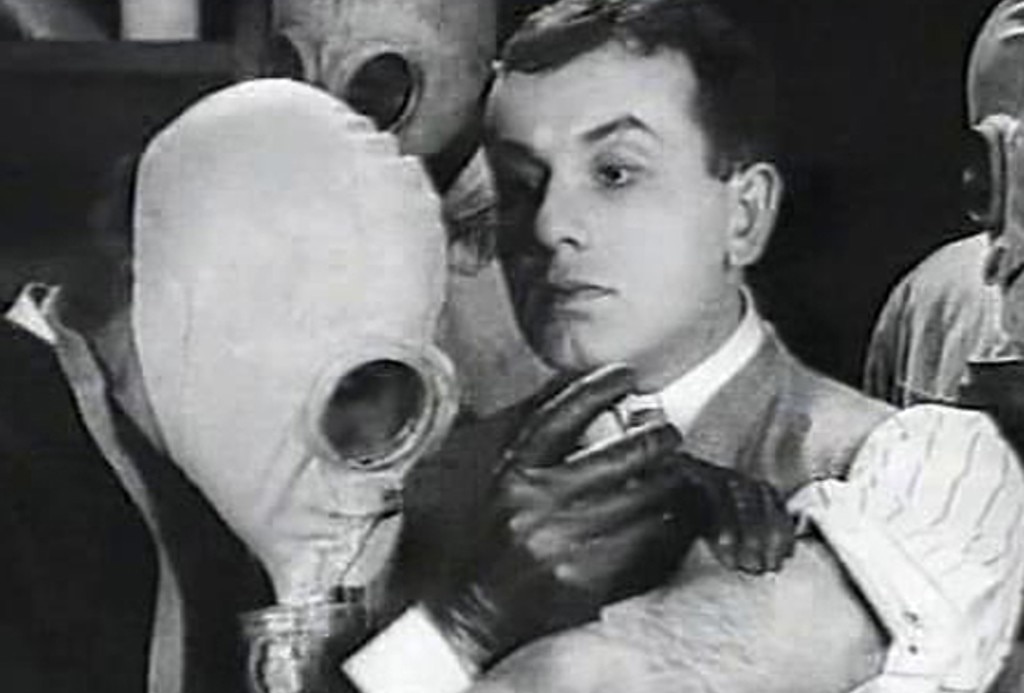
In part two, the nefarious Chiche reveals a plot to sell plague-inducing biological weapons to a cabal of wealthy industrialists. To demonstrate the effectiveness of the germs, he sends an ampule to be discharged in Soviet Russia (where it will eliminate thousands of labor activists). A motorboat chase ensues and the ampule is intercepted by Vogel, but is accidentally smashed... and the passengers and crew on the S.S. Preussen begin dropping like flies.
In the concluding section, the plague is contained and pursuit of Chiche reaches a fever pitch. Hopkins falls under Chiche's hypnotic spell (a reference perhaps to Fritz Lang's arch-villain Dr. Mabuse, who was a master of mind control) but it is unclear just how deeply entranced he may be. As the Organization begins to unravel, its mastermind makes a last-ditch effort to release the plague-bearing bacterium upon the world, but he hasn't accounted for the presence of the Soviet Police, who have the chance to be the heroes of the climactic third act.
According to Youngblood, "Miss Mend was one of the most-seen [Soviet] films of the twenties, with a recorded audience of more than 1.7 million in the first six months. It played at least two months at the deluxe Ars theatre in Moscow." But Youngblood reveals that the critics were not as enthusiastic as the ticket-buyers. "Miss Mend was one of the most criticized movies of the twenties... The reviews ranged from the dismissive ('naive and stupid' and 'varnished barbarism') to the denunciatory (accusations that the film's cheerful antics promoted 'hooliganism')."
Not exactly an intellectual exercise, the film was nonetheless laced with bits of social commentary, often aimed at various forms of Western decadence (including corrupt cops and red hot jazz).
Miss Mend was adapted from Marietta Shaginian's Mess-Mend: Yankees in Petrograd (1923), an epic novel initially serialized as ten paperbacks (one released every two weeks). So popular was the series that Shaginian revived some of the characters and continued the saga with Laurie Lane, Metalworker (1924) and The Road to Baghdad (1925), all published under the banner of Mess-Mend.
It was during the screenwriting process that Mess-Mend evolved into Miss Mend. The original serial was not named after a plucky secretary, but an underground revolutionary organization whose call-and-response passwords were "Mess-Mend" and "Mend-Mess." In his introduction to the 1991 English-language edition, Samuel D. Cioran observed, "As the name of the secret alliance suggests, they have shouldered the responsibility of mending the mess created in the world by capitalism and fascism."
In addition to the title change, Barnet and his co-writers radically reworked Shaginian's serial, which had evolved around a blue-eyed American super-laborer and organizer of revolutionaries: Michael Thingsmaster. Why would a Russian writer make her hero an American? Cioran explains that Shaginian was greatly influenced by the dime novels of Western lowbrow literature, as well as the influx of American silent films. This led to the circus-like cross-pollination of genres and media and politics that one finds in Barnet and Otsep's film as well. Shaginian capped off her playful satire by attributing authorship to one Jim Dollar, and even concocted a phony bio of Dollar as a two-fisted labor organizer who inherited a fortune and was now devoting himself to, "write propagandistic novels such as Mess-Mend which he forces the large and indifferent American capitalist presses to publish by paying three times the value of the entire edition." A photo of Dollar depicted a mustachioed man in a fez. It wasn't until the film Miss Mend was released that the true author was unmasked.
Born near Moscow in 1902, co-director Boris Barnet studied at the Moscow Art Academy, before joining the Red Army in 1920, serving as a medic. After contracting cholera, he was discharged, in 1922. A physical fitness enthusiast he became a boxing instructor and professional pugilist (hence the punching bags in the fictionalized Barnet's office in Miss Mend). Barnet was performing in the ring when he was discovered by filmmaker and theorist Lev Kuleshov, who invited the graceful fighter to join his influential cinema collective. Kuleshov later cast Barnet as "Cowboy Jeddy" in his slapstick spoof Mr. West. In addition to acting, Barnet tried his hand as a scenarist, which led to the offer to co-write and co-direct Miss Mend.
Though some sources list only Fyodor Otsep as director, history has determined that Barnet was the dominant creative force on the film. Youngblood notes that, "Barnet was added as co-director at the last minute. Barnet apparently proved more capable on the set than Otsep, and Otsep served as junior to Barnet during the shooting." As Bernard Eisenschitz put it in his essay, "A Fickle Man, or Portrait of Boris Barnet as a Soviet Director," "Otsep, apparently, was too lazy to keep up with the pace of shooting on Miss Mend."
Barnet's subsequent films as director include The Girl with the Hat Box (1927), Okraina (The Patriots, 1933) and By the Bluest of Seas (1936). His last completed work was 1963's Whistle Stop. In addition to directing, he made acting appearances in a number of his films.
"Speaking generally about my attitude toward cinema, I like comedy best of all," Barnet said in 1959, "I like to insert amusing scenes into dramas and dramatic scenes into comedies, but of course it's all a matter of proportion. With a few obvious exceptions, all my films, for better of worse, deal with contemporary life and its problems. When I have had the option, I have always chosen contemporary subjects, even though it is not always easy to tackle these," (quoted in Eisenschitz's "A Fickle Man").
After working in film for more than four decades, Barnet grew disillusioned with life and work. He committed suicide on January 8, 1965, while working on a film in Latvia, "leaving behind a note that said he seemed to have lost the ability to make good films" (Jonathan Rosenbaum).
For decades, Barnet's films were largely unseen and underappreciated by Western viewers -- dwarfed by the reputations of Eisenstein, Kuleshov, et al. This changed in 1980, when the National Film Theatre in London hosted a retrospective of the director's work. John Gillet reported on the event in Sight and Sound: "Perhaps the eddies which will doubtless emanate from this event may encourage other cinematheques to do the same, and his oeuvre will no longer be one which slides into reference books either in footnotes or as material to fill the cracks between discussion of the universally 'accepted' innovators."
Director: Boris Barnet and Fyodor Otsep
Screenplay: Boris Barnet, Fyodor Otsep and Vasili Sakhnovsky
Based on the novel Mess-Mend: Yankees in Petrograd by Marietta Shaginian
Cinematography: Yevgeni Alekseyev
Production Design: Vladimir Yegorov
Cast: Natalya Glan (Vivian Mend), Boris Barnet (Barnet), Vladimir Fogel (Vogel), Igor Ilyinsky (Tom Hopkins), Sergei Komarov (Chiche), Ivan Koval-Samborsky (Arthur Stern/Engineer Johnson), Natalya Rozenel (Elizabeth Stern).
BW-204m.
by Bret Wood
Miss Mend
by Bret Wood | October 21, 2009
SIGN UP FOR OUR NEWSLETTERS

CONNECT WITH TCM