In the late 1930s, the management of Warner Bros. Pictures was often kidded in the press for turning out a slate of repetitious crime and prison movies. The studio had no real defense in the case of Crime School (1938), which was blatantly patched together from two older scripts and hurriedly produced by the studio's B unit. Although it is the very definition of a programmer, Crime School rises above its B-movie origins thanks to the efforts of Vincent Sherman, the co-scripter and uncredited dialogue director, and to the enthusiasm of stars Humphrey Bogart and the Dead End Kids, eager to make the patchwork quickie click.
The film came about solely because studio head Jack Warner didn't like to see his contract players sitting idle. Following the great critical and box-office success of Samuel Goldwyn's Dead End (1937), for which Warners had loaned Bogart out for the tough-guy role, the studio bought Goldwyn's two-year contract with the juvenile leads of that picture. The young actors (Billy Halop, Huntz Hall, Leo Gorcey, Bobby Jordan, Gabriel Dell, and Bernard Punsley) had been brought to Hollywood by Goldwyn to reprise their roles from the Broadway production of the Robert Sherwood play. Warner Bros. producer Mervyn LeRoy had been impressed with the kids and had a project in mind for them, which was to have been written by Robert Rossen. According to Vincent Sherman, in his book Studio Affairs: My Life as a Film Director, "the project never came to life, and Warner, annoyed with having to pay the Kids' salaries for months when nothing was being done with them, voiced his feelings one day at the lunch table. [The head of Warner Bros' B-unit Bryan] Foy said he could put the boys to work quickly by doing a switch, remaking and combining two old studio A films. Warner said, 'Go ahead. You've got 'em.'"
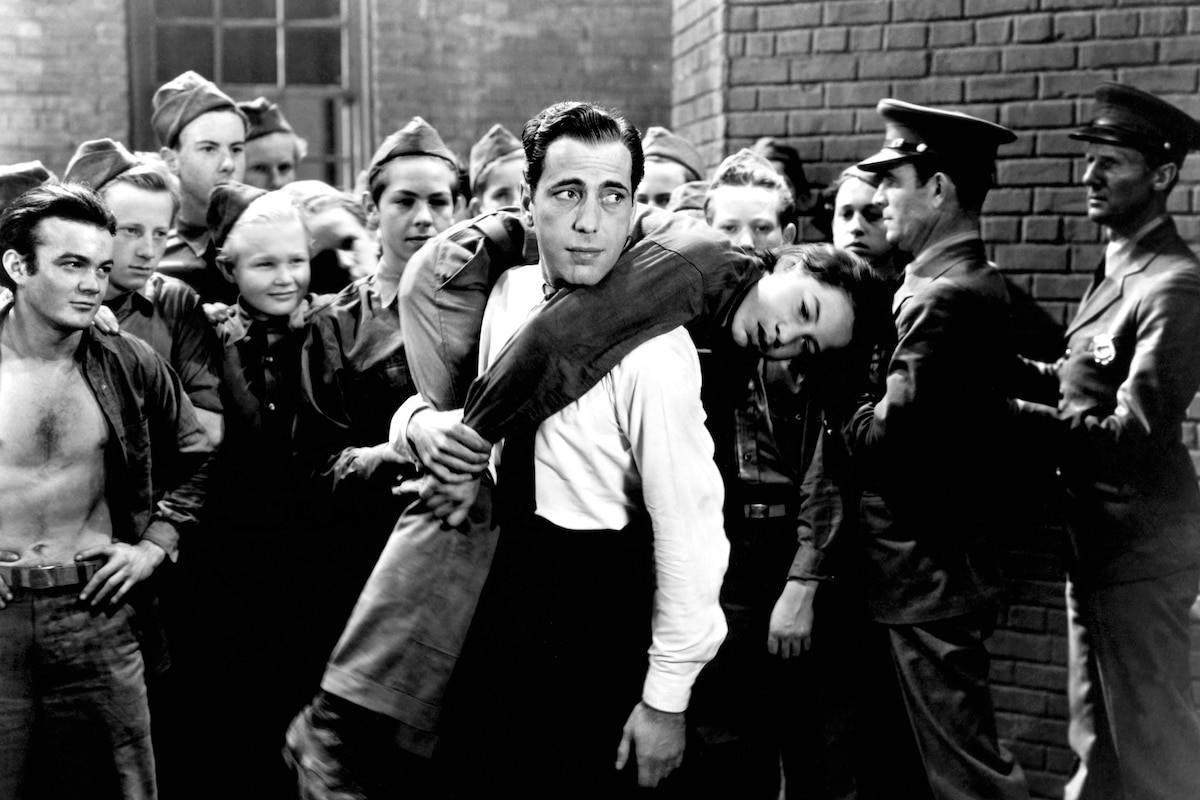
Former actor Vincent Sherman was a new writer on the Warners lot in 1938. He penned his first screenplay for an unproduced Mark Hellinger project and was then assigned to rewrites on Crime School. Veteran writer Crane Wilbur took the first pass on the patchwork job, combining the first half of The Doorway to Hell (1930) starring Lew Ayres with elements from the second half of San Quentin (1937), co-starring Pat O'Brien and Bogart. The focus of the story is a group of slum kids led by Frankie Warren (Billy Halop) who are always getting into trouble. Frankie's older sister Sue (Gale Page) is studying to get a better job and move Frankie to a stable neighborhood. The local cop on the beat has his eye on the kids, but they nevertheless steal a variety of items in the neighborhood and bring them to "Junkie" (Frank Otto), a fence and junkshop owner, for petty cash. When the gang brings in a haul one night, Junkie only offers them five dollars; a fight ensues, and "Spike" (Leo Gorcey), the most violent of the kids, hits Junkie over the head and knocks him out. The six boys are rounded up and brought to juvenile court. They refuse to "rat out" one of their own, so Judge Clinton (Charles Trowbridge) sentences them all to do time at Gatesville Reformatory. The reform school is run by the brutal hand of Superintendant Morgan (Cy Kendall), in cahoots with his corrupt Head Guard, Mr. Cooper (Weldon Heyburn). When the new Deputy Commissioner Mark Braden (Humphrey Bogart) tours the school and discovers that Morgan has sadistically beaten Frankie with a whip, he fires Morgan and several of the guards on the spot, but retains Cooper, mistakenly thinking he is clean. Braden institutes a new attitude at the school, giving the boys more freedoms and responsibilities in the hope that they will learn respect for themselves and others. Cooper, meanwhile, hatches a plan with Morgan to discredit Braden, who has developed a relationship with Frankie's sister Sue.
As authors David Hayes and Brent Walker noted (in The Bowery Boys: A Pictorial History of the Dead End Kids), Crime School also took some of its plot points, uncredited, from the property that established the Kids, Dead End: "Billy Halop once again has a hard working sister, and Leo Gorcey again plays the wise guy who double-crosses Halop when circumstances force him to act against his will. [Also], Halop retaliates against Gorcey, in a scene that is virtually a carbon copy of the scene in Dead End...pinning his adversary to the ground and [threatening to cut his face]. In both films Halop is restrained before he can inflict bodily harm." The final script for Crime School emulated some of the sociological seriousness of Dead End, but it could also shift confidently between melodrama and broad humor, sometimes in the same scene. Before Junkie is knocked out, we see the kids bring in an eclectic assortment of pilfered items, including a huge bathtub ("Squirt" [Bobby Jordan] adds that "there was a tootsie in it but she wouldn't go along"). When Commissioner Braden gives the kids more work responsibilities at the school, one scene employs broad slapstick as the boys paint their dormitory and manage to splatter everything in sight while swinging from ropes across the room; in contrast, a later situation turns tragic when the kids are entrusted to stoke a dangerous boiler and they intentionally cause it to overheat.
Crime School was given a brisk eighteen-day shooting schedule and assigned to workmanlike director Lewis Seiler. Sherman was asked to be the dialogue director, and as he later wrote, "at the end of the third day's shooting, after we had seen the rushes of the first two day's work, I thought the scenes... lacked spontaneity and a sense of life: The Kids seemed to be constrained by the individual lines of dialog assigned to them. I felt they needed to be free to ad lib..." Seiler agreed and the two set upon a routine: after blocking the shots with Seiler, Sherman would take the Kids aside and run through the scene, allowing them to use their own words. "I sat nearby with a pad and pencil, and as they ad libbed I jotted down as much as I could, especially those lines that were good, and there were plenty."
Humphrey Bogart was enjoying the experience on Crime School; as the male lead and the "good guy" of the film, it was a relief from the tedium of always playing a gun-toting heavy. As Bogart biographer Eric Lax worded it, "he was in constant need of money and therefore hooked by a studio who had him in what seemed a set pattern for his future: lead roles in minor films, minor roles in big films, and occasional appearances in great ones but only grooming a horse or toting a gun." As Sherman put it, "the word was, if it's a louse-heel, give it to Bogart." Bogart also participated in Sherman's ad-libbed rehearsals with the Dead End Kids.
The reviewer for Time magazine noted the film's heavy borrowings, saying that "Crime School is a mug of cinema mulligan stocked with chunks of such seasoned staples as James Cagney's The Mayor of Hell [1933], Freddie Bartholomew's The Devil Is a Sissy [1936], and the Pat O'Brien-Humphrey Bogart San Quentin. But what gives it a rich and salty flavor of its own is ingredients like the six young toughies from Dead End and a dialogue script that is often spicier than Dead End. That some day this gang would wind up in a tough cinema reformatory was entirely conceivable. That it would reform them as thoroughly as Crime School does is not so easy to believe."
The Warner Bros. regime felt that Crime School turned out so well that they opened it as an "A" picture rather than a "B." The final cost was $186,000, but it grossed over $2 Million at the box-office one of their most successful pictures of 1938. The success was a definite feather in the cap of Sherman, who had aspirations to direct. As he later wrote, "...because I had been blamed for the film being behind schedule, rewriting every day, and working with the Dead End Kids on the side, with its success I received the lion's share of the credit. ...As a result I suddenly found myself the fair-haired boy." Sherman's option was picked up by the studio and he was given his own office in the Writer's Building. Soon thereafter Sherman was further rewarded by being picked by Jack Warner to be among a small group to be developed as directors. Foy offered Sherman the choice of two properties, a remake of Kid Galahad (1937), or a horror movie called The Return of Dr. X (1939). Sherman chose the mad doctor film, and was given Bogart as star. The final film was a competent start for the director and a new career low in the opinion of the actor; both would soon advance to better opportunities.
Even after Crime School was completed, Warner Bros. did not give thought to creating a series of films with the Dead End Kids; in fact, they split up the group. Four of the actors Halop, Hall, Dell, and Punsley were released from their contracts, while Leo Gorcey and Bobby Jordan were kept on to appear in juvenile parts in other Warner productions. The four Kids who were let go went to Universal and appeared in Little Tough Guy (1938), with the additions of Hal E. Chester and David Gorcey (Leo's brother) to round out the gang. When Crime School proved to be such an attention-getter, Warners realized their mistake. According to Hayes and Walker, "The four kids had been earning $275 a week when their contracts were cancelled, but they were able to renegotiate for $650 a week." The next Dead End Kids film would be Michael Curtiz' superb Angels with Dirty Faces (1938), with Bogart again in a supporting gangster role, third-billed after James Cagney and Pat O'Brien.
Producer: Bryan Foy
Director: Lewis Seiler
Screenplay: Vincent Sherman; Crane Wilbur (screenplay and story)
Cinematography: Arthur Todd
Art Direction: Charles Novi
Music: Max Steiner
Film Editing: Terry Morse
Dialogue Director: Vincent Sherman
Cast: Humphrey Bogart (Deputy Commissioner Mark Braden), Gale Page (Sue Warren), Billy Halop (Frank 'Frankie' Warren), Bobby Jordan (Lester 'Squirt' Smith), Huntz Hall (Richard 'Goofy' Slade), Leo Gorcey (Charles 'Spike' Hawkins), Bernard Punsley (George 'Fats' Papadopolos), Gabriel Dell (Timothy 'Bugs' Burke), George Offerman, Jr. (Red, Reform School 'Oldtimer').
BW-85m.
by John M. Miller
Crime School
by John M. Miller | October 20, 2009
SIGN UP FOR OUR NEWSLETTERS

CONNECT WITH TCM