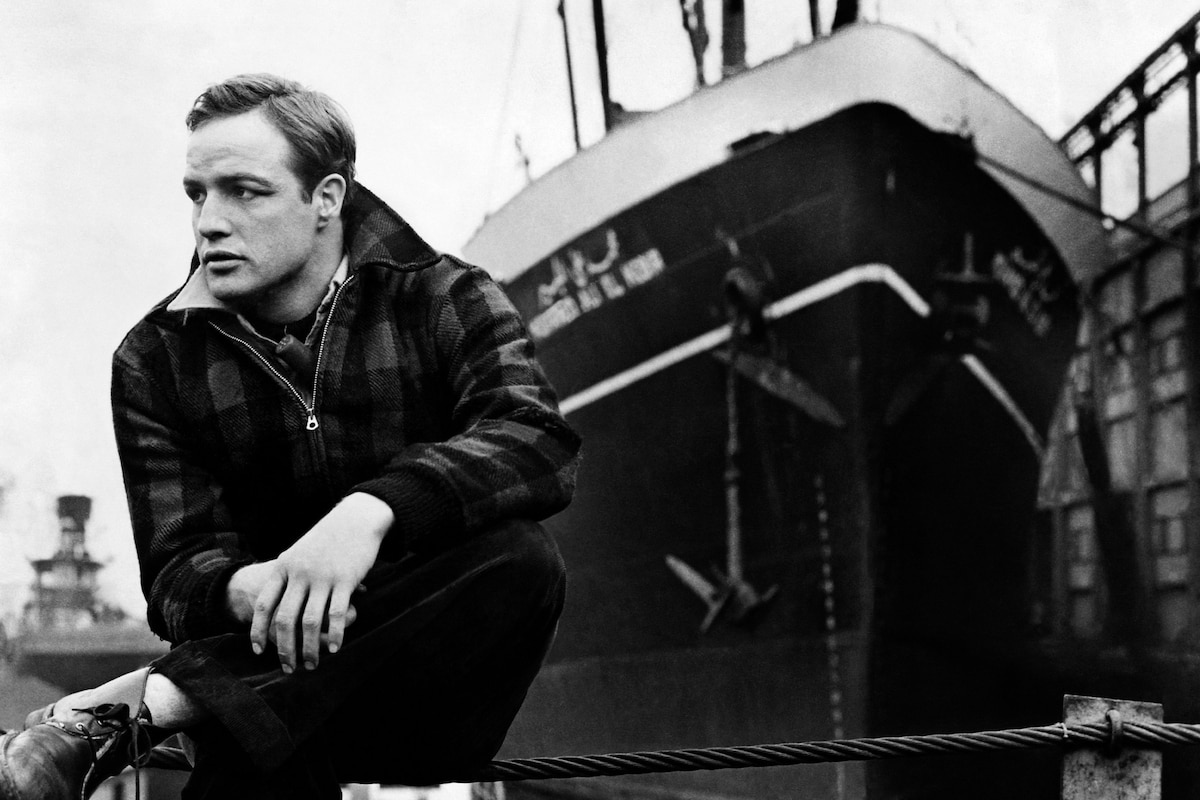
Nearly every scene of On the Waterfront was shot on location in Hoboken, New Jersey, much to the dismay of Columbia Studios' mogul, Harry Cohn; he thought he could exercise tighter control over the picture if it was filmed in Hollywood.
One advantage to filming on location was the brutal reality of the cold, harsh winter weather which lent the production a verisimilitude that could not have been recreated on a Hollywood soundstage.
Even though he considered Elia Kazan a father figure, Marlon Brando was extremely reluctant to accept the lead role in On the Waterfront, since he harbored ill feelings towards the director for cooperating as a friendly witness before the House on Un-American Activities Committee just a year earlier.
Having just earned an Oscar and a professional comeback in the Columbia picture, From Here to Eternity (1953), Frank Sinatra was all set to play the character of Terry Malloy when producer Sam Spiegel convinced Elia Kazan, after several heated discussions, to hire Marlon Brando instead. Brando had already turned down the role several times, mostly because he did not want to work with Kazan, but producer Spiegel and screenwriter Budd Schulberg convinced him otherwise.
Frank Sinatra was extremely bitter about being passed over for the lead role in On the Waterfront and his hard feelings only increased when Sam Spiegel offered him the Father Barry part instead (despite the fact that Karl Malden had already been cast in the role). Elia Kazan, however, refused to dump Malden, and Sinatra settled the matter with a $500,000 lawsuit against Spiegel.
Marlon Brando agreed to star in On the Waterfront with one condition - that he could get off every afternoon at four o'clock to drive across the Hudson River to meet his therapist.
Producer Sam Spiegel was insistent on Schulberg delivering a perfect screenplay for On the Waterfront and harassed the writer constantly with changes and suggestions. One night, his wife awoke to find Budd shaving at three-thirty in the morning. She asked him what the hell he was doing, to which he replied, "I'm driving to New York...to kill Sam Spiegel."
Elia Kazan originally intended to shoot the famous taxicab scene between Rod Steiger and Marlon Brando in an actual cab. But producer Sam Spiegel opted instead to use a shabby old taxicab shell. When the crucial rear-projection equipment was not available to shoot the scene, cameraman Boris Kaufman had to put a small venetian blind across the window and small, flickering lights on the side of the cab to create the illusion of movement.
The famous taxicab scene between Rod Steiger and Marlon Brando is now considered one of the great sequences in American cinema, performed by two master Method actors who partially improvised their dialogue with little to no direction from Elia Kazan.
In his autobiography, director Elia Kazan admitted having uneasy feelings about shooting on location near Mafia operated businesses and hangouts. Local hoods connected to the Costa Nostra were constantly watching the production from the sidelines and would occasionally intimidate Kazan and his crew. Kazan eventually employed an armed bodyguard, Joe Marotta, the brother of the local chief of police.
Sam Spiegel and Elia Kazan hired countless real longshoremen to play extras in the film.
Columbia Studios chief Harry Cohn did not think the line "go to hell," uttered in an exchange between Marlon Brando and Karl Malden, would get pass the censors. But when the Breen Office approved the line without objection, Cohn angrily barraged their office with questions regarding the censoring of lesser offenses in previous Columbia efforts.
Upon completion, Harry Cohn predicted that the $900,000 production would tank, but On the Waterfront grossed more than $9,000,000 upon its initial release.
In his autobiography, Marlon Brando revealed his initial thoughts about his performance. "On the day (Elia Kazan) showed me the completed picture, I was so depressed by my performance I got up and left the screening room. I thought I was a huge failure, and walked out without a word to him. I was simply embarrassed for myself."
by Scott McGee
Behind the Camera-On the Waterfront
by Scott McGee | June 03, 2003
SIGN UP FOR OUR NEWSLETTERS

CONNECT WITH TCM