The idea for Notorious came initially from a story by John Tainter Foote published in The Saturday Evening Post in 1921. Hitchcock told French director Francois Truffaut the story was called "The Song of the Flame." Most sources give the title as "Song of the Dragon." In any case, it was producer David O. Selznick, to whom Hitchcock was under contract, who gave the director the story from his file of unproduced ideas.
The Foote story was about a young woman in love with the son of a prominent New York society woman. The young woman fears a secret from her past will destroy her chances of happiness ¿she slept with a foreign spy to gain valuable secrets. Hitchcock talked the story over with writer Ben Hecht, and they decided to keep only the part about the young woman pressed into sexual service for her country.
As the two developed the story, Hitchcock came up with an idea for the "MacGuffin," centering the Nazi spy plot around wine bottles filled with uranium ore. According to the story Hitchcock told for many years, the idea came to him in 1944 (a year before the world became of aware of the atom bomb). He said a writer friend of his had told him about a secret project in New Mexico, and he also claimed to be aware of the Germans conducting undercover experiments in Norway. And Hecht read an article about uranium, which he believed had something to do with the work being done in New Mexico and Norway and was rumored to be development of an atomic bomb.
Hitchcock and Hecht went to see Dr. Robert Millikan at the California Institute of Technology to run their uranium idea by him. He warned them they could get arrested if they discussed the atom bomb too much, and told them hydrogen was the element they hoped to harness, not uranium. Satisfied they weren't giving away government secrets, the two kept the uranium idea. But Hitchcock claimed he was kept under surveillance by the FBI as a result of the idea and the meeting with Millikan.
Hitchcock said Selznick decided not to produce the picture under his own banner because the uranium plot was too unbelievable. The producer sold the entire package - director, script, and cast - to RKO for $800,000 and 50 percent of the profits. Hitchcock and RKO's William Dozier took over as production executives.
Hitchcock biographer Donald Spoto disputes the director's claims about guessing the importance of uranium. According to Spoto, Hecht and Hitchcock didn't put the final touches on the script until just before shooting began in October 1945. By that time, the atom bomb had been used against Japan and Hitchcock had interviewed several actors for supporting parts who were German refugees carrying rumors of escaped Nazis in South America (the film's location and a crucial plot point), Spoto said.
Spoto and others also said that although it was true Selznick was not enthusiastic about the movie's plot, the main reason he sold the package to RKO was that he was deeply embroiled in the production of his epic Western Duel in the Sun (1946) and needed the money.
Some memos in the RKO and Selznick archives seem to suggest that playwright Clifford Odets may have been hired to do minor script revisions just before filming began, but there is no evidence of any Odets contributions incorporated into the script and no record of any payment made to him.
Some sources say that Selznick originally wanted Vivien Leigh for the role of Alicia. But Bergman was under contract to him and one of his biggest stars.
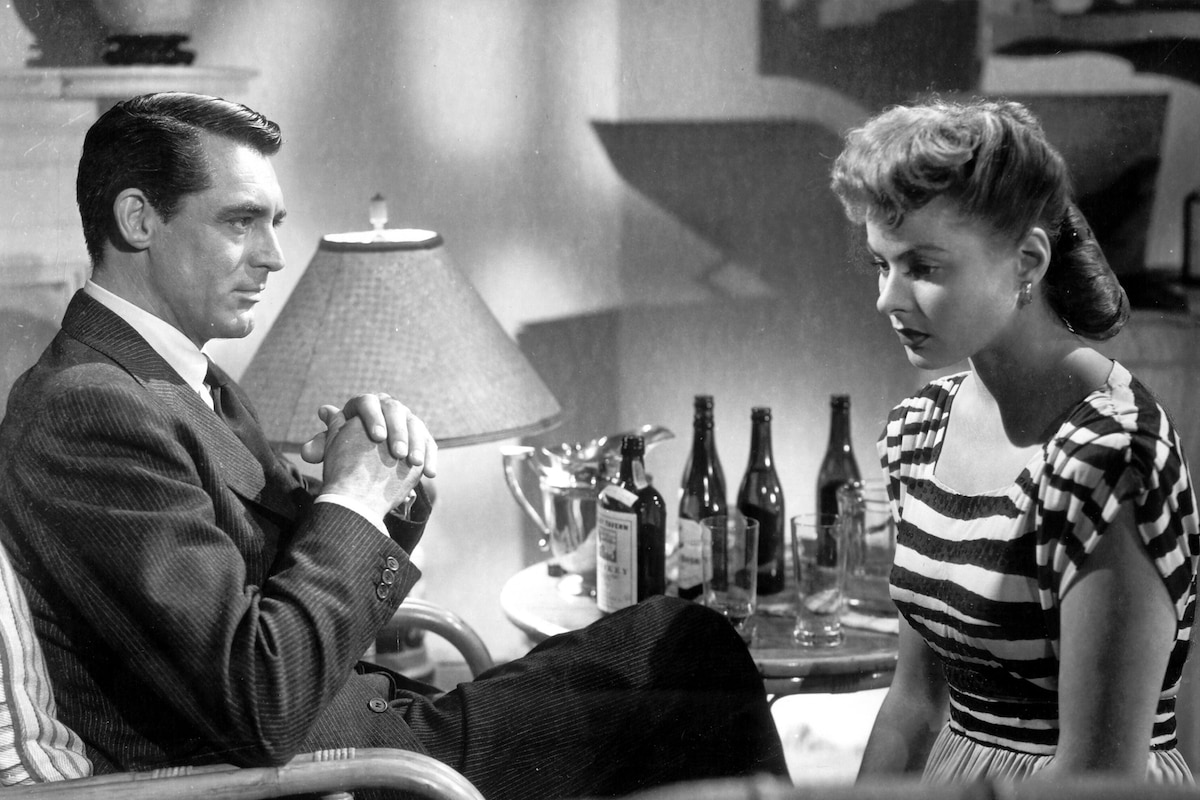
Bergman was Hitchcock's choice from the beginning. The two had worked well together on Spellbound (1945), and Hitchcock, who had something of a crush on his star, was eager to work with her again.
Hitchcock had also worked previously with Cary Grant on Suspicion (1941). When the Notorious package was sold to RKO, Grant and Bergman were already locked in as part of the deal.
Hitchcock wanted Clifton Webb for the role of Alex Sebastian, the German who Bergman marries to gain access to the Nazi plot, but Dozier prevailed in his choice of Claude Rains.
When Ethel Barrymore rejected the role of Sebastian's domineering mother, RKO suggested Mildred Natwick. But the director felt the role required a stronger presence. The part finally went to legendary German actress Leopoldine Konstantin (credited as "Madame Konstantin"), one of several German refugees cast as the escaped Nazis in the film. Konstantin had acted for three decades with Max Reinhardt's famous theater troupe and made several pictures in Europe. But she was so unknown here she received a mere pittance for her work, even though she was fifth billed. Notorious was her only American film and her last screen appearance.
by Rob Nixon
The Big Idea - Notorious
by Rob Nixon | April 30, 2009
SIGN UP FOR OUR NEWSLETTERS

CONNECT WITH TCM