Novelist MacKinlay Kantor modeled Boone City, the setting for The
Best Years of Our Lives on Cincinnati.
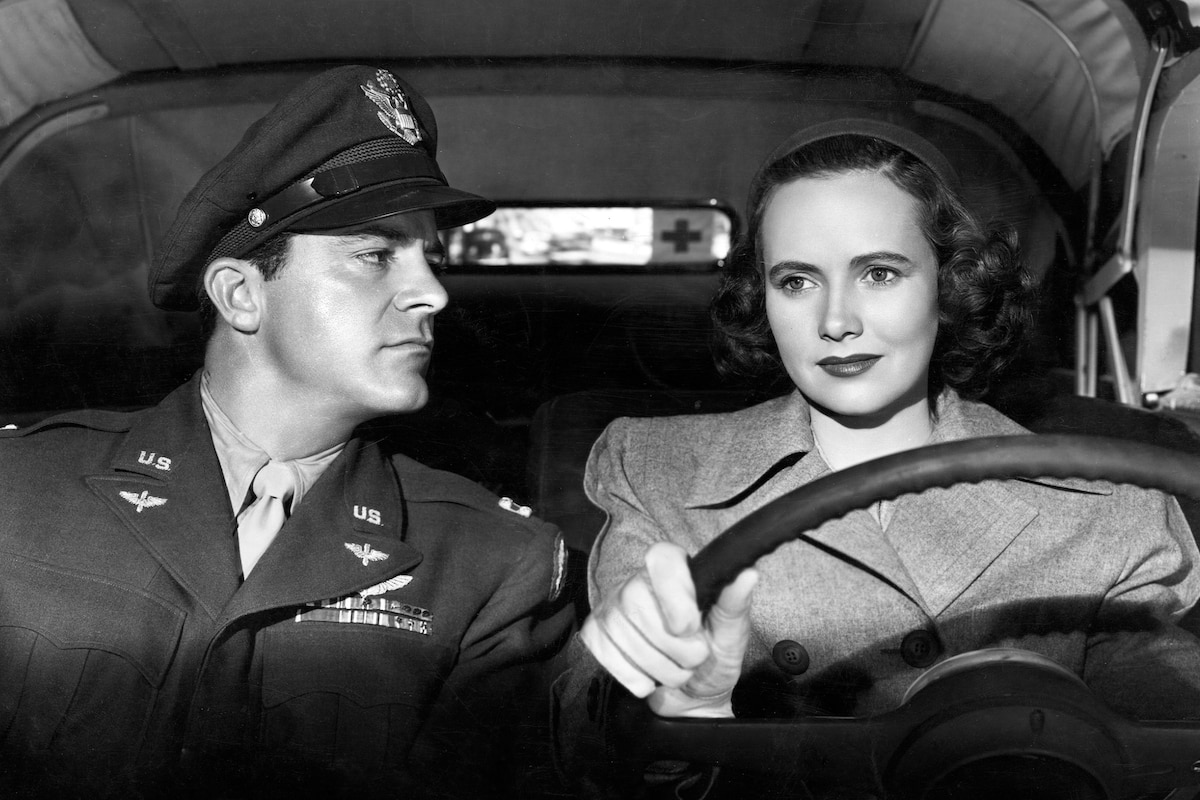
Although they were cast as mother and daughter, Myrna Loy was only 12
years older than Teresa Wright.
While rehearsing the hangover scene, actor Fredric March mixed a bromo
with two glasses, then accidentally lifted the empty glass to his lips. He
stopped the scene to get it right, but Loy suggested that they leave the
mistake in because it seemed "real", so they did.
Future director Blake Edwards had an unbilled bit as a
corporal.
Wyler's daughters, seven-year-old Cathy and four-year-old Judy, made
their screen debuts in a scene with Dana Andrews in the drug
store.
Because of Wyler's use of deep focus photography, The Best
Years of Our Lives contains less than 200 separate shots. The average
Hollywood film of the period had 300 to 400 shots -- per hour.
Goldwyn was so impressed with the picture that when he saw fellow
independent producer David O. Selznick leaving the preview, he asked him,
"How much did you love my picture?"
Sam Goldwyn was famous for his mangling of the English language, though
his PR department probably wrote some of his most famous gaffes on purpose.
In talking to the press about the importance of making significant films
like The Best Years of Our Lives, he said "I don't care if it
doesn't make a nickel as long as every man, woman and child in America sees
it."
To publicize the picture, Goldwyn arranged to appear on Bob Hope's
radio show, then asked one of his contract writers for a snappy way to
pitch the film. Since Hope had just made a Goldwyn film of his own, The
Princess and the Pirate (1944), the writer suggested a simple exchange. Hope
would ask, "Well, Mr. Goldwyn, how have things been going since I left your
studio?" And Goldwyn would reply, "I'll tell you, Bob -- since you left,
we've had the Best Years of Our Lives." Goldwyn liked the exchange and sent
it to Hope's writers, who inserted it in the script. When they reached
that point in the show, Hope said, "Well, Mr. Goldwyn, how have things been
going since I left the studio?" Without looking at his script, Goldwyn
replied, "I'll tell you, Bob, since you left, things are better than
ever."
President and Mrs. Truman attended the film's Washington, D.C.,
premiere on March 11, 1947. Also in attendance was Wyler's wartime
commander, Major General Carl Spaatz.
When the film was released, cinematographer Gregg Toland took it upon
himself to check 41 of the prints distributed. He also visited theatres in
Los Angeles to make sure they had the best possible projection equipment.
At some of these he ordered new lenses for the projectors and reduced the
size of the screens to guarantee the film would be seen under optimal
conditions.
Following his performance in The Best Years of Our Lives, Harold
Russell returned to college, then headed up AMVETS, a support group for
U.S. veterans. In 1992, he made headlines when he defied the Motion
Picture Academy® by selling his Best Supporting Actor Oscar® to a
private buyer for $60,500 to help pay for an operation his wife
needed.
When William Wyler won the Lifetime Achievement Award from the American
Film Institute, Myrna Loy was one of the featured speakers. After hearing
other actors kid Wyler about his penchant for numerous re-takes, she spoke
in his defense, saying that he only did the re-takes because "he suspects
some wonderful new thing is going to happen -- and it usually does." The
next morning, Wyler called to thank her.
FAMOUS QUOTES FROM THE BEST YEARS OF OUR LIVES (1946)
"I look terrible...It isn't fair of you to bust in on us like this." -
Myrna Loy as Milly Stephenson.
"What do you think of the children?"
"Children? I don't recognize 'em. They've grown so old."
"I tried to stop them, to keep them just as they were when you left, but
they got away from me." - Myrna Loy, as Milly Stephenson, and Fredric
March, as Al Stephenson, catching up.
"Give 'em time, kid. They'll catch on. You know, your folks will get used
to you, and you'll get used to them. Then everything will settle down
nicely, unless we have another war. Then none of us have to worry because
we'll all be blown to bits the first day. So cheer up, huh?" - Hoagy
Carmichael as Butch.
"Last year, it was Kill Japs. This year, it's Make Money." - Fredric March
as Al Stephenson.
"When we were married, Babe, the Justice of the Peace said something about
'for richer, for poorer, for better, for worse.' Remember? Well, this is
the worse." - Dana Andrews as Fred Derry.
"I'm sure you'll all agree with me if I said that now is the time for all
of us to stop all this nonsense, face facts, get down to brass tacks,
forget about the war and go fishing. But I'm not gonna say it. I'm just
going to sum the whole thing up in one word. (Milly coughs loudly to
caution him -- worrying that he will tell off the boss.) My wife
doesn't think I'd better sum it up in that one word. I want to tell you all
that the reason for my success as a Sergeant is due primarily to my
previous training in the Cornbelt Loan and Trust Company. The knowledge I
acquired in the good ol' bank I applied to my problems in the infantry. For
instance, one day in Okinawa, a Major comes up to me and he says,
'Stephenson, you see that hill?' 'Yes sir, I see it.' 'All right,' he said.
'You and your platoon will attack said hill and take it.' So I said to the
Major, 'But that operation involves considerable risk. We haven't
sufficient collateral.' 'I'm aware of that,' said the Major, 'but the fact
remains that there's the hill, and you are the guys that are going to take
it.' So I said to him, 'I'm sorry Major, no collateral, no hill.' So we
didn't take the hill, and we lost the war.' I think that little story has
considerable significance, but I've forgotten what it is. And now in
conclusion, I'd like to tell you a humorous anecdote. I know several
humorous anecdotes, but I can't think of any way to clean them up, so I'll
only say this much. I love the Cornbelt Loan and Trust Company. There are
some who say that the old bank is suffering from hardening of the arteries
and of the heart. I refuse to listen to such radical talk. I say that our
bank is alive, it's generous, it's human, and we're going to have such a
line of customers seeking and getting small loans that people will think
we're gambling with the depositors' money. And we will be. We will be
gambling on the future of this country. I thank you." - Fredric March as Al
Stephenson
"I've made up my mind...I'm going to break that marriage up." - Teresa
Wright as Peggy Stephenson.
"How many times have I told you I hated you and believed it in my heart?
How many times have you said you were sick and tired of me and that we were
all washed up? How many times have we had to fall in love all over again?"
- Myrna Loy as Milly Stephenson.
"I don't like the idea of you sneaking around corners to see Peggy, taking
her love on a bootleg basis. I give you fair warning, I'm going to do
everything I can to keep her away from you, to help her forget about you
and get married to some decent guy who can make her happy." - Fredric March
as Al Stephenson.
"I've given you every chance to make something of yourself. I gave up my
own job when you asked me. I gave up the best years of my life, and what
have you done? You flopped! Couldn't even hold that job at the drugstore.
So I'm going back to work for myself and that means I'm gonna live for
myself, too. And in case you don't understand English, I'm gonna get a
divorce. What have you got to say to that?" - Virginia Mayo as Marie
Derry.
"Headquarters, Eighth Air Force. Award of the Distinguished Flying
Cross...Despite intense pain, shock, and loss of blood, with complete
disregard of his personal safety, Captain Derry crawled back to his
bombsight, guided his formation on a perfect run over the objective and
released his bombs with great accuracy. The heroism, devotion to duty,
professional skill and coolness under fire displayed by Captain Derry under
the most difficult conditions reflect highest credit upon himself and the
Armed Forces of the United States of America. By command of Lieutenant
General Doolittle." - Roman Bohnen as Pat Derry, reading his son's
distinguished service citation.
"This is when I know I'm helpless. My hands are down there on the bed. I
can't put them on again without calling to somebody for help. Can't smoke
a cigarette or read a book. If that door should blow shut, I can't open it
to get out of this room. I'm as dependent as a baby that doesn't know how
to get anything except to cry for it." - Harold Russell as Homer
Parrish.
by Frank Miller
Trivia - The Best Years of Our Lives - Trivia: THE BEST YEARS OF OUR LIVES
by Frank Miller | July 28, 2003
SIGN UP FOR OUR NEWSLETTERS

CONNECT WITH TCM