While the script was still being worked on, Hitchcock went to the Forest Hills tennis club in New York to film the Davis Cup matches between Australia and the U.S. for long shots of Guy competing.
Location scenes were shot in October 1950 at Penn Station in New York, a railroad stop in Danbury, Conn. (standing in for the town of Metcalf), and at various places around the nation's capital.
An amusement park was created according to Hitchcock's exact specifications at the ranch of director Rowland V. Lee in the Los Angeles suburb of Chatsworth. However, the tunnel-of-love scenes were shot at a fairground in Canoga Park.
Farley Granger said that Hitchcock, who worked all his shots out in great detail on paper before shooting, often looked unhappy on the set. When the actor asked him if something was wrong, Hitchcock complained, "Oh, I'm so bored!"
Hitchcock supervised the minutest detail of the filming. He personally selected an orange peel, a chewing gum wrapper, wet leaves, and a bit of crumpled paper that were used as debris in the sewer where Bruno strains to recover Guy's dropped cigarette lighter.
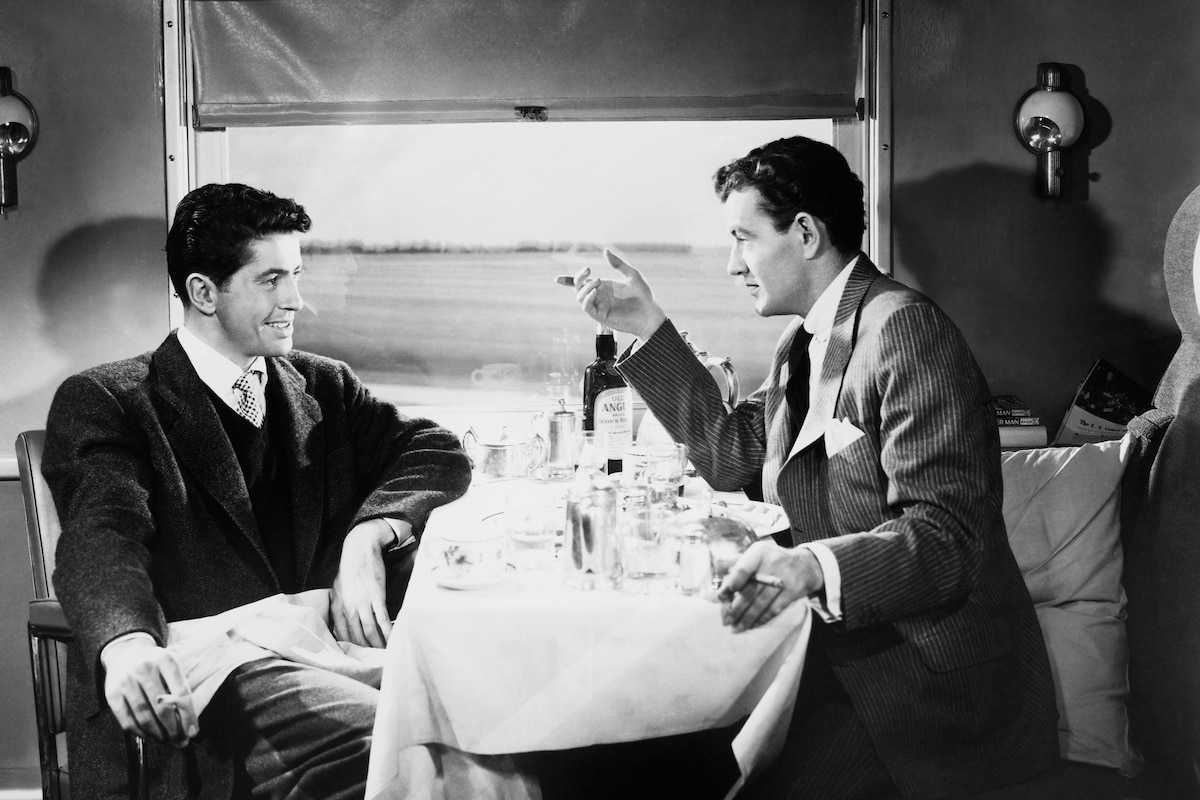
Hitchcock personally designed Bruno's necktie with its threatening lobster claw image.
Cinematographer Robert Burks began an association with Hitchcock on this picture that would last another 13 years and a dozen films. "You never have any trouble with him as long as you know your job and do it," Burks said. "Hitchcock insists on perfection. He has no patience with mediocrity on the set or at a dinner table. There can be no compromise in his work, his food, or his wines."
Tennis pro Jack Cunningham coached Farley Granger for the scenes that depicted Guy Haines engaged in a tennis match. Cunningham also played his opponent in those scenes.
Hitchcock and Robert Walker worked out an elaborate series of gestures and physical appearance to suggest the homosexuality and seductiveness of Bruno's character while bypassing censor objections.
Granger said Hitchcock, who did not like Ruth Roman in the role, treated her very harshly and criticized her often in front of everyone. "He had to have one person in each film he could harass," Granger noted.
Hitchcock refused to treat his daughter preferentially, which won them both the respect of the other players. "We never discuss Strangers on a Train at home," she told an interviewer at the time. "On the set, he gives me direction as well as criticism. I might as well be Jane Jones instead of Patricia Hitchcock."
Hitchcock's treatment of his daughter went beyond professional in one instance. Pat had begged for a ride on the Ferris wheel constructed on the fairgrounds set. When she reached the top, Hitchcock ordered the ride stopped and all lights turned out. Leaving the area in total darkness, he took cast and crew to another location in the far corner of the park to direct a different scene. His daughter remained in terror at the top of the Ferris wheel for an hour before he sent someone back to lower it and let her out.
The scene of the climactic fight on the carousel and the ride's subsequent explosion was very complicated to shoot with a combination of live action and rear screen projection. It usually took about a half day to set up each shot so the actors and the projected image matched.
The carousel explosion was filmed in miniature then enlarged on a huge rear-projection screen behind the live performers.
The shot of the carousel operator crawling under the ride to shut it off when it spins out of control did not employ special effects other than speeding up the film slightly. The man actually crawled under the spinning carousel. Hitchcock swore he would never do anything like that again.
To achieve the shot of Bruno murdering Miriam reflected in her glasses, an enormous distorting lens was constructed. The two actors were then reflected in it at a 90-degree angle.
On Strangers on a Train, as was his usual practice, Hitchcock shot each scene so that there was only one way to edit it which always conformed to his initial visual concept and pre-production storyboards.
Strangers on a Train was completed just before Christmas 1950.
by Rob Nixon
Behind the Camera - Strangers on a Train
by Rob Nixon | March 11, 2010
SIGN UP FOR OUR NEWSLETTERS

CONNECT WITH TCM