When Alfred Hitchcock read Patricia Highsmith's thriller Strangers on a Train, he immediately decided to buy the film rights. He found he shared with Highsmith an interest in the duality of the human psyche and each person's capacity for evil. He decided to create from the novel a suspense story centering around two men who would represent both sides of the same personality.
Hitchcock instructed his agents to negotiate the purchase of Highsmith's book without mentioning his name for fear of jacking up the price. He ended up getting it for only $7500,
which seriously irritated its author.
Hitchcock contracted Whitfield Cook, who worked with him on the screenplay for Stage Fright (1950), to help him hammer out a 65-page treatment of the novel. Their treatment tightened the story, limited the location, and delineated a series of shots that would set up the structure and visual motif of doubles and morally opposing forces.
Hitchcock had a hard time finding a first-rate writer willing to take on the script assignment. "They all felt my first draft was so flat and factual that they couldn't see one iota of quality in it," he later said. "Yet the whole film was there visually."
Hitchcock wanted a mystery writer to handle the script. It was first submitted to Dashiell Hammett, whose novels The Maltese Falcon, The Glass Key, and The Thin Man had been adapted for the screen. But that collaboration never materialized.
Finally Raymond Chandler was hired at $2,500. Chandler had a great track record, both as a screenwriter himself and as an author whose novels were successfully adapted to screen. He and Hitchcock met only once, briefly, before Chandler took the treatment, Highsmith's novel, and a secretary to his La Jolla home to work.
The working relationship between Hitchcock and Chandler was not a happy one. Chandler was a hard drinker and a difficult person to get along with under the best of circumstances. He had very little respect for Hitchcock. One day when the director was getting out of his car at Chandler's home, the writer turned to his secretary and said, "Look at that fat bastard trying to get out of his car." When the secretary warned that Hitchcock might be able to hear him, Chandler said he didn't care.
The main bone of contention between the two men was that Chandler's writing paid more attention to character motivation while Hitchcock was more interested in the visual development and formal structure of the movie laid out in the treatment. In a letter to a studio executive, Chandler said he preferred to work with a director "who realizes that what is said and how it is said is more important than shooting it upside down through a glass of champagne."
"The thing that amuses me about Hitchcock is the way he directs the film in his head before he knows what the story is," Chandler wrote to his British editor. "He has a strong feeling for stage business and mood and background, not so much for the guts of the business. But he is as nice as can be to argue with."
Chandler and Hitchcock were also at an impasse over the notion of suspense. "Suspense as an absolute quality has never seemed to me very important," Chandler wrote a friend in September 1950. "At best it is a secondary growth, and at worst an attempt to make something out of nothing."
"After a while, I had to give up working with him," Hitchcock recalled later. "I would offer him a suggestion. Instead of giving it some thought, he would remark to me, 'If you can go it alone, why the hell do you need me?' He refused to work with me as director."
Chandler finished a draft of the script that ended with the murderer apprehended and sent to an insane asylum, writhing in a strait jacket in the final shot. Hitchcock noted revisions he wanted made. Although Chandler carped furiously to his agent, he went forward with a second draft. Upon reading the revised version, Hitchcock immediately decided he needed another writer.
Although Chandler had been complaining all along that the reason his work wasn't up to snuff was because Hitchcock interfered too much, after the second draft he began grousing that the director had ignored him and left him to work on his own too much to produce a satisfactory script.
Hitchcock next assigned the script to Czenzi Ormonde, assistant to Ben Hecht, the noted screenwriter with whom the director often worked. With help from Hecht, production associate Barbara Keon, and Hitchcock's wife, Alma, Ormonde completed a script that Chandler said removed "almost every trace of my writing." A comparison of the two scripts bear out Chandler¿ assertion.
Chandler threatened to have his name removed from the credits. "It is obvious to me now, and must have been obvious to many people long since, that a Hitchcock picture has to be all Hitchcock," he wrote in a December 1950 letter. His name, however, was kept on the credits.
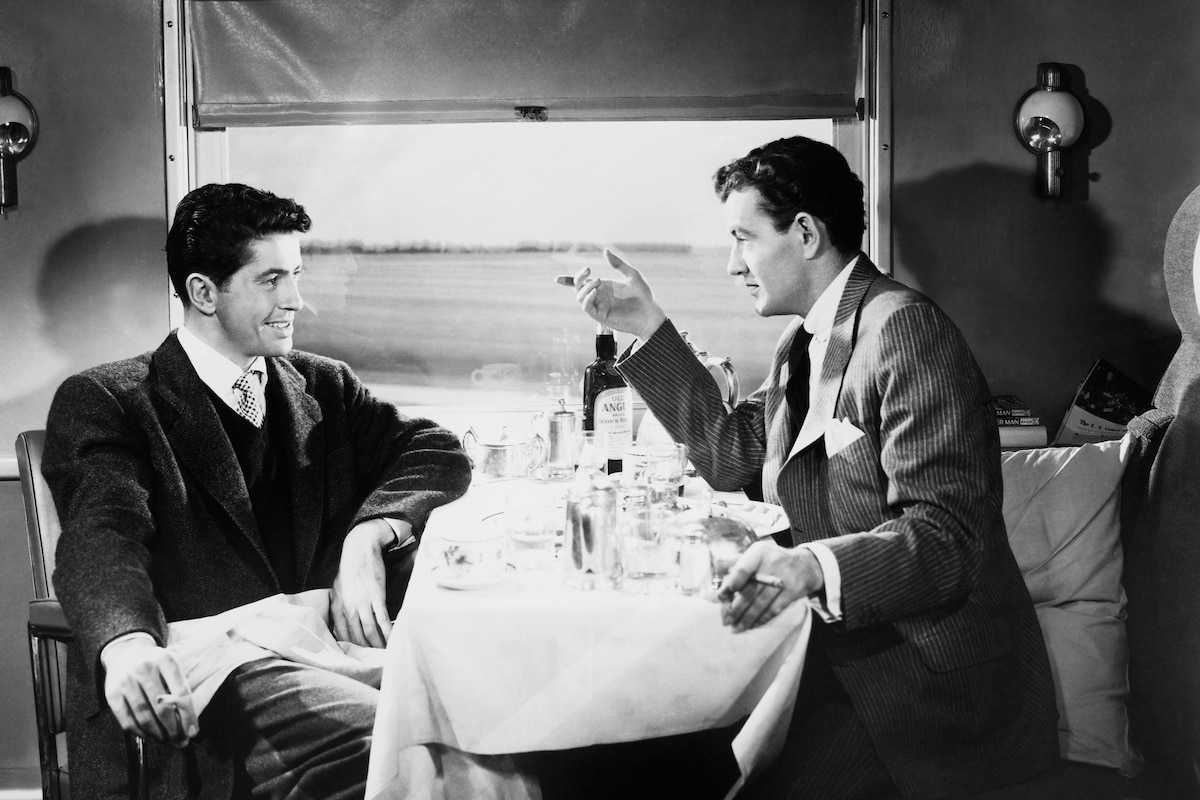
With the script complete, casting was begun. Hitchcock wanted - and got - Robert Walker for the role of the psychopathic Bruno. Because Walker was best known as the All-American boy next door in such films as Since You Went Away (1944), The Clock (1945), and One Touch of Venus (1948), Hitchcock liked the idea of casting him totally against type.
Hitchcock wanted William Holden for the role of tennis pro Guy Haines. When he couldn't get Holden, he signed Farley Granger, who played one of the troubled young killers in Rope (1948).
Against Hitchcock's wishes, Warner Brothers cast one of their contract players, Ruth Roman, as Guy¿ love interest.
Hitchcock's daughter Patricia was informed by her agent there might be a part for her in the film. The director handled his daughter as he would any other actor, formally interviewing her, doing a screen test, and discussing her rightness for the role.
by Rob Nixon
The Big Idea - Strangers on a Train
by Rob Nixon | March 11, 2010
SIGN UP FOR OUR NEWSLETTERS

CONNECT WITH TCM