SYNOPSIS
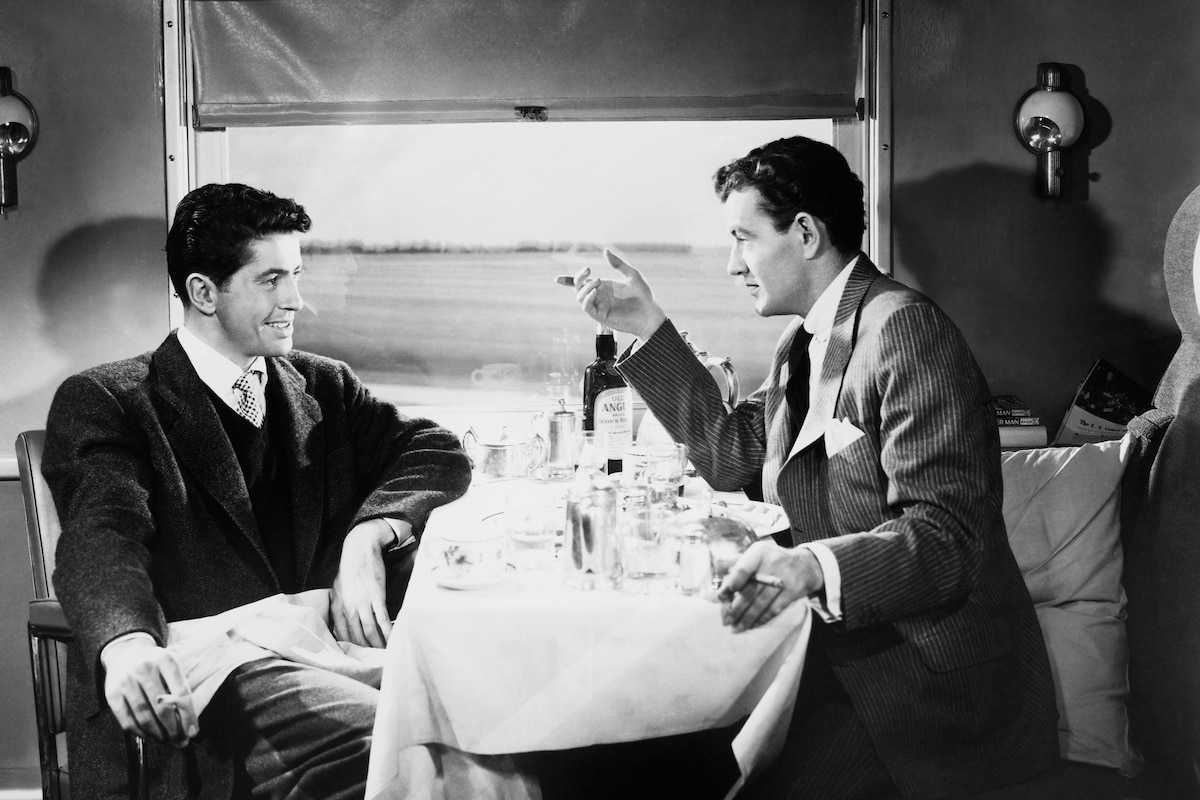
Two strangers meet by chance on a train from Washington, D.C., to New York - Guy Haines, a married professional tennis player in love with the daughter of a U.S. Senator, and Bruno Antony, a cynical mama's boy who hates his wealthy father. Bruno poses the wild idea of each committing the other's perfect murder; Guy would kill Bruno's father and Bruno would do away with Guy's promiscuous, blackmailing wife. Guy thinks it's all a joke and laughingly agrees, but when Bruno murders Guy's wife in a small-town amusement park, the joke turns deadly.
Director/Producer: Alfred Hitchcock
Screenplay: Raymond Chandler, Czenzi Ormonde, Whitfield Cook, based on the novel by Patricia Highsmith
Cinematography: Robert Burks
Editing: William H. Ziegler
Art Direction: Ted Haworth
Original Music: Dimitri Tiomkin
Cast: Robert Walker (Bruno Antony), Farley Granger (Guy Haines), Ruth Roman (Anne Morton), Patricia Hitchcock (Barbara Morton), Leo G. Carroll (Senator Morton), Laura Elliott (Miriam Haines).
BW-101m.
Why STRANGERS ON A TRAIN is Essential
After riding high for several years as one of the most popular directors in film, Alfred Hitchcock produced a string of critical and commercial failures in the late 1940s. Following the great success of Notorious (1946), his next four pictures - The Paradine Case (1947), Rope (1948), Under Capricorn (1949), and Stage Fright (1950) - turned out to be major disappointments. He needed a first-rate thriller that could put him back on top, and he found it in Patricia Highsmith's novel, Strangers on a Train.
In the story, Hitchcock found more than just opportunities for a wild suspenseful ride with a climactic amusement park disaster. He was able to work out in the script and in the film's structure and visual design, the motif of doubling, of opposing forces of dark and light, good and evil, innocence and guilt coming together. Through crosscutting and visual cues that echo each other from one scene to the next, Hitchcock shows how the psychopathic murderer is the shadow of the "innocent" tennis pro, putting into action what the athlete really wants, bringing out the dark underside of potentially murderous desires.
Strangers on a Train isn't usually considered Hitchcock's best work, and in film history, it is generally overshadowed by Notorious (1946), Rear Window (1954), Vertigo (1958), and Psycho (1960). (It didn't even make the list of Hitchcock's top ten films compiled by a panel of noted directors at the behest of the British Film Institute in 1999.) But film critics, students and fans love to pick it apart, discuss it, argue over it. Even Hitchcock himself confessed to be enthralled by its elaborate, tightly worked-out design. And even today, such set pieces as the stalking and murder of the young wife, the near-strangulation at the cocktail party, and the climactic carousel scene can still make audiences gasp in unison.
by Rob Nixon
The Essentials - Strangers on a Train
by Rob Nixon | March 11, 2010
SIGN UP FOR OUR NEWSLETTERS

CONNECT WITH TCM