Director George Cukor had crossed paths professionally with Judy
Garland twice before. After he was fired from Gone With the Wind,
and he spent a week directing tests for The Wizard of Oz. His main
contribution to that film was changing Garland's look as Dorothy by
discarding her blonde wig and getting the makeup
department to give her a more natural look. That experience inspired the
scene in which studio makeup artists completely change Esther's appearance for her
screen test. Cukor was also considered as the director for Meet Me in St.
Louis (1944) and even spent a few months working with the screenwriters before
the film was assigned to Vincente Minnelli, who would become Garland's
second husband.
The crowd shots of the Motion Picture Relief Fund benefit at the film's
opening combined footage shot for the film with newsreels from the world
premiere of The Robe, the picture that had prevented Richard Burton from
playing Norman Maine.
The shots of dancers backstage at the Shrine Auditorium were modeled on
the Degas' painting Dancers Adjusting Their Slippers.
The beach house scenes were actually shot on the studio sound stage.
Cukor created the illusion that the ocean was right outside by asking the
special effects department to superimpose the reflection of the ocean on
the glass doors. They also created a light breeze to move Garland's scarf.
Since a regular fan would have been too noisy and required post-dubbing,
the crew built a wind tunnel to pump in air from outside while also
muffling the sound of the fans.
One day when Garland refused to leave her dressing room, Cukor, who
hated summoning actors, decided to see what he could do to get her on the
set. When he walked into the room, she was the picture of dejection. "Is
anything wrong?" he asked. Then he realized how absurd the question was
and started laughing. Garland laughed too and said, "This is the story of
my life. I'm about to shoot myself, and I'm asked if there's anything
wrong." Then she came out to film the scene.
When Cukor complimented Garland on the intensity of her performance in
two takes of her temperamental scene after Norman's suicide, she quipped,
"Oh, that's nothing. Come over to my house any afternoon. I do it every
afternoon. But I only do it once at home."
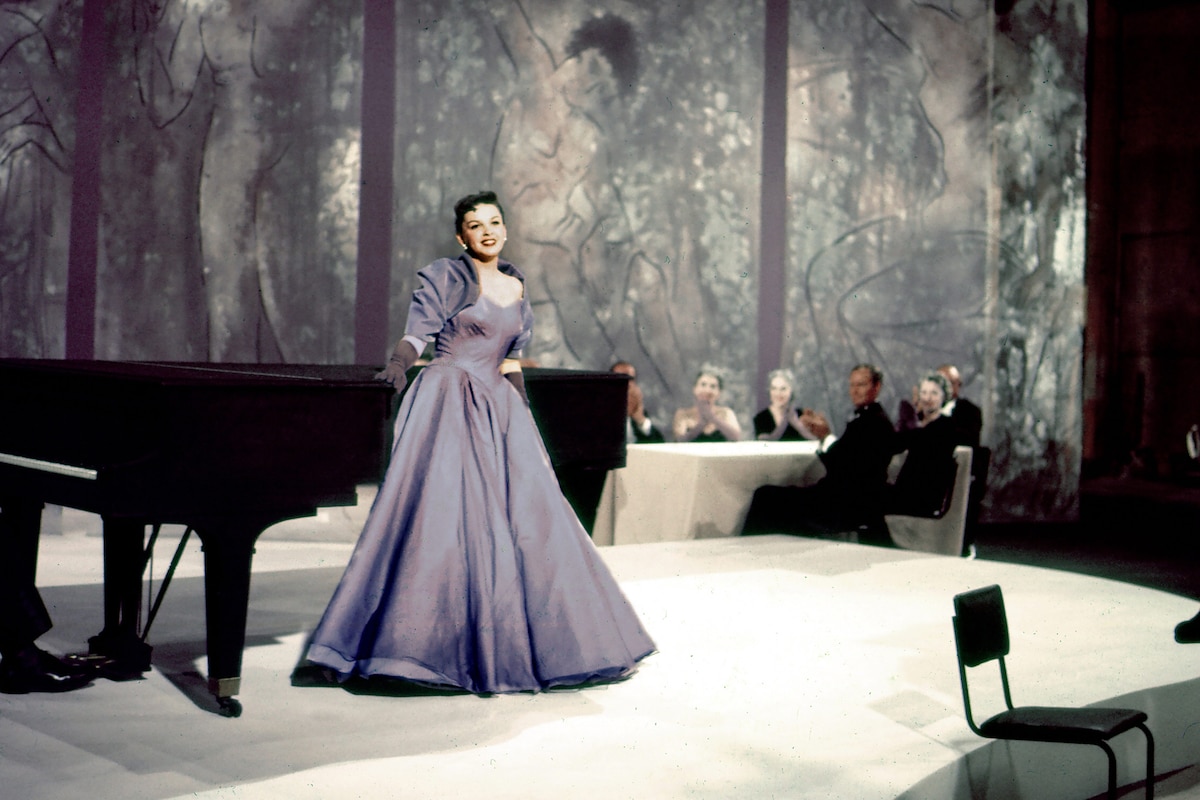
A Star Is Born was the only Judy Garland film to be released in
stereo.
A Star Is Born was the first film to have its premiere telecast
nationally. The live telecast was so well received that it was repeated the
following evening. This program is now available on the most recent VHS
and DVD releases of the film.
Film projects offered to Garland as a result of her performance in A
Star Is Born included Carousel, South Pacific, The
Three Faces of Eve and musical versions of Alice Adams,
Saratoga Trunk and All About Eve. She also was mentioned for
film biographies of Helen Morgan, Sophie Tucker, Laurette Taylor, Gertrude
Lawrence and Fannie Brice. She never appeared in any of these. In fact,
she would not make another film for seven years, when she won an Oscar®
nomination for Best Supporting Actress for Judgment at
Nuremberg (1961).
FAMOUS QUOTES FROM A STAR IS BORN (1954)
" There are certain pleasures you get - little jabs of pleasure. When a swordfish takes the hook, or when you watch a great fighter getting ready for the kill, see?...If you had ever
seen a bullfight in your life, you'd know a great bullfighter the moment he
set foot to the ring -- from the way he stood, from the way he moved -- or,
or a dancer. You don't happen to know about ballet? That little bell rings
inside your head, that little jab of pleasure. And that's what happened to
me just now. You're a great singer!" - James Mason as Norman Maine.
"You've got that little something extra that Ellen Terry talked about.
Ellen Terry, a great actress long before you were born. She said that that
was what star quality was -- that little something extra. Well, you've got
it." - James Mason as Norman Maine.
"Do you know the only thing I can think of right now? The only thought that
comes into my mind is the way I wash my hair. You see, when anything
happens to me, good or bad, I make straight for the shampoo bottle." - Judy
Garland as Esther Blodgett.
"I can remember my first job singing with the band. And then one-night
stands clear across country by bus. Putting on nail polish in the ladies
rooms of gas stations. Waiting on tables. Wow! That was a low point. I'll
never forget it. And I'll never never do that again, no matter what. But I
had to sing. I somehow feel most alive when I'm singing." - Judy Garland as
Esther Blodgett.
"Listen, Esther, a career is a curious thing. Talent isn't always enough.
You need a sense of timing -- an eye for seeing the turning point -- or
recognizing the big chance when it comes and grabbing it. A career can rest
on a trifle. Like -- like us sitting here tonight. Or it can turn on
somebody saying to you, 'You're better than that. You're better than you
know.' Don't settle for the little dream. Go on to the big one...Scared?
Scared to take the plunge?" - James Mason as Norman Maine.
"He gave me a look at myself I've never had before. He saw something in me
nobody else ever did. He made me see it too. He made me believe it." - Judy
Garland as Esther Blodgett.
"If you'll be kind enough to glance between my shoulder blades, Mr. and
Mrs. Gubbins, you'll find there a knife buried to the hilt. On its handle
are your initials." - Jack Carson as Matt Libby.
"You know, Oliver, I sometimes think I was born with a genius -- an
absolute genius -- for doing the wrong thing." - James Mason as Norman
Maine.
" I know most of you sitting out there by your first names, don't I? I made a lot o' money for you gentlemen in my time through the years, didn't I? Well, I need a job now. Yeah, that's it...that's the speech. That's the -- I need a job. That's what I
wanted to say. I -- I need a job. It's as simple as that. I -- I need a
job, that's all. My talents, I may say, are not confined to dramatic parts.
I can play comedy, too." - James Mason, as Norman Maine, interrupting his
wife's acceptance speech at the Oscars®.
"...sometimes, I hate him. I hate his promises to stop, and then the
watching and waiting to see it begin again. I hate to go home to him at
nights and listen to his lies...I hate me cause I've failed too." - Judy
Garland as Esther Blodgett.
"I shall have to introduce myself all over again to a lot of people. They
won't know me when I'm not drinking." - James Mason as Norman
Maine.
"Friends, my eye! Listen. I got you out of your jams because it was my job,
not because I was your friend. I don't like you. I never did like you. And
nothing made me happier than to see all those cute little pranks of yours
catch up with you and land you on your celebrated face." - Jack Carson as
Matt Libby.
"Sympathy? That's not what you're getting from me, baby. You don't deserve
it! You know what a great monument to Norman Maine you are? He was a drunk,
and he wasted his life, but he loved you. And he took enormous pride in the
one thing in his life that wasn't a waste -- you. His love for you and your
success, that was the one thing in his life that wasn't a waste, and he
knew it. Maybe it was wrong to do what he did, but he didn't want to
destroy that -- destroy the only thing he took pride in. And now you are
doing the one thing he was terrified of. You're wiping it out! You're
tossing aside the one thing he had left. You're tossing it right back into
the ocean after him....You're the only thing that remains of him now, and
if you just kick it away, it's like he never existed. Like there never was
a Norman Maine at all." - Tommy Noonan as Danny McGuire.
"Hello everybody -- this is -- Mrs. Norman Maine." - Judy Garland as
Mrs. Norman Maine.
Compiled by Frank Miller
Trivia - A Star is Born ('54) - Trivia & Fun Facts About A STAR IS BORN
by Frank Miller | June 03, 2003
SIGN UP FOR OUR NEWSLETTERS

CONNECT WITH TCM