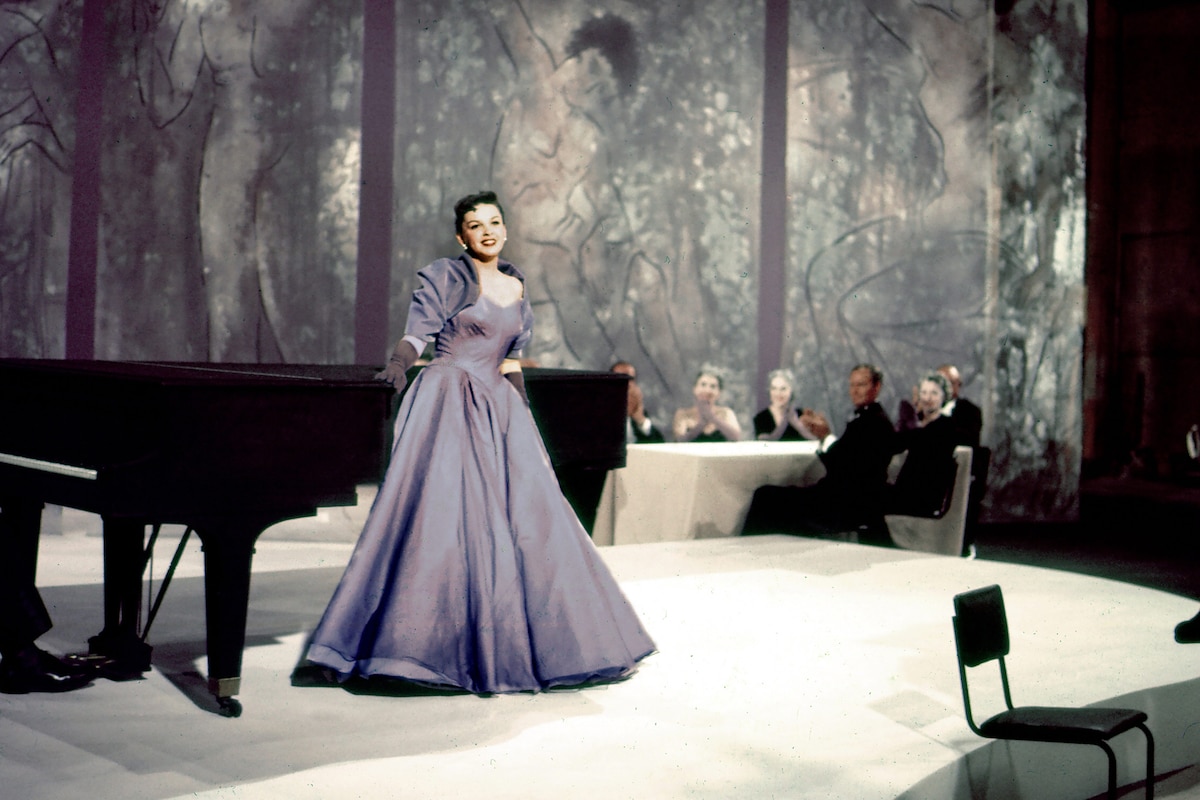
Filming started on October 12, 1953, with the train station sequence,
in which the newly signed Esther doubles for a star by waving a
handkerchief out a train window.
The first major delays were technical. Cukor had started making the
film in WarnerScope, a wide-screen process Warner Bros. had designed to
compete with CinemaScope. But even studio management knew the process
wasn't perfected. Albert Warner, who supervised the studio's technical
side, was negotiating for the use of CinemaScope as the film started
shooting. After two weeks of filming, he asked that they test the process,
so "The Man That Got Away" number was shot in two versions, one in
WarnerScope and one in CinemaScope. It was obvious the latter version was
superior, so they had to start the film over, at a cost of $300,000. They
also had to redo the number to make better use of the new screen size. As
a result, the film fell behind schedule a total of 18 days.
At first the limitations of working in CinemaScope presented an obstacle to Cukor.
There was a whole set of rules about what would and would not work in the
new system. The so-called experts advised against certain camera moves,
certain colors, tight close-ups and too much quick cutting. Finally he and
his two consultants on the film, production designer Gene Allen and color
consultant George Hoyningen-Huene, decided to ignore the rules and make up
new ones as they went along. As a result, A Star Is Born was one of
the first films to make truly creative use of the CinemaScope
process.
Garland's musical mentor, Roger Edens, came over from MGM to supervise
the arrangements of her numbers.
Garland was on her best behavior during the early days of shooting, but
she slowly lost control. She first called in sick on November 9, which
kept her off the film for four days. She got sick again shooting outdoor
locations and missed three more days. She was sick again for two days in
December. Then they had to postpone a scene because she didn't like her
costume. Other days, she had to leave early because she was too tired or
sick to go on. By February, they were 41 days behind schedule. In late
March, she took two weeks off to get herself off all prescription
medications. Ultimately, the production would drag on for nine
months.
Making matters worse was the fact that Garland wasn't always home
resting when she was sick. She'd take a day off, then Cukor would read in
Louella Parsons' column that she had spent the night singing at a
nightclub. She'd leave early and go to the races. None of this was
released to the press. Instead, the Warners PR department attributed the
delays to Garland's relentless perfectionism.
Cukor was an expert on pushing actresses to an emotional brink and then
capturing it on film. For Garland's breakdown scene in Esther's dressing
room, he drove her so hard that she threw up before the first take. Then
he made her do the scene over and over until he had it just right. But he
was also an expert in easing tension on the set through humor. After the final take,
Garland was sobbing uncontrollably. He came up to her quietly, put his
hand on her shoulder and said, "Judy, Marjorie Main couldn't have done that
any better!"
In March, studio executives viewed a rough-cut of everything that had
been completed up to that point. Cukor wasn't happy with the footage, but
everyone else was delighted.
One addition Luft and Warners felt necessary was a number to
demonstrate Esther's triumph in her first big film. Rather than take a
chance on a new number that might not go over, Luft convinced Warner to
authorize a medley of standards. The sequence would become the "Born in
the Trunk" number, including performances of "I'll Get By," "You Took
Advantage of Me," "Black Bottom," "The Peanut Vendor Song," "Melancholy
Baby" and "Swanee." The number would add 18 minutes to the already long
film and cost an additional $250,000. Cukor, who objected to the sequence,
had already planned his annual vacation to Europe, so Warners took him off
salary and the film's choreographer, Richard Barstow, directed it instead.
Allen and Huene personally oversaw the shoot in order to protect Cukor's vision.
For the last two weeks of production, during which the "Born in a
Trunk" number was completed, Jack Warner approved a night-time shooting
schedule to better accommodate Garland's "body clock." This added still
more to the budget, as the unions required extra payments for evening
work.
Shooting finally ended on July 28, 1954, with retakes of the "Peanut
Vendor" song from the "Born in a Trunk" sequence. The first preview was
only five days away. The film's final budget was $5,019,770, making it
Warner Bros.' most expensive film and the second costliest in Hollywood
history, just behind David O. Selznick's Duel in the Sun (1946), which
had cost just $205,000 more.
The film's completion was particularly joyous for Garland and Luft, who
had just learned that she was pregnant for the third time.
Shortly before the premiere, Cukor cut the film down to 181 minutes. Among the footage removed was a segment from the "Born in the Trunk" number (Garland's duet with her father to "When My Sugar Walks Down the Street" - a number she had performed at the start of her career with the Gumm Sisters); Norman's return to the Shrine Auditorium to try to learn Esther's name; Norman and Esther planning the beach house; and a montage of scenes from Norman Maine's leading roles. The musical number is included in the most recent DVDs of the film but the other footage has never been recovered.
A Star Is Born premiered at the Pantages Theatre in Hollywood on September 29. The New York premiere on October 11 was so big it had to be held at two theatres, the Victoria and the Capitol.
In October 1954, after the film had opened and been reviewed, Harry Warner, head of the studio's business side in New York, decided that the picture was too long. He ordered another half-hour of cuts so that exhibitors could get in one more showing per day. By this time, Cukor was in India filming Bhowani Junction, so he was unable to influence the re-editing of the film. The cuts included an entire sequence in which Norman and Esther lose touch with each other while Norman is on location. A comic scene of her getting sick on the way to her first preview was also deleted, along with two complete numbers, "Here's What I'm Here For," the song Esther is recording when Norman proposes to her, and "Lose That Long Face," the number she does before and after she breaks down in her dressing room. The cuts represented most of the scenes that developed Norman and Esther's relationship. To make matters worse, the studio melted the negative from the cut scenes to retrieve the film's silver content. Word of the cuts hit the press and generated such a strong backlash against the film that attendance dropped precipitously. As a result, despite the film's promising opening, it ended up losing money.
With the film's box-office failure, Garland and Luft were broke. Both Jack and Harry Warner had advanced Luft money against his share of the profits. With they failed to see their money returned from ticket sales, they both ended up suing Luft to get their money back. And the Lufts' contract with Warners for future pictures was cancelled.
In 1974, film historian Ronald Haver was doing a Cukor retrospective at the Los Angeles County Museum of Art. For the showing of A Star Is Born, he put together a brochure featuring stills from the cut scenes and descriptions of what was missing. This triggered interest at Warner Bros., where an apprentice film editor discovered the complete three-hour soundtrack in the sound department's storage vaults. Haver wanted to create a restored version using the soundtrack with stills filling in for the missing scenes, but was unable to raise the budget through the LA County Museum.
In 1981, Haver enlisted the help of writer Fay Kanin, president of the Motion Picture Academy® and a member of the National Committee for Film Preservation. She pitched the restoration project to Warner Bros. chairman Robert Daly, who gave Haver the go-ahead. Haver went through film storage vaults on both coasts and dug up leads about private, illegally obtained footage held by private collectors. He even had to call the police to track down one collector who had a 35mm negative of "Lose That Long Face. Eventually he assembled about 20 minutes of the missing half-hour, including both cut musical numbers and the proposal scene. Along the way, he also found a negative and print of the 1932 version of The Animal Kingdom, a film long thought lost; a pristine 35mm print of the 1934 Of Human Bondage and the original negatives for the 1937 A Star Is Born, along with costume and photographic tests for the 1954 version. Other treats he found included newsreel footage and kinescopes of the film's premieres in Hollywood and New York and the first CinemaScope version of "The Man That Got Away."
Ultimately, Haver put together a 176 minute restored print, featuring the newly discovered footage, restored footage from the shorter version and stills to fill in for the sequences nobody could find.
Haver showed the restored version to Daly on January 24, 1983. Daly was so impressed that he authorized a theatrical reissue through Warner Classics. Haver had invited Cukor to this screening, but the director died the day before.
The restored A Star Is Born received its world premiere at the Radio City Musical in New York on July 7, 1983. As soon as the lost musical numbers appeared, the audience started applauding. At the end, the audience gave the film a standing ovation. Both of Garland's daughters, Liza Minnelli and Lorna Luft, were in the audience. Afterwards, they had to be taken to a dressing room, where it took them 20 minutes to stop crying.
by Frank Miller
