Judy Garland was considered washed up in Hollywood after she was fired
by MGM in 1950 on grounds of "unreliability." When her personal manager and, eventually, third husband, Sid Luft, engineered her comeback as a concert
entertainer at New York's Palace Theatre and the London Palladium in 1951,
however, Hollywood's interest in her piqued. Luft was convinced that Garland
would return to movies as an even bigger star, and the vehicle he knew
would do it was a musical remake of the 1937 film classic A Star Is
Born.
The role of screen newcomer Esther Blodgett was nothing new to Garland.
She had played her in a 1942 radio adaptation for Lux Radio
Theatre. Before she left MGM, she had pitched a musical remake to
Louis B. Mayer as a follow-up to Summer Stock (1950), but he rejected
the idea, claiming that her fans would never accept her as the wife of an
alcoholic. When Luft proposed the project to her in September 1951, she
jumped at the idea.
The original film's producer, David O. Selznick, had put re-make rights
up for auction in the '40s when his production company, Selznick
International, went out of business. They were picked up by Edward
Alperson. He joined Luft and Garland to create Transcona, their own
production company, to market the project.
Transcona sold A Star Is Born to Warner Bros. as the first part
of a nine-picture deal that included three films starring Garland and six
others produced by Luft without her. The deal was announced in December
1952.
Transcona's contract included a list of acceptable directors and
co-stars for the film. At the top of the former list was George Cukor, one of
Hollywood's best directors of female stars. They never had to go any
further down the list. Luft called Cukor to arrange a meeting at the Brown
Derby. Before they could even sit down, the director told him that if he
was looking for someone to direct Garland, he'd be happy to do it. Cukor
was paid $6,250 a week for his work, but since he was under contract to MGM
at the time, he only got $4,000 a week from his home studio.
Finding a leading man was much harder. Laurence Olivier was the first
name on the list, but he wasn't interested. Richard Burton was next, but
he was already committed to make The Robe at 20th Century-Fox.
Tyrone Power was too expensive. Stewart Granger read for the role, but
after two rehearsals decided that he didn't like Cukor's approach to film acting.
Cukor suggested Humphrey Bogart, who was a huge fan
of the first film, and Frank Sinatra, who desperately wanted the role.
Studio head Jack Warner felt Bogart was too old and Sinatra, who had not
yet made his own career comeback in From Here to Eternity (1953), was considered too difficult. Errol Flynn also campaigned for the role, but Warner blackballed him from negative past experiences.
One name on the list that interested everybody was Cary Grant. The
thought of Hollywood's most debonair actor sinking into alcoholic despair
on screen was irresistible. Accounts differ as to why he turned down the
role. Luft, who courted him avidly for the part, says that Warner refused
to give Grant a percentage of the gross. Cukor, however, suggests more
personal reasons. Grant had misgivings from the start, but finally Cukor
got him to consent to a private reading, with the director reading all the
other roles. Grant was brilliant, and Cukor enthused, "Can there be any
doubt? This is the part you were born to play!" "Of course," Grant
replied. "That is why I won't." Apparently, the role struck too close to
home and his refusal to do it triggered a rift between the longtime friends that
would last for years.
When Grant turned down the role, Luft and Garland turned to the actor
they'd always considered their fallback, James Mason. The British star was
already a respected actor with acclaimed performances in such films as Odd Man
Out (1947). He'd also revealed a brooding romantic side in art-house hits
like The Wicked Lady (1945) and The Seventh Veil (1946). In addition, he
and Garland had become friends when he'd first moved to Hollywood to star
in Madame Bovary (1949), directed by her ex-husband Vincente Minnelli. He was
thrilled at the chance to work with her.
To complete the production team, Luft signed Moss Hart, an acclaimed
playwright and Oscar®-winning screenwriter, to adapt the script; Harold
Arlen, who had written "Over the Rainbow," to write the music; and Ira
Gershwin to do the lyrics.
In tailoring the screenplay for Garland's talents, Hart transformed Esther Blodgett from a
North Dakota farm girl who becomes a star in costume dramas to a seasoned
singer who leaves her current job with a band to become a Hollywood musical
star. They also combined aspects from two characters from the original - Esther's grandmother and an assistant director - to create the role of Danny, the
band leader who stands by Esther after Norman's death.
The Production Code Administration, Hollywood's self-censorship
organization, was concerned that the film not romanticize Norman's suicide.
In particular, when Esther's friend, Danny, tries to talk her out of her
depression after Norman's death, they demanded that Hart cut the line "It
took guts to do what he did when he found out he couldn't lick it. But he
did it." Instead, Danny says, "Maybe he was wrong to do what he
did."
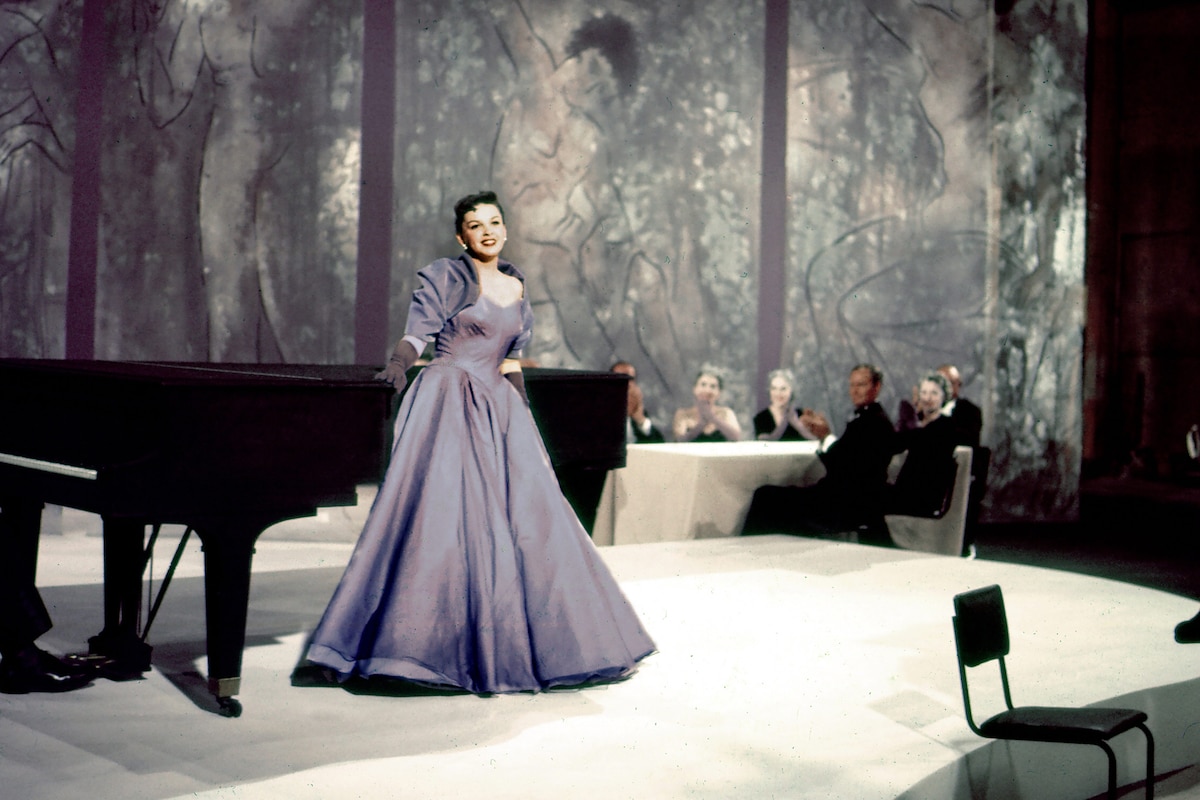
Since this would be his first color film, Cukor enlisted noted fashion
photographer George Hoyningen-Huene as a special visual and color
consultant. During production meetings, Cukor was impressed with one of
set designer Lemuel Ayres' staff, Gene Allen, and elevated him to a
position as production designer. He would continue to collaborate with
Huene and Allen through the rest of his career.
by Frank Miller
The Big Idea - A Star is Born ('54)
by Frank Miller | June 03, 2003
SIGN UP FOR OUR NEWSLETTERS

CONNECT WITH TCM