SYNOPSIS
Norman Maine, a screen star whose alcoholism is beginning to interfere with his career,
discovers Esther Blodgett, a singer with "that little something extra,"
star quality. He shepherds her through the birth of her career even as his
own is falling apart, and as he does so, their love grows. But soon it
becomes clear that his problems are ruining her life and Maine performs a final, desperate act to free Esther from her commitment to him.
Director: George Cukor
Producer: Sidney Luft
Screenplay: Moss Hart
Adapted from the Screenplay by Alan Campbell, Dorothy Parker and Robert
Carson and the Story by Carson and William A. Wellman
Cinematography: Sam Leavitt
Editing: Folmar Blangsted
Art Direction: Malcolm Bert, Irene Sharaff
Music: Harold Arlen
Cast: Judy Garland (Esther Blodgett/Vicki Lester), James Mason (Norman
Maine), Jack Carson (Matt Libby), Charles Bickford (Oliver Niles), Tommy
Noonan (Danny McGuire), Lucy Marlow (Lola Lavery), Amanda Blake (Susan
Ettinger), Irving Bacon (Graves), Strother Martin (Delivery Boy), Grady
Sutton (Carver), Joan Shawlee (Announcer), John Saxon (Usher),
C-176 m.
Why A STAR IS BORN is Essential
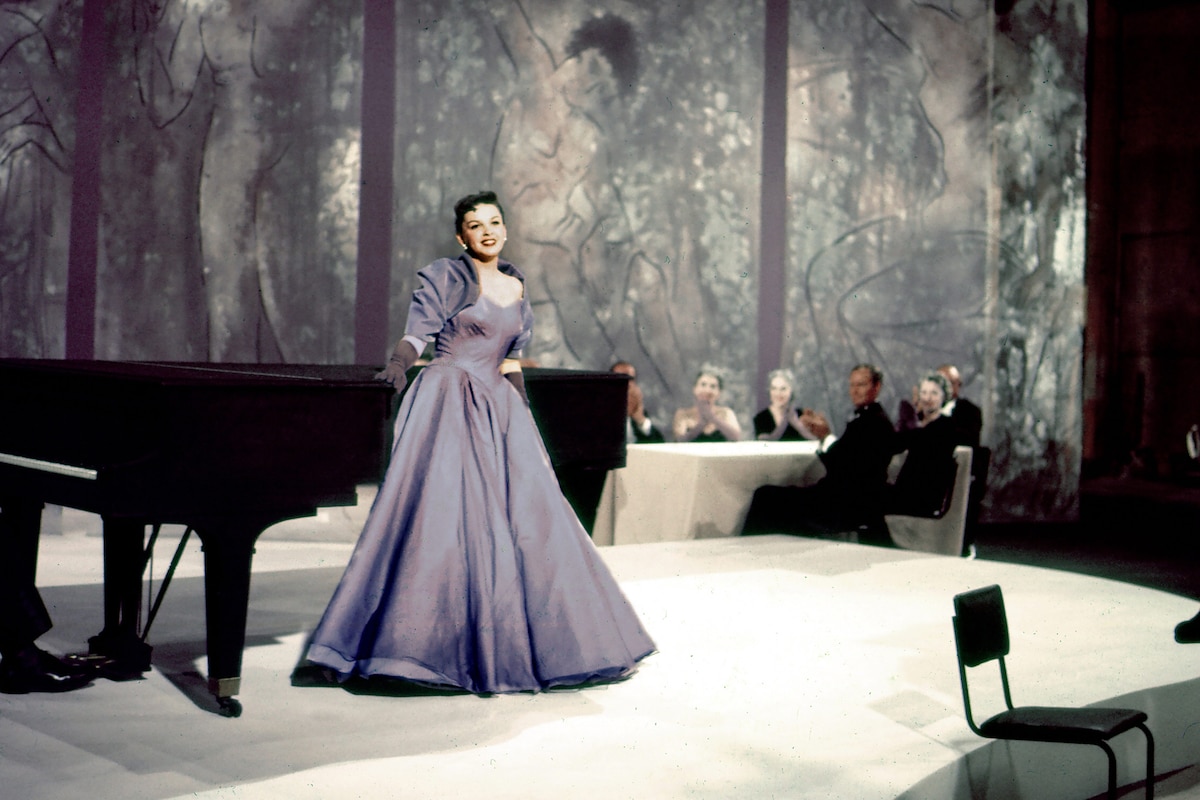
A Star Is Born (1954) marks the apotheosis of Judy Garland's career, a
multi-faceted role exploiting her talents for song, dance, comedy and
tragedy alike as none of her other films ever did. In a sense, it was
planned that way. Screenwriter Moss Hart drew on his knowledge of Garland and
her career to re-structure the story for the 1954 version.
A Star Is Born marked the start of two profitable collaborations
for director George Cukor. Special Visual and Color Consultant George
Hoyningen-Huene, one of the nation's leading fashion photographers, and
production designer Gene Allen would play a major role in shaping his
directorial vision as he moved into directing in color. They would work with
him on most of his later films, making notable contributions to the visual look
of Bhowani Junction (1956) and Les Girls (1957) in particular.
Thanks to Huene and Allen's influence, and Cukor's immaculate taste,
A Star Is Born was one of the first films to indicate how the
CinemaScope process could be used artistically. Introduced only a year
earlier, the wide-screen process had helped draw audiences to epics like
The Robe (1953), the first film shot that way, but had stymied directors,
who found the new image unwieldy. Director George Stevens suggested it was
only good for photographing snakes. But by playing with color and
composition, Cukor showed that it could actually enhance a film's
effectiveness.
Ronald Haver's 1983 restoration of A Star Is Born was the first
high-profile project of its nature, thereby raising public awareness of
film preservation issues. It sparked a movement to rescue other lost films, with his innovative use of stills and soundtrack to fill in for scenes that no longer exist. Certainly, it opened new doors for film preservationists. Later projects that followed in the wake of Haver's A Star is Born restoration have included Frank Capra's Lost Horizon (1937), Raoul Walsh's Sadie Thompson (1928), Erich von Stroheim's Queen Kelly (1929) and Greed (1923-25).
Haver's search for missing scenes from the film, some illegally held by
collectors, also increased public and industry awareness of piracy. In the
year following the restoration's successful re-issue, legal action against private film collectors who had ignored the law and police raids on their homes increased
significantly.
by Frank Miller
The Essentials - A Star is Born ('54)
by Frank Miller | June 03, 2003
SIGN UP FOR OUR NEWSLETTERS

CONNECT WITH TCM