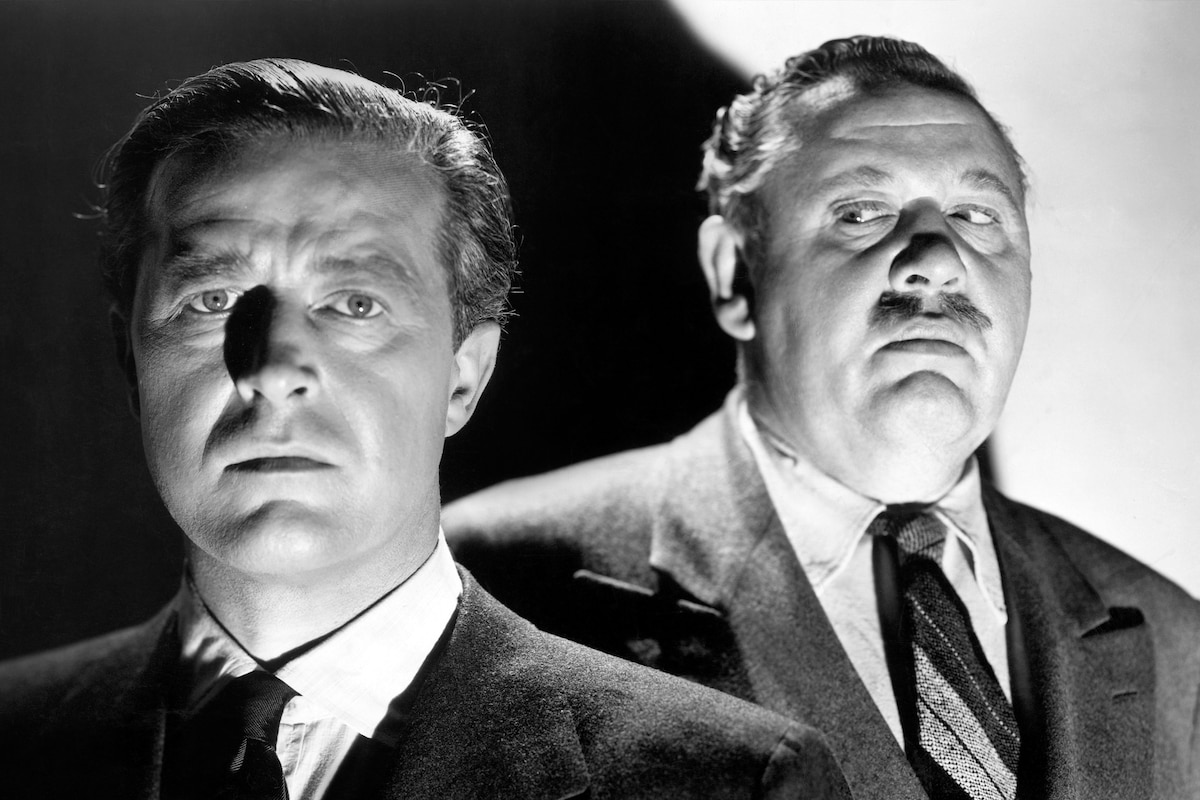
In The Big Clock (1948), George Stroud, (Milland) the editor of
Crimeways magazine has been given the task of solving a murder
before his own staff finds evidence that will point to him as the killer.
As he races to find the real murderer, Milland discovers that his search
has led him to his magazine's corporate headquarters. Located in a massive
tower within the cold confines of those headquarters, the big clock seems
to dominate and watch over everything. Even when Milland hides in a room
just behind the clock, it's as if he's trapped inside a box of time within
other boxes, one onto the other. All of them enclosed in the labyrinthian
corridors of the imposing, futuristic-looking Janoth building. Time is the real enemy in The Big Clock. Even the murder weapon, a
sundial, reinforces this notion.
The Big Clock is directed by John Farrow in an elegant style,
described by Simon Callow in his book, Charles Laughton: A Difficult
Actor, as "nearly" noir. As Callow puts it, "The play of shadows is
handled in a masterly way, while the plot with its inversions and
convolutions, presents an image of nightmarish reversals." Callow also
speculates that Laughton, as Earl Janoth, the owner of a publishing empire,
seemed to be, "drawing attention to the robotic heartlessness of big
business." Just after World War Two, Americans were witnessing the
building of corporate giants, and the complications that come from such
growth and progress. As much as The Big Clock is an entertaining thriller, it also seems to be an attempt to come to grips with that loss of identity within the corporate milieu.
Workers, now faced with more powerful corporate heads in the new
streamlined workplace, could relate to Laughton's cunning portrayal of what
Callow called, "a Napoleon of print." And the camera follows Laughton
closely. It captures his nervous tics and twitches as he rules his
employees with a fierce adherence to the adage that time does, indeed,
equal money. A perfect example of this occurs when Laughton gives an order to an underling:
"There's a bulb been burning for hours in a cupboard on the fourth floor.
Find out who's responsible and dock his pay, will you?"
Charles Laughton probably played more memorable and varied characters than
any actor who ever lived. Remember him as Captain Bligh in Mutiny on
the Bounty, or as the butler who was won in a poker game in Ruggles
of Red Gap, or as Javert in Les Miserables? All were released
in the same year -1935! And then there's Laughton as the hearty monarch, Henry the
VIII in The Private Life of Henry VIII (1933), or as the haunting
Quasimodo in The Hunchback of Notre Dame (1939), or as a defense
attorney outwitting everyone in Witness for the Prosecution (1957).
In The Big Clock Laughton gives one of his more fascinating
performances. As Earl Janoth, he rules over a publishing world that would
rival Hearst or Murdoch. As Callow puts it, "The performance is a
technical tour-de-force of high-speed throwaway, comic and powerful at the same time." We know everything about what he (Janoth) is, and how he
works - like a clock, as it happens, the image that dominates and unifies the
whole film."
But it was Ray Milland who received top billing in The Big Clock, a rather ironic turn of events considering that Laughton once helped Milland as a struggling young actor in a
supporting role in Payment Deferred (1932). If anything was made of
this Hollywood twist of fate, it doesn't show in the final product. The
two men work well together and Milland is, as always, the consummate
professional. We feel his confusion and anxiety as a man who misses a
train and has a fateful, soon-to-be disastrous meeting. A meeting which
leaves him a man on the run, desperate to clear himself of murder. Born
Reginald Alfred John Truscott-Jones, the official word on how he changed
his name to Milland confirms that he took it from his stepfather's surname,
Mullane. But the Hollywood version of the facts is more interesting: He took the name
Milland because of his fond memories of the mill lands in his home area of
Neath in Wales. The actor had a long and distinguished career (57
years in the movies), specializing in well-bred heroes and proper British gentlemen.
But when Milland won the Oscar for his gritty portrayal of an alcoholic in
The Lost Weekend (1945), he began to take on less glamorous, more challenging
roles. In movies like Dial M for Murder (1954), for example, he
comes full circle playing a jaded sophisticate and man-about-town who plots his wife's murder. Coming just two years after The Lost Weekend, The Big Clock came at a transitional point in Milland's career, offering him a role that falls somewhere between the elegant leading man of his earlier period and the more cynical and corrupt characters he later essayed.
Based on Kenneth Fearing's novel of the same name, The Big Clock was
remade as No Way Out (1987). A conspiracy thriller set in Washington, D.C. and starring Kevin Costner, it is best remembered for a steamy sex scene between Costner and Sean Young in the back seat of a car.
As a final note there were two real life couples working on The Big Clock. Elsa Lanchester, Laughton's wife, plays an eccentric artist in a funny supporting role, and Maureen O'Sullivan, John Farrow's wife, took a small role as Milland's long-suffering spouse in order to be closer to her director husband. The third of the Farrows' seven children is the actress, Mia Farrow.
Producer: John Farrow, Richard Maibaum
Director: John Farrow
Screenplay: Jonathan Latimer, based on the novel by Kenneth Fearing
Art Direction: Roland Anderson, Hans Dreier, Albert Nozaki
Cinematography: Daniel L. Fapp, John F. Seitz
Costume Design: Edith Head
Film Editing: LeRoy Stone
Original Music: Victor Young
Principal Cast: Ray Milland (George Stroud), Charles Laughton (Earl Janoth), Maureen O'Sullivan (Georgette Stroud), George Macready (Steve Hagen), Rita Johnson (Pauline York), Elsa Lanchester (Louise Patterson), Harry Morgan (Bill Womack), Dan Tobin (Roy Cordette).
BW-95m. Closed captioning.
by Joseph D'Onofrio
The Big Clock
by Joseph | April 29, 2003
SIGN UP FOR OUR NEWSLETTERS

CONNECT WITH TCM