The Italian cinema reached a turning point when Roberto Rossellini made Paisan, his
1946 omnibus film about the U.S. invasion of Italy at the end of World War
II. More than any other film, Paisan embodied every element of
neo-realism, the style that would characterize the best of the country's
post-war films. Where Rossellini's first international triumph, Open
City (1946) had combined its stunning location shots of war-torn Rome
with a manipulative and melodramatic plot, Paisan combined
documentary footage, non-professional actors and a simple screenplay often
improvised on the spot. The result was one of the most realistic visions ever
put on screen in a fiction film. Moreover, with this, his twelfth film,
Rossellini finally began to find his footing as a writer-director.
At first, he wasn't even considering directing the film. The project started
out as Seven from the U.S., a tribute to the U.S. Army's role in
liberating Italy. The package had been put together by a team of American
producers and writers that included Rod E. Geiger, who would stay with the
film through its release, and Klaus Mann, son of acclaimed novelist Thomas
Mann. They turned to Rossellini to help bring the production together. At
first, he saw himself merely as the producer, with different directors working
on each of the seven planned sequences (there would be six sequences in the
final film). But as the screenplay took shape, Rossellini and co-writer
Sergio Amidei began making it more about the Italian reaction to the U.S.
invasion. Ultimately, Mann left the production in anger, but later, so
would Amidei, who saw many of his ideas scrapped as Rossellini re-wrote the
film during nine months of shooting -- six more than had originally been
planned.
Part of the problem was the difficulty of shooting in post-war Italy. Even
though Rossellini had his largest budget ever, he still had to scrounge for
locations and equipment. He only survived the frequent power outages of
the time by discovering a portable generator left behind by the Nazis. But
he also worked slowly, partly because of illness, partly out of his own
quixotic nature. At one point he was in so much pain that he tied a San
Pellegrino bottle filled with warm water to his body. At other times,
however, he would leave the crew waiting for hours, only to send word that
he wasn't even in the same city. His illnesses and other absences gave
script writer Federico Fellini his first chance to direct (In addition,
Fellini's wife and future star, Giulietta Masina, would make her film
debut in the picture with an unbilled bit). As production dragged on, the
film's U.S. backers stopped sending money. Rossellini had to pay his crew
on Fridays by borrowing against the projected weekend receipts for Open
City and then repaying the loans the following Monday.
Geiger had promised Rossellini a cast of American stars, including Frances
Farmer and the great black actor Canada Lee. But when the American cast
arrived -- on the first passenger boat to travel from the U.S. to Europe
since the war had begun -- they were all unknowns. The closest Rossellini
got to any of his promised cast was Dots M. Johnson, cast as the black MP
in the Naples sequence, who had understudied for Lee in stock.
Alongside these professional actors, Rossellini cast actual U.S. soldiers,
local citizens, resistance fighters and even some German POWs. One of his
most memorable finds was Carmela Sazio, the girl in the Sicilian sequence
who falls for a GI (played by American soldier Robert Van Loon) even though
neither speaks the other's language. Rossellini discovered the 15-year-old
while scouting locations in the most remote parts of Sicily. At first, she
didn't even understand basic hygiene, but she learned by watching the women
on the production crew. She also fell in love, first with Von Loon, which
added to the emotional authenticity of their scenes, and then with
Rossellini. She was heartbroken when the company moved on to their next
location, writing Rossellini a touching letter he chose not to answer.
Years later he would learn that she had become a prostitute.
With the first sequence, Rossellini stayed close to Mann and Amidei's
script, but as the production moved, he and Fellini began improvising.
When Fellini discovered a monastery near the Sicilian location, they
re-wrote the Romagna sequence to incorporate the monks' daily routine.
Then Rossellini had the actual monks there play themselves. When
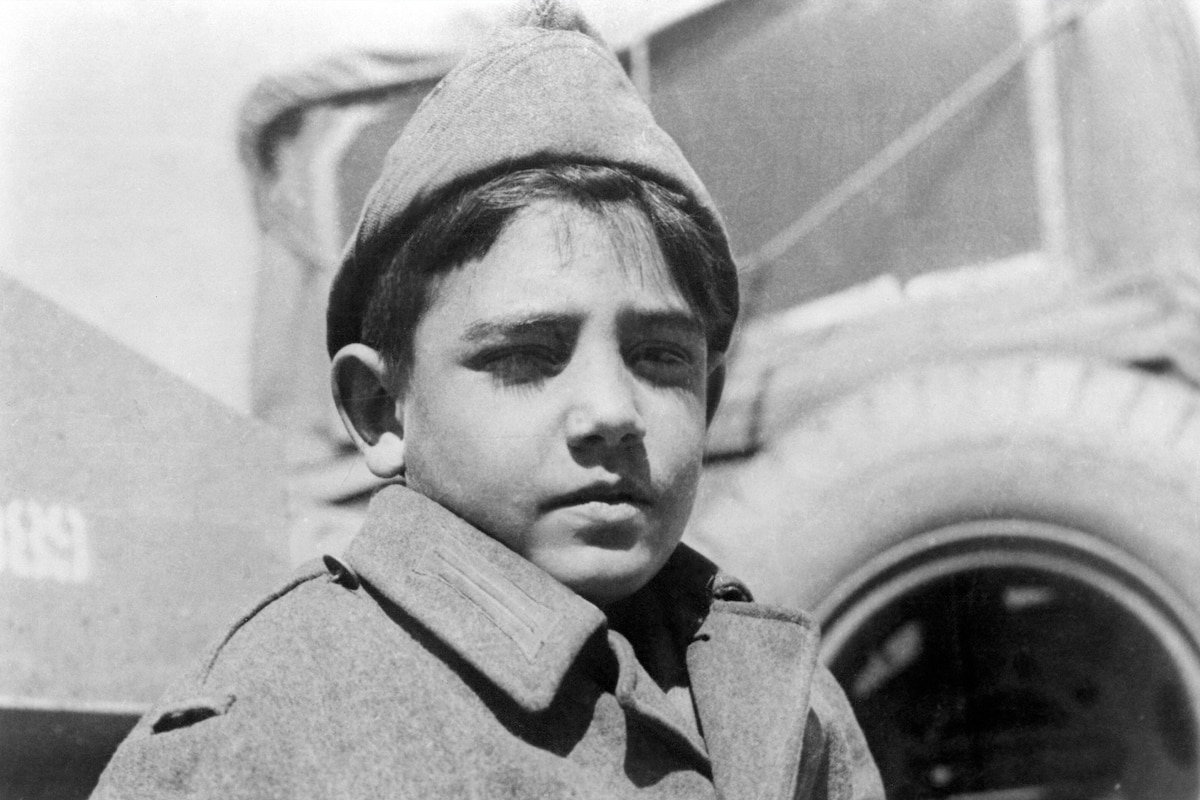
Rossellini discovered a cave inhabited by orphaned children and homeless
families near Naples, they re-wrote the Naples sequence completely. The
Florence sequence, about a nurse in love with a partisan, was given a new plot; it was based on a story Rossellini had heard about a Peruvian woman who relentlessly searched
for the rebel leader she had fallen in love with only to find he had been
killed.
After nine months, shooting finally finished, but during post-production
Rossellini's son died suddenly while vacationing in Spain. The director
was so busy dealing with his grief and fighting red tape to bring the boy's
body back home, that the film sat untouched until just before its opening
at the Venice Film Festival. Then Rossellini's brother, Renzo, who had
composed the score, rushed through the final post-production work. The
film that screened at the festival was half an hour too long (the director would later cut it) and fared poorly with the mainstream critics. Nor did it do well at the Italian box office; local filmgoers were already tired of realistic war stories. In international release,
however, the film was a triumph. The French embraced the film, while it
became one of a string of post-war Italian hits in the U.S. Ultimately it
would win Best Foreign Language Film from the New York Film Critics, Best
Picture and Best Director from the National Board of Review and an
Oscar® nomination for Best Story and Screenplay. Today Paisan
is viewed as a classic, one of the triumphs of Italian neo-realism and of
Rossellini's directing career.
Producer: Roberto Rossellini, Rod E. Geiger, Mario Conti
Director: Roberto Rossellini
Screenplay: Sergio Amidei, Federico Fellini, Alfred Hayes, Marcello
Pagliero, Roberto Rossellini
Story: Victor Haines, Marcello Pagliero, Sergio Amidei, Federico Fellini,
Roberto Rossellini, Klaus Mann, Vasco Pratolini
Cinematography: Otello Martelli
Music: Renzo Rossellini
Principal Cast: Carmela Sazio (Carmela), Robert Van Loon (Joe from Jersey), Maria Michi (Francesca), Renzo Avanzo (Renzo), Harriet White (Harriet), Dots M. Johnson (MP), Bill Tubbs (Captain Bill Martin).
BW-120m.
by Frank Miller
Paisan
by Frank Miller | April 23, 2003
SIGN UP FOR OUR NEWSLETTERS

CONNECT WITH TCM