It's no secret that sequels are often little more than calculated rehashes
of popular movies, with extra emphasis placed on re-creating dialogue or
bits of action that everyone talked about the first time around. But Peter
Hyams' 2010 (1984), the long awaited follow-up to Stanley Kubrick's
monumental classic, 2001: A Space Odyssey (1968), is a different
beast altogether. It may well be the only sequel in movie history that was
designed to explain the plot of its predecessor...not that everyone was
clamoring for an answer.
2010's relatively straight-forward narrative picks up nine years
after the first film ended. The United States government discovers that the
Soviets are planning to travel to Jupiter to find out what happened to The
Discovery, the doomed ship that served as a sort of metaphysical launching
pad in 2001: A Space Odyssey. The Soviets eventually contact the
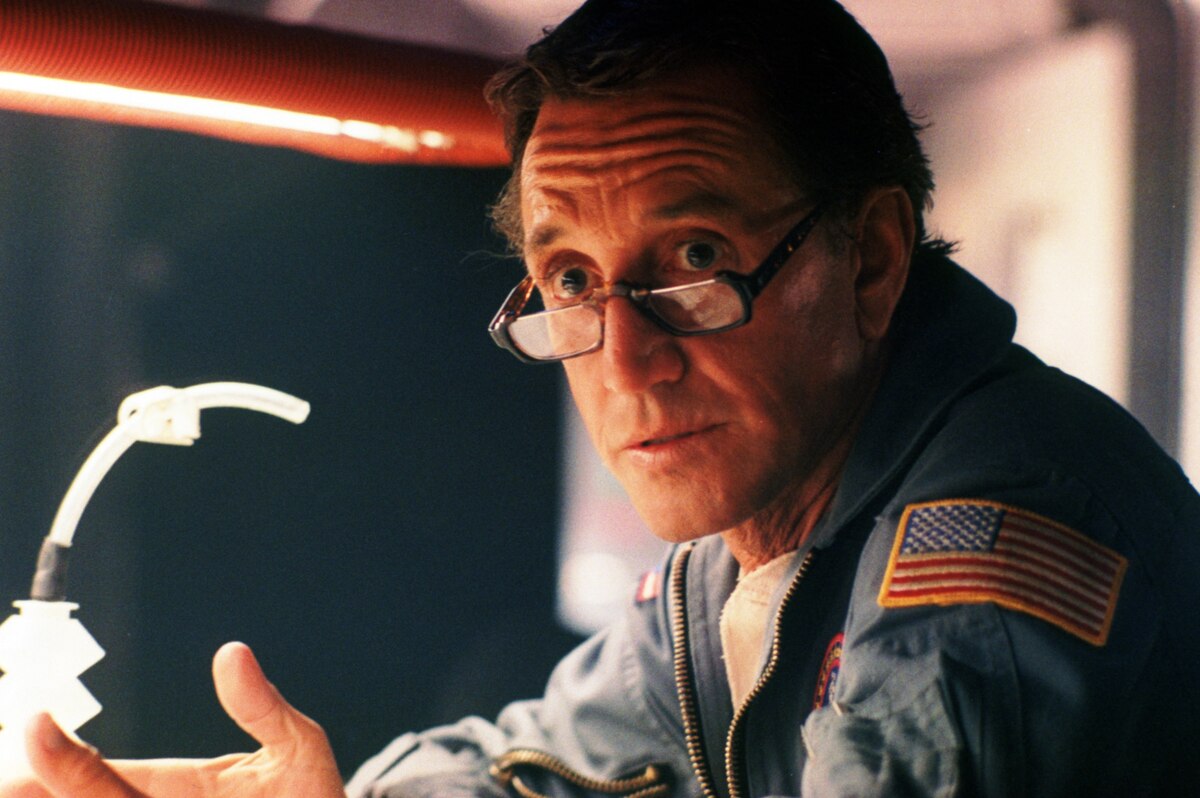
U.S. and request that Heywood Floyd (Roy Scheider), the mastermind behind
the original mission, accompany them on their journey. It's never explained
how Floyd, who was played by William Sylvester in 2001, managed to
transform himself into a completely different person between
stories.
Floyd and his fellow American astronauts, Walter Curnow (John Lithgow) and
Dr. Chandra (Bob Balaban), are welcome additions to the crew, mainly because
the Russians have no working knowledge of the HAL 9000 computer that
controls The Discovery. Fans of the first film, of course, realize that
nobody knows exactly what's going on with HAL. (Note also that
2010 contains a guest appearance by HAL's sister, SAL 9000. SAL
speaks with Candice Bergen's mellifluous voice, though Bergen is
inexplicably billed in the credits as "Olga Mallsnerd.") Soviet-American
political tensions - which were a reality at the time and now may be puzzling to today's viewers - add another dimension to the proceedings. Before it's all
over, you may (or may not) have a better idea what Kubrick and co-writer
Arthur C. Clarke were getting at with 2001.
One could debate whether there was a need to make 2010 at all. "I
certainly would not have not thought of doing the film," Hyams admitted, "if
I had not gotten the blessing of Kubrick." Though Kubrick gave Hyams the
go-ahead, he always intended 2001: A Space Odyssey to operate
somewhere beyond the realm of verbal explanation. The questions it raises
aren't designed to be answered directly, since the film's "point" hinges on
the unknowable mysteries of human consciousness. It's the kind of picture
that can be viewed as profound, pretentious or incomprehensible depending on who's viewing it. Thus the sequel received a mixed reception; some people saw it and some people
avoided it out of respect for Kubrick's original, mind-bending
experience.
Clarke, for his part, was receptive when a nervous Hyams sent him the screenplay. "I
felt like playing a few tricks on you - like a message from my secretary
that I was last seen heading for the airport carrying a gun," he told him.
However, Clarke added, "I'll say right away that it's a splendid job and you
have brilliantly chiseled out the basic elements of the novel, besides
adding quite a few of your own."
Whether or not Hyams succeeds in clarifying a deliberately unknowable film
will hinge on your eagerness to abandon your personal interpretation of
Kubrick's and Clarke's work. Regardless, 2010 can still be
appreciated as a solidly entertaining piece of sci-fi, one that was
nominated for Academy Awards for Best Sound, Best Art Direction, Best Costume Design,
Best Makeup, and Best Visual effects.
Directed by: Peter Hyams
Screenplay: Peter Hyams, based on Arthur C. Clarke’s novel, 2010, Odyssey
Two
Art Direction: Albert Brenner
Set Design: Rick Simpson
Cinematography: Peter Hyams
Editing: James Mitchell and Mia Goldman
Music: David Shire, Richard Strauss, and Gyorgi Ligeti
Special Effects: Henry Millar, Jr. and Richard Edlund
Costume Design: Patricia Norris
Principal Cast: Roy Scheider (Heywood Floyd), John Lithgow (Walter Curnow),
Helen Mirren (Tanya Kirbuk), Bob Balaban (Dr. Chandra), Keir Dullea (David
Bowman), Dana Elcar (Dimitri Moisevitch), Elya Baskin (Maxim
Brailovsky).
C-116m. Letterboxed. Closed captioning.
by Paul Tatara
2010
by Paul Tatara | April 29, 2003
SIGN UP FOR OUR NEWSLETTERS

CONNECT WITH TCM