Depravity was the word of the day in The Shanghai Gesture (1941).
Although the original play by John Colton had been heavily censored by the
time it reached the screen in 1941, it remained an unusual blend of
atmospheric photography and sets, fruity dialogue and enough kinks to fill
several chapters in Kraft-Ebbing. The person to thank for this heady
mixture was director Josef von Sternberg, making the last major film of his
career. He was helped by an eclectic cast and crew that included a future
congressional wife, two internationally renowned acting teachers and a man
and woman who had each shared a bed with famed Russian superstar Alla
Nazimova. The heady mixture of talents and style has made The Shanghai
Gesture a cult favorite over the years, more revered today than it was
on its initial release.
Controversy was nothing new to playwright Colton, who had scandalized London and
Broadway stages with Rain, his adaptation of W. Somerset Maugham's
famous story about a South Seas trollop. Two years later, he went even
further with The Shanghai Gesture, a tale of murder and mayhem in a
Chinese bordello presided over by the diabolical Mother Goddamn. When
Hollywood started censoring its own films in the '20s under the guidance of
Will Hays, both of Colton's plays were high on the list of properties too
hot for the screen. Over the years, Hays turned down 30 different
treatments of the story, even as other forbidden properties were cleaned up
to fit the Production Code.
The last person likely to create an acceptable adaptation of The
Shanghai Gesture was von Sternberg, the self-consciously exotic
director who had made Marlene Dietrich a star in such decadent films as
The Blue Angel (1930), Morocco (1930) and Shanghai Express (1932). With increased censorship in Hollywood and the more conventional tastes of U.S.
audiences, his career had faltered, and after the box-office failure of his 1935 feature, The Devil Is a Woman starring Dietrich, his career seemed to be
over. After suffering a nervous breakdown while working at MGM, he was
pretty much finished with Hollywood. But an old friend, Hungarian-born
producer Arnold Pressburger, needed a picture to establish himself in
Hollywood after fleeing war-torn Europe. Von Sternberg may also have
needed the money to help get about 20 of his relations out of Europe.
Nonetheless, he was so physically disabled, he did most of his work while
lying on a cot.
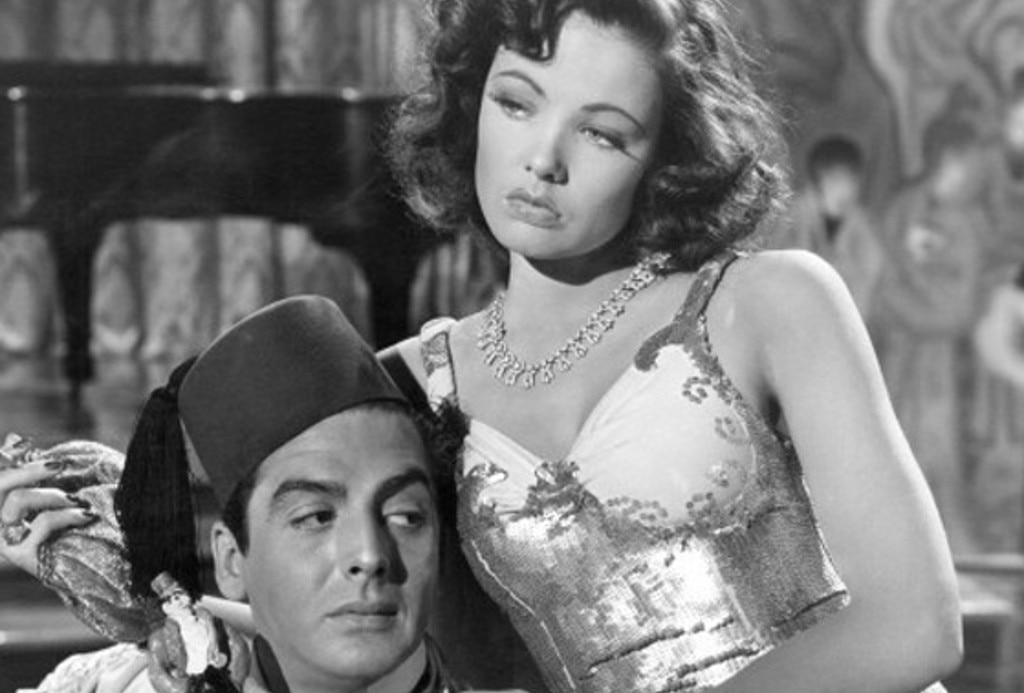
This didn't stop him from making the film distinctly his own. To the
original script he added two new characters: an American showgirl (Phyllis
Brooks, who would retire from acting to marry Congressman Torbert H.
MacDonald) and Omar, a "Doctor of Nothing" (Victor Mature, in one of his
first film roles) whose sardonic presence seems to mirror the director's
own viewpoint. Working with frequent collaborator Jules Furthman and Karl
Vollmoeller (who had worked on the script for The Blue Angel), he
also got the story past the censors. Mother Goddamn became Mother Gin
Sling, and her brothel was transformed into a gambling casino. In the
play, she took revenge on the British businessman out to close her
establishment by addicting his daughter to drugs. All that remained of the
drugs in the film version was the girl's name, Poppy. Instead of drug
addiction, she succumbed to the lure of the gambling table and a romance
with Gin Sling's lover, Dr. Omar.
The rest of von Sternberg's cast is as disparate as the clientele at Mother
Gin Sling's. Poppy was played by rising star Gene Tierney, who was
particularly happy that her new husband, Oleg Cassini, had been hired to
provide her gowns. Her father was played by stage and screen veteran
Walter Huston. Supporting players included famed German stage star Albert
Bassermann, who taught acting in Hollywood between character roles like his
turn here as a corrupt police commissioner, and former Stanislavsky star
Maria Ouspenskaya, also a noted acting teacher. Despite her prominent
billing in The Shanghai Gesture, Ouspenskaya has no lines. Rumors
at the time suggested that her dialogue was cut when preview audiences
roared at the thought of a Chinese maid with a broad Russian
accent.
The most fascinating member of the film's fascinating cast, however, was
Ona Munson, who had her last shot at stardom playing Mother Gin Sling. The
skinny, freckled blonde was best known for her role as Belle Watling in
Gone With the Wind (1939), another character she created through her sheer acting
presence and liberal applications of makeup. For The Shanghai
Gesture, she also had the benefit of a series of outlandish
headdresses, the most lavish anyone had put on screen since von Sternberg's
films with Dietrich. Off-screen, Munson was a shy young woman, driven by
her thirst for success and love. Although married three times, she also
maintained a secret lesbian love life and, like the film's cinematographer,
Paul Ivano, had gotten an early start as the protege/lover of Russian stage
star Nazimova. Since then, she had enjoyed a lengthy affair with writer
Mercedes de Acosta and a briefer fling, some biographers suggest, with
Dietrich. Tormented by her failure to achieve stardom and her unhappy love
life, she would commit suicide in 1955.
The Shanghai Gesture opened in late 1941 to generally dismal reviews.
Although praised for its heady atmosphere, which helped win Oscar®
nominations for Best Score and Best Art Direction, it was loudly derided
for its convoluted melodramatic plot and such fruity dialogue as Tierney's
attack on Munson, "You're no more my mother than a toad." It marked the
death knell for von Sternberg's career as a Hollywood director, even though
his glamorous photography of Tierney helped her rise to stardom. The
carefully written role of Omar also helped Victor Mature move on to better
roles. Removed from the world of the U.S. on the brink of war, however,
the film fared quite well. Tierney was amazed during a tour of France
years later, to find it the film of hers that consistently elicited
questions from fans. With the rise of the auteur school of
criticism in that country, which deified Hollywood directors like von
Sternberg who managed to impart a personal style and viewpoint on even the
most unpromising projects, the film's reputation has grown over the years. Today, The Shanghai Gesture has a solid core of fans
who see it as one of the most vivid expressions of von Sternberg's
strengths as a director, a triumph of style over substance.
Producer: Arnold Pressburger
Director: Josef von Sternberg
Screenplay: Josef von Sternberg, Karl Vollmoeller, Geza Herczeg, Jules
Furthman
Based on the play by John Colton
Cinematography: Paul Ivano
Art Direction: Boris Leven
Music: Richard Hageman
Principal Cast: Gene Tierney (Poppy Charteris), Walter Huston (Sir Guy
Charteris), Victor Mature (Dr. Omar), Ona Munson (Mother Gin Sling),
Phyllis Brooks (Dixie Pomeroy), Albert Basserman (Van Alst), Maria
Ouspenskaya (Amah), Eric Blore (Caesar Hawkins), Mike Mazurki (Coolie),
Marcel Dalio (Croupier).
BW-98m.
by Frank Miller
The Shanghai Gesture
by Frank Miller | April 25, 2003
SIGN UP FOR OUR NEWSLETTERS

CONNECT WITH TCM