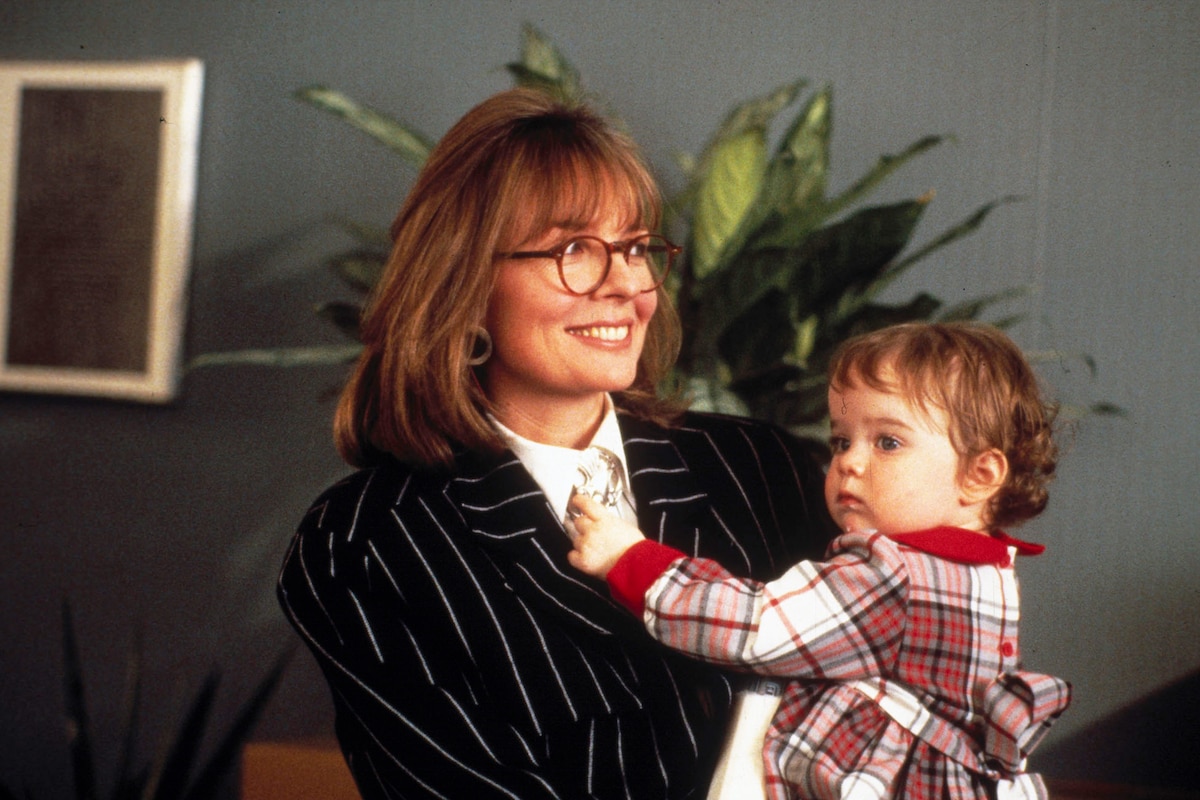
In 1987 United Artists released Baby Boom, starring Diane Keaton in the lead role of J.C. Wiatt, a.k.a. "The Tiger Lady." Billed as "An unexpected comedy," the film depicts the life of a corporate businesswoman turned upside-down when she unwittingly inherits a baby. Charles Shyer and Nancy Meyers, filmmaking partners and husband and wife at the time, shared writing responsibilities with Shyer doubling as the film's director and Meyers moonlighting as the producer. The two had honed their craft on such films as Private Benjamin (1980) and Irreconcilable Differences (1984). Drawing on such film inspirations as Woman of the Year (1942) and Bachelor Mother (1939), starring Ginger Rogers, Meyers explained that, "Our movie is about someone who never planned on motherhood. The comedy comes from J.C.’s ineptness to deal with this surprise. Ten years ago, Baby Boom would have probably starred a man, because not until recently, with the great female drive toward careerism and success, would it be believable that a woman could be so ill-prepared for motherhood." Wiatt’s failed attempts at childcare—such as feeding the baby pasta and Perrier - wreak havoc on her yuppie lifestyle; her boyfriend, played by Harold Ramis, leaves her, and she misses out on a promotion at work. Eventually she quits her job and moves out to the Vermont countryside. There, a love interest in the form of Sam Shepard appears - and ultimately Keaton must make a decision between work, home, or finding something in between.
Keaton's performance garnered rave reviews, with critics hailing her comic performance as successful as her Oscar-winning role in Annie Hall (1977). Her clothing also caused a sensation, much as it did in the Woody Allen comedy ten years previously. In Annie Hall, however, it was waistcoats and men's ties - Baby Boom featured Keaton in a whole new look with Armani suits and Donna Karan skirts. The marked departure from Keaton's usual style caused a sensation on and off screen; in the biography Diane Keaton: The Story of the Real Annie Hall, author Jonathon Moor explains, "On the first day of shooting, when Diane walked onto the set the whole crew stopped and stared. Used to her highly individual rummage-sale look they couldn't believe this sophisticated, glamorous lady with a body was the layered, hidden Diane everyone knows. Someone, in total admiration, said to her, "You look like...." "A female of the species?" laughed Diane." The film's press kit revealed that Shyer, Meyers and costume designer Susan Becker used classic 30s and 40s films as their model. "I always loved how Roz Russell and Katharine Hepburn portrayed working women. They wore wonderfully tailored suits, and always carried envelope bags under their arms as they walked through their offices dishing out orders," noted Meyers.
Her co-star/playwright/actor/screenwriter/director Sam Shepard unexpectedly accepted the role of a country veterinarian. According to Meyers, "From the beginning, we were told to forget trying to get Sam to portray a character who doesn’t enter the film until the third act. But we sent the script care of a True Value Hardware Store in Virginia, and two days later he said he’d do it." They shouldn’t have been surprised: from his Oscar-nominated performance in The Right Stuff (1983) to the Pulitzer Prize winning success of his play Fool for Love, Shepard has always made unconventional career decisions. Ramis was a more obvious casting decision; he read for the part twice in his enthusiasm to play the role of a vapid and superficial yuppie. Baby Boom marked the first time Ramis had one job to do in a film, act—in movies like Caddyshack (1980) and Ghostbusters (1984), he would also have directorial, writing, or producing responsibilities.
Veteran character actors Sam Wanamaker and Pat Hingle played featured roles in the film. Hingle, who had appeared in On the Waterfront (1954) and Norma Rae (1979), is perhaps best known by younger audiences for his portrayal of Commissioner Gordon in the Batman film series. Wanamaker, with an impressive fifty-year career, was effectively sidelined from stardom by his leftist politics in the heat of the communist witch-hunts conducted by the House Un-American Activities Committee.
The youngest actors in the film, twins Kristina and Elizabeth Kennedy, were only seventeen months old during production. One of the benefits of having two children play the role was the ability to double up on the shooting schedule - labor laws allowed only two hours of set time per day per child. Keaton dedicated herself to bonding with the babies, according to author Jonathan Moor in his biography of the actress; he wrote, "As someone who prepares herself exhaustively for any role, Diane went to see the babies every day, spending time alone with each of them for a couple of months before shooting started. It came to the point that when principal photography commenced she was their surrogate mother; during filming it was often Diane who would cajole the right reaction out of the babies by playing the clown with them or singing a lullaby to get them to sleep." There was speculation that all this projected maternal instinct was causing Keaton to think about having children herself - at the time she was dating Al Pacino, but it was not until 1996 that Keaton adopted a child. The film had a more direct effect on producer Meyers: she became pregnant with her second child during production.
Behind the scenes on Baby Boom, the crew was kept busy: the New York scenes were filmed in cool colors to convey the modern and rigid quality of a big city; by contrast, the Vermont scenes, filmed in the quaint town of Peru, featured warm, earth colors to suggest a sense of coziness. In order to portray three seasons in a two-week filming span, the crew had to come up with creative solutions for several scenes such as bagging colorful September leaves for use in drab November, and affixing icicles to building eaves. But their efforts paid off and the critics declared Baby Boom as "a delightful comedy about "having it all" in the eighties signals Diane Keaton's triumphant return to the ranks of the screen's top comediennes." A brief television series resulted, with ex-Charlie's Angel Kate Jackson taking over the Wiatt role. Speaking of television, another future TV star can be glimpsed in a bit role in the film: Chris Noth, of Law and Order and Sex in the City fame, whose film credit here reads "Yuppie Husband."
Producer: Bruce A. Block, Nancy Meyers
Director: Charles Shyer
Screenplay: Nancy Meyers, Charles Shyer
Art Direction: Beala Neel
Cinematography: William A. Fraker
Editing: Lynzee Klingman
Music: Bill Conti, Burt Bacharach, Carole Bayer Sager
Cast: Diane Keaton (J.C. Wiatt, Management Consultant), Harold Ramis (Steven Bochner, Investment Banker), Sam Wanamaker (Fritz Curtis), James Spader (Ken Arrenberg), Pat Hingle (Hughes Larrabee), Sam Shepard (Dr. Jeff Copper, Veterinarian), Britt Leach (Vern Boone).
C-111m. Letterboxed.
Baby Boom
by Eleanor Quin | April 25, 2003
SIGN UP FOR OUR NEWSLETTERS

CONNECT WITH TCM