You can't really blame people who work in the movie industry, especially
big-money stars and directors, for mistrusting the media. Unsubstantiated
gossip has long been a staple of entertainment coverage. But a lot of
principled newspaper reporters took offense at Sydney Pollack's Absence
of Malice (1981), and what they considered to be a reverse smear campaign by
Pollack, and the film's notoriously press-weary star, Paul Newman. Never mind
that first-time screenwriter Kurt Luedtke was inspired by the case of a
Washington Post correspondent who won a Pulitzer Prize for what
turned out to be a fabricated story (she had to return the prize, of
course). It also didn't matter that Luedtke was a former reporter for
The Detroit Free Press. This one ruffled a few media
feathers.
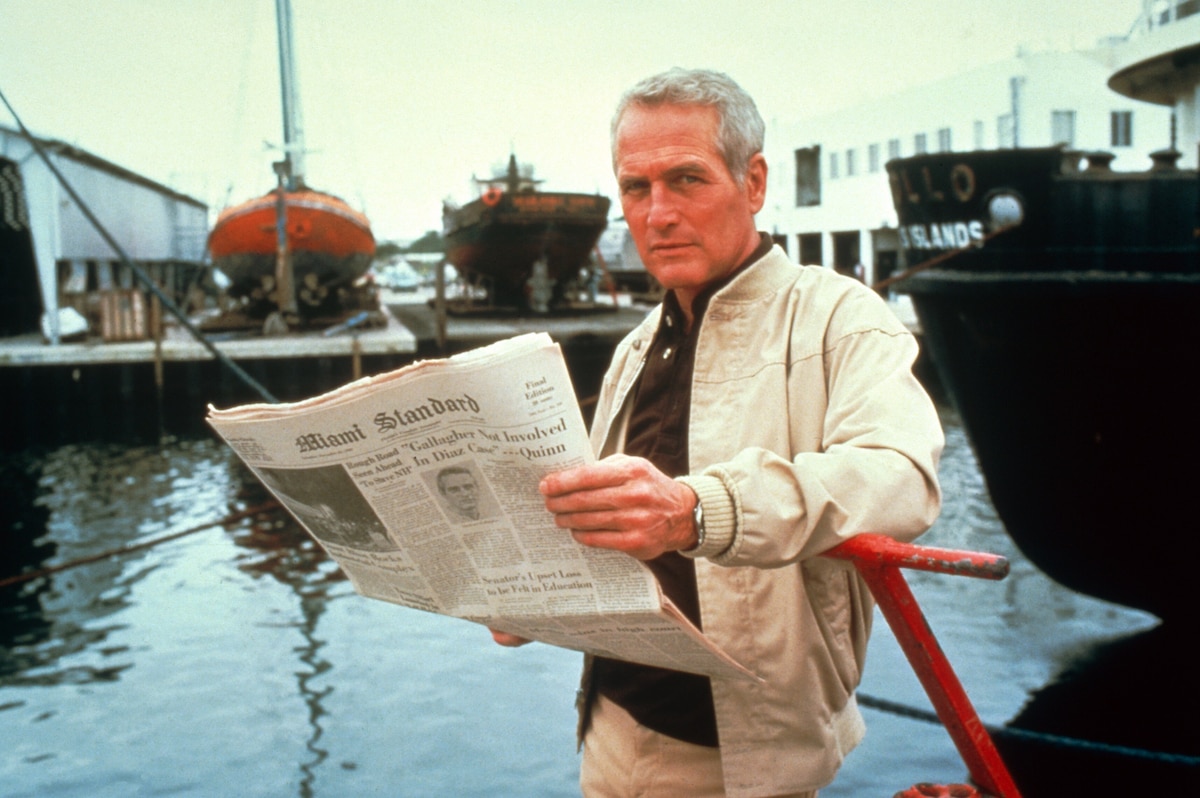
Newman stars as Michael Gallagher, a Miami-based beer distributor whose
deceased father was a powerful mob figure. Gallagher's dad always protected
him from the inner workings of the crime world, so he's grown up as a straight arrow, his only connection to the past being his still-crooked Uncle
Santos (Luther Adler). Elliot Rosen (Bob Balaban), a scheming federal
investigator, wrongly believes that Gallagher knows the story behind the
disappearance of an important labor leader and will do anything to nail
Gallagher.
One day, while talking to a newspaper reporter named Megan Carter (Sally
Field), Rosen leaves his office and just "happens" to place Gallagher's
folder on his desk. Carter takes a peek and winds up writing a story that implicates Gallagher in the crime. But Gallagher has an alibi - he was in Atlanta at the time, where he was
helping a close friend (Melinda Dillon) arrange an abortion. When Carter
tries to fix things by writing a too-blunt retraction of her original story,
a tragedy occurs. This leads to a complicated ruse by Gallagher that turns
the tables on the reporter and newspaper who besmirched his good
name.
In a nutshell, a lot of real-life reporters (and some audience members)
weren't buying that a woman in Carter's position would quickly rifle through
a file when no one was looking, then write a semi-imagined story based on
what she saw. Luedtke's argument was that this particular reporter did just
that, but that doesn't mean every reporter on earth would do the same thing.
Besides, he said, 'I don't walk out of a "bad cop" movie saying what I have
been told is that the police are bad people."
In an interview at the time of the film's release, Newman made it abundantly
clear how he feels about the media: "I would say that 90% of what people
read about me in the newspapers is untrue. Ninety percent is garbage.
(Reporters) are expected to come up with something sensational every night
of the week to keep their readers' noses buried in the pages, and, well, you
tell me. If nothing's happening, what do you do? Well, in their case, they
make it up."
But that barrage came later. First, there was a press conference/luncheon
featuring Newman, Field, Pollack, and others at New York City_s Tavern on
the Green restaurant. What started out as a glowing ember of discontent
among reporters turned into a raging fire by the time Newman and Field were
done answering questions. When a reporter from the sensationalist tabloid
The New York Post introduced herself to Field, the actress responded,
"Wouldn't you rather say you're from someplace else?," despite the fact that
the actress recently participated in a perfectly cordial interview with
the paper. Then, when Newman was introduced to the Post's Diana
Maychick, he bluntly snapped, "I hate your paper."
Newman's trademark blue eyes didn't work their charm this time. In an
article in The Village Voice, Arthur Bell, who was at the luncheon,
described the overriding vibe: "Over veal and carrots, (Newman) played the
guru with all the philosophically correct answers, and his performance
didn't sit too well. Are we supposed to write attractive copy about one of
the most bankable movie stars in the world when he obviously doesn't like us
and is using the press to make him more bankable for his next
project?"
The answer to that one was obviously "no," since many writers tore into
Newman, and what they considered to be the lopsided screenplay, with a
vengeance. Nevertheless, this is an interesting picture that asks
increasingly important questions about the consequences
of shoddy news reporting. Perhaps the Pulitzer Prize-winning reporter,
Lucinda Franks - she got to keep her prize - put it best in The Columbia
Journalism Review when she wrote that B>Absence of Malice is
unbelievable not because Fields' reporter and her editor are unethical, but
because they're so stupid.
You be the judge, but be prepared to back your position up with facts. And
try to find a corroborating source.
Directed by: Sydney Pollack
Screenplay: Kurt Luedtke
Producer: Sydney Pollack
Cinematography: Owen Roizman
Editing: Sheldon Kahn
Music: Dave Grusin
Production Design: Terence Marsh
Set Decoration: John Franco, Jr.
Costume Design: Bernie Pollack
Principal Cast: Paul Newman (Michael Gallagher), Sally Field (Megan Carter),
Bob Balaban (Elliot Rosen), Melinda Dillon (Teresa Perrone), Luther Adler
(Santos Malderone), Barry Primus (Bob Waddell), Wilford Brimley (James A.
Wells).
C-117m. Letterboxed. Closed captioning.
by Paul Tatara
Absence of Malice
by Paul Tatara | July 28, 2003
SIGN UP FOR OUR NEWSLETTERS

CONNECT WITH TCM