"Men's all alike -- married or single -- I happen to be smart enough to
play it their way."
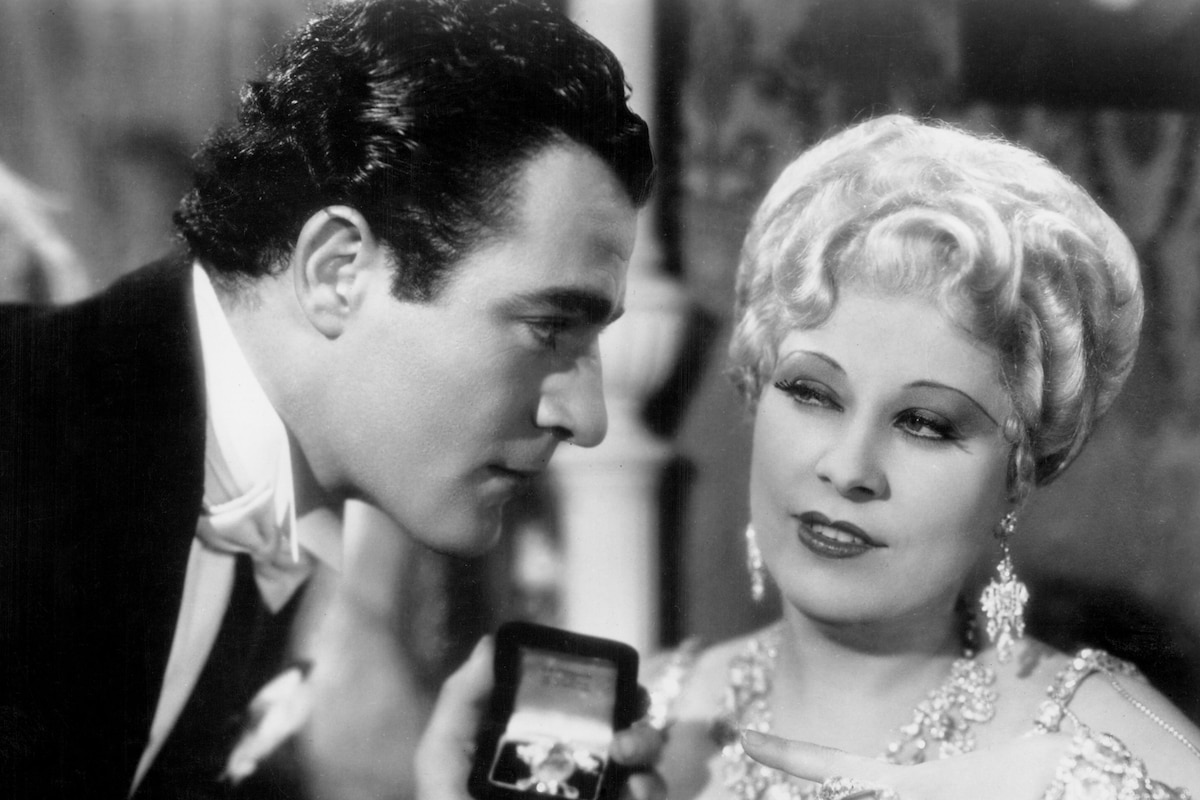
Mae West in She Done Him Wrong
Mae West played at sex like a man. She used her partners for pleasure and,
with most of them, discarded them as soon as she got bored. Though there
was usually one leading man who was given exclusive rights to her by the
film's conclusion, she was the one doing the giving, with the veiled
suggestion that she could always withdraw her approval if things didn't
work out. More than any innuendo, more than the tightly corseted gowns she
generously overflowed, this was what excited the censors' ire. Not only
did she treat sex as an act of pleasure without any undue consequences, but
also her attitude exposed the unwritten code by which many men operated,
even after they were married. Little wonder she was often credited as the
woman who brought stricter censorship to Hollywood. She wasn't, but as
Pauline Kael once said, if she was, the delights she offered on screen more
than made for the later depredations of censorship.
In the early '30s, the major Hollywood studios gave lip service to the
Production Code, a set of rules for what could and could not be done on
screen enforced by Will Hays of the Motion Picture Producers and
Distributors of America (MPPDA). Originally, Paramount Pictures was very
good about following the Code. They hadn't done much to follow the trend
toward gangster films spearheaded by Little Caesar in 1931. But by
1932 the studio was running $21 million in the hole. By that time, there
was a new genre challenging the censors, the sex film (also called "women's
pictures"), which dealt with women who stray from the straight and
narrow and pay for it tearfully by the film's end. Paramount had flirted
with the genre with its early Marlene Dietrich films like Morocco (1930)
and Blonde Venus (1932), but they mostly let the other studios blaze new
sexual trails and reap the box office rewards, at least until Mae West
showed up.
West had been developing her act since the early days of the 20th century,
when she sang bawdy songs in vaudeville, creating a delivery copied from
the female impersonators of the day and night-club queen Texas Guinan.
She'd scored some huge hits on Broadway, particularly with the
controversial Diamond Lil, in which she played a saloon singer on
The Bowery in the 1890s who sets out to seduce a Salvation Army officer.
Universal Pictures had proposed bringing the play to the screen in 1930,
when she toured it to Los Angeles. Hays issued a firm edict, however. The
play was off limits, and when Universal suggested hiring West to write
something new for them, he talked them out of it. Meanwhile, West fell on
hard times when her follow-up play, The Constant Sinner, closed
after only eight weeks. The 39-year-old sex star began to wonder if she
wasn't over the hill.
Then old friend George Raft came to the rescue. There was a juicy part for an
older woman playing his ex-girlfriend in Night After Night (1932) at
Paramount. The studio wanted to cast Texas Guinan, but he talked them into
giving West a chance. She almost turned the role down when she saw how
poorly it was written. Instead, however, she got producer Harry Le Baron,
another old friend, to agree to let her re-write her lines. Loading the
script with comic innuendo, she, in Raft's words, "stole everything but the
cameras." Exhibitors were clamoring for another film with West, and
Paramount decided to take a chance on bucking the censors.
When the studio approached her about making another film, she considered
her options, then insisted on adapting Diamond Lil. Rather than
buck Will Hays outright, they suggested changing the title and enough
details to make it seem like a new story. But when Hays found out, he
tried to shut the film down. Studio head Adolph Zukor made his case to
Hays' New York board of directors, and won the concession that they could
redo the script with a new title and new character names (Diamond Lil
became Lady Lou). Other demands made by the Hays Office included making
the leading man (Cary Grant) a mission worker with no specific affiliation
to the Salvation Army and cutting overt references to prostitution. They
also changed the nationality of West's female nemesis from Brazilian to
Russian, since there was little market for U.S. films in the Soviet
Union.
In some ways, Hays' demands actually improved the film. Screenwriter John
Bright, who had scored a hit with The Public Enemy (1931), was assigned to
collaborate on the screenplay, but he didn't click with West, and her
script didn't impress him either. He thought it was a creaky old melodrama
filled with cheap jokes and tried to make it more of a straight crime film.
West hated his ideas, but had a battle getting the studio to side with
her. Then one of Hays' associates suggested that the film might be more
palatable if played for comedy. That was the excuse she needed to cut
Bright's additions and return many of her laugh lines (eventually she had
him replaced by Harvey Thew). When Hays suggested toning down references
to Lou's past affairs, West added a maid character (played by Louise
Beavers) who knew of her past so the two could discuss it in a series of
veiled references.
Those references -- and West's ability to make even the most innocent lines
sound risque - made the film a hit and made her one of the world's most
quoted writers. Early in the film she describes herself as "one of the
finest women ever walked the streets." When a young woman complains about
losing her virtue, West quips, "When women go wrong, men go after them."
One of the play's most controversial lines was part of her come on to the
Salvation Army officer, "You can be had," which West repeated at the end
when the two hooked up. Hays thought it was too raw, so West replaced the
line's second appearance with a comic exchange. Grant chastises her with
"You bad girl," to which she coyly replies, "You'll find out." Another
line, however, only sounded racy in West's patented delivery - the line where
she tells Grant, "Why don't you come up some time, see me?"
She Done Him Wrong was a huge hit. Made for just $200,000, half of
which went to West for writing and starring, it returned $2 million
domestically on its initial release and another $1 million in international
markets. That wasn't enough to pull Paramount out of the hole, but it
raised studio morale and their image enough to help them edge back toward profitability. The film made West a household name and boosted the career of
co-star Grant, who was just starting in films. He would later claim that
he learned most of what he knew about playing comedy from watching West at
work.
She Done Him Wrong also changed fashions, bringing back the
hourglass figure, and encouraged a run of films set in the 1890s. But
there was also the inevitable backlash. West's suggestive song "I Like a
Man That Takes his Time" was so heavily cut by censors that Paramount
called back all release prints to cut the middle stanzas. Other lines were
cut by local censors, and the film was banned outright in Java, Latvia,
Australia and Vienna. It also triggered renewed cries for national film
censorship that led to the strengthening of the Production Code in 1934.
That, in turn, would create even more battles for West and the censors,
though they could do nothing to diminish the sexual independence of her
characters. Even in the more liberated era of the '70s, West amazed
audiences with her sexual forthrightness when she returned to filmmaking
after decades off-screen for a small role as a predatory agent in Myra
Breckinridge (1970).
Producer: William LeBaron
Director: Lowell Sherman
Screenplay: Mae West, Harvey Thew, John Bright
Based on the play Diamond Lil by Mae West
Cinematography: Charles Lang
Art Direction: Robert Usher
Music: Ralph Rainger
Principal Cast: Mae West (Lady Lou), Cary Grant (Capt. Cummings), Owen
Moore (Chick Clark), Gilbert Roland (Serge Stanieff), Noah Beery, Sr. (Gus
Jordan), Rafaela Ottiano (Russian Rita), Rochelle Hudson (Sally Glynn),
Fuzzy Knight (Ragtime Kelly), Louise Beavers (Pearl).
BW-65m. Closed captioning.
by Frank Miller
She Done Him Wrong
by Frank Miller | May 21, 2003
SIGN UP FOR OUR NEWSLETTERS

CONNECT WITH TCM