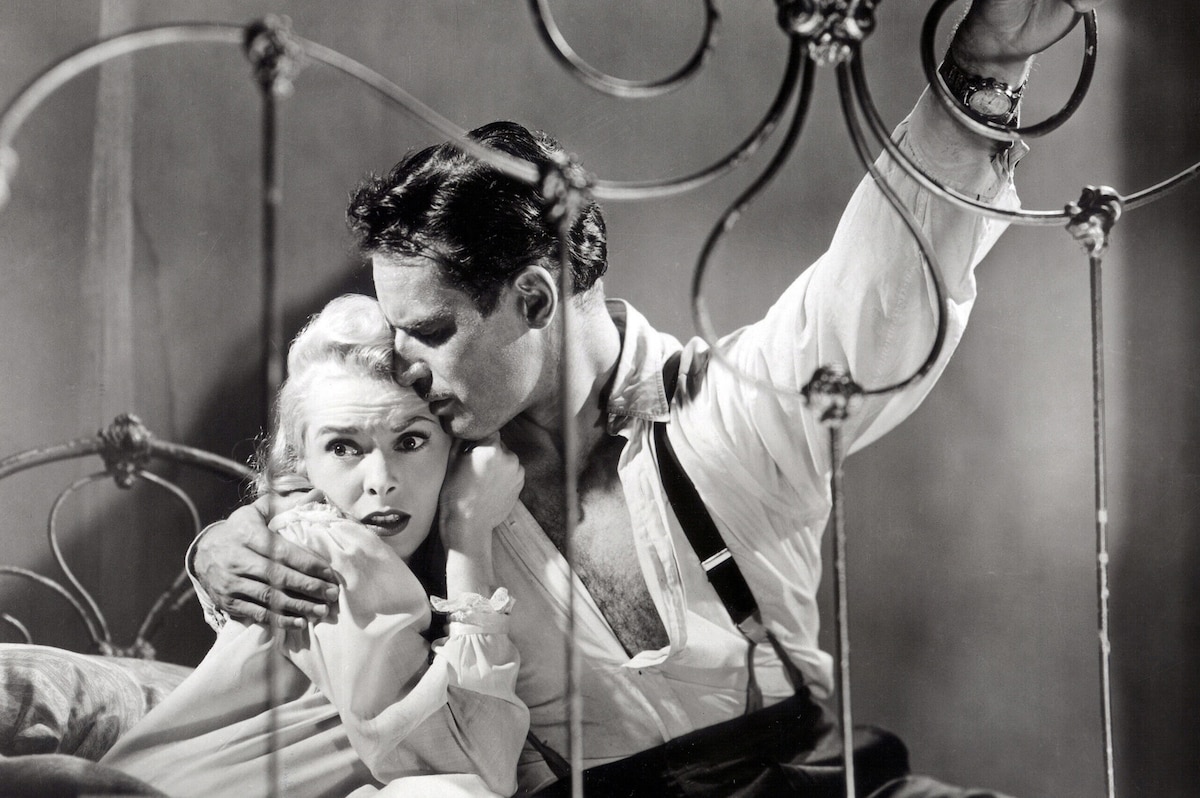
For the role of Vargas' wife, Welles wanted Janet Leigh. According to biographer Barbara Leaming (in Orson Welles, Viking Press), "Even before her agent had told her anything about Orson's offer, a puzzled Miss Leigh had received a telegram from the director to say how delighted he was that they would be working together. Correctly calculating that she would be as pleased by the idea of being directed by him as Charlton Heston was, Orson had figured that the telegram would get her at a lower price than if he had to negotiate with her agent first."
At first all was well on the set of Touch of Evil. Knowing there were studio spies on the set, Welles planned his first day of shooting to start with two uncomplicated
close-ups. He started work at 9 a.m. and had the first shot finished by
9:15. Then he got the second shot by 9:25. The studio spy was called off,
so nobody noticed that the next shot wasn't completed until 7:40 p.m.
Fortunately, that was a long take that covered 11 pages of script, so
Welles ended his first day of shooting two days ahead of schedule.
Welles further evaded studio control by shooting much of the picture on
location. He had originally asked to make the film in Tijuana, but the
executives had feared that was too far from Hollywood for them to call the
shots. Instead, he proposed shooting in Venice, California, for a few days.
Once he got there, however, he settled in for most of the remaining shoot. By then,
the executives were thrilled with each day's rushes, so they pretty much
left him alone.
Orson Welles encouraged Dennis Weaver to improvise his role as the strange hotel manager and together they created a unique character that ran counter to Weaver's role on the popular television series Gunsmoke. Welles later described the part as a "Shakespearean loony." According to Weaver in Barbara Leaming's bio of Welles, "We went into his whole background - about his mother and how he was a mamma's boy. He had this terrible guilt about sex and yet he had a large sex drive. There were no words to indicate such a thing in the script at all - but it gave him an interesting behavior pattern when we put it all together. The main thing was his attraction to women and his fear of them at the same time. That was the thing that was basic to his character."
Even though Orson Welles already weighed nearly 300 pounds, he made himself appear even fatter by wearing padding and using makeup that turned him into a greasy, corpulent specimen of corruption. Maurice Seiderman, the makeup artist who turned Orson Welles into a convincing old man in Citizen Kane (1941), created bags under Welles' eyes, changed his hairline, and added a false nose.
Akim Tamiroff, in the role of sleazy Uncle Joe Grandi, was required to stick the butt of a lamb's tongue into his mouth for his grotesque death scene. Orson Welles felt this was necessary to achieve the proper effect he wanted - that of a criminal who had been strangled so savagely that his tongue was unnaturally distended from his mouth. But as it turned out, the lamb's tongue proved to be too disgusting to show onscreen, so Tamiroff's unenviable ordeal was for nothing.
After finishing a first edit of Touch of Evil, Orson Welles went to South America to start another project. Welles returned to the States to find his film completely re-cut by the studio, who were concerned about the film's commercial viability. Welles submitted a 58-page memo suggesting changes that fell in line with his own vision of the final piece, but no one responded to it.
The biggest and most damaging change was the executives' design to run the
lengthy opening tracking shot under the film's credits. That also meant
playing Henry Mancini's main title theme over the sequence. Originally the
scene had been scored entirely with sound effects, with the theme only
appearing as a selection playing on the car radio. Even in this cut
version, Universal didn't know what to do with the film. They kept it out
of distribution for months, then finally snuck it into theatres in 1958 as
the bottom half of a double bill. They didn't even bother screening it for
critics. Welles' hopes of a Hollywood comeback were dashed.
by Scott McGee, Frank Miller and Jeff Stafford
Behind the Camera (11/23)
by Scott Mc | April 25, 2003
SIGN UP FOR OUR NEWSLETTERS

CONNECT WITH TCM