Early into Walt Disney's Mary Poppins (1964), an animatronic robin alights on
the forefinger of Julie Andrews' mystery governess as she sings to her pint-sized
charges the sprightly clean-up song "A Spoonful of Sugar." The song and the moment
serve a dual purpose to establish Mary's twin citizenship in both natural and
supernatural realms and to mark the narrative as a rite of passage, of learning.
Mary Poppins is not about Mary Poppins but rather Jane and Michael Banks, the
spirited progeny of a staid London bank executive, as they learn about the world of
make-believe that exists behind the curtain of dull reality. Another mechanical
bird, also a robin (but probably not the same one) turns up in the final frames of
David Lynch's Blue Velvet (1986). After two hours of murder, mutilation,
sexual intimidation, rape, scopophilia, drug use and sadomasochism, this
juxtaposition of harsh reality with a Disney-like simulacrum defies cozy
categorization. While the film's protagonists consider the vision miraculous, a
harbinger of love eternal and a testament to the inexplicable wonder and strange
beauty of the world, its patent fakeness leavens the optimism. Therein lies the
charm of Blue Velvet. On paper, the highly fetishized and deeply weird film
couldn't be more removed from the family friendly fare of Mary Poppins, yet
their narratives are alarmingly similar as they push their heroes towards an
appreciation that "there are opportunities in life for gaining knowledge and
experience."
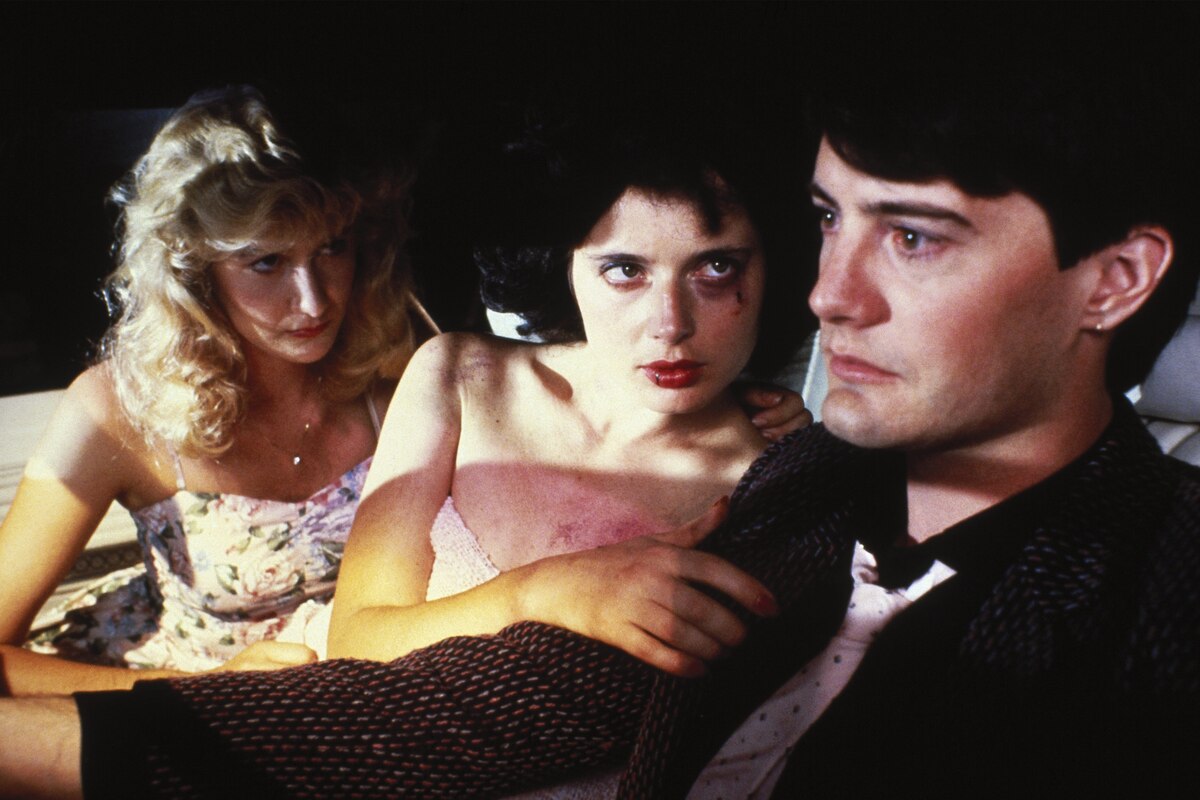
If Blue Velvet's answer to Michael and Jane Banks is its young adult
protagonists Jeffrey Beaumont (Kyle MacLachlan, the boy hero of Dune, Lynch's
1984 adaptation of the classic Frank Herbert novel) and Sandy Williams (Laura Dern),
then its Mary Poppins is the villain of the piece, Frank Booth. As played by Dennis
Hopper, Frank is, for all his profanity, brutality, nitrous oxide abuse and
predilection for cheap beer, a mentor to Jeffrey. It is Frank who takes Jeffrey and
Sandy through the figurative sidewalk chalk to the other side of dreamland. It is
Frank who (like Mary) propels the story both by commission (his various crimes,
among them homicide, rape and dope peddling) and omission (the dropping of clues for
Jeffrey to follow like bread crumbs). It is Frank who gets Jeffrey dirty (as Mary
Poppins and her confederate Bert the chimney sweep did for Michael and Jane) and in
so doing makes a man of him. One of many iconic moments from Blue Velvet
finds Jeffrey concealed inside a walk-in closet, peeking through the slats of the
louvered door, to witness Frank brutalizing Dorothy Vallens (Isabella Rossellini), a
nightclub singer whose husband and child he holds hostage. Apart from its folkloric
resonance, the image of Jeffrey spying on this primal scene recalls the voyeurism of
Norman Bates in Alfred Hitchcock's Psycho (1960). Kyle MacLachlan even bears
a passing resemblance to Anthony Perkins, while Blue Velvet suggests, with
its marriage of the saccharine and the sick, that madness is more than just a
sometimes thing.
Just as Psycho had polarized audiences and critics at the time of its release
so did Blue Velvet, which also has become a cult classic, if not an outright
American classic. Like so many other classics, the whole thing might just as easily
never have come together. Smarting from the box office failure of Dune,
producer Dino De Laurentiis pulled the plug on Blue Velvet's original January
1985 start date. Lynch had already begun casting when he was given the ultimatum to
cut the budget or see the project die on the stalk. Slashing his own salary and
getting his actors to work at just above union scale, Lynch cut thirty percent out
of the budget and got cameras rolling on Blue Velvet that summer. Recently
rehabilitated from decades of alcohol and substance abuse, Dennis Hopper was risky
casting as Frank Booth. Lynch had in fact wanted to use British actor Steven
Berkoff, at the time a familiar villainous face from such films as Beverly Hills
Cop (1984) and Rambo: First Blood Part II (1985). Lynch had also wanted
Helen Mirren for Dorothy Vallens and only met with Isabella Rossellini because she
had just worked with Mirren in White Nights (1985) and Lynch hoped the
ex-model would put in a good word for him. Val Kilmer also reportedly turned down
the chance to play Jeffrey in Blue Velvet. It's difficult to imagine Blue
Velvet being as memorable as it remains a quarter century after the fact if even
one of these casting decisions had come to fruition.
Blue Velvet was shot on location in and around Wilmington, North Carolina,
where the De Laurentiis Entertainment Group had been headquartered since the 1970s.
To keep costs down, standing locations were used as settings in the film. Arlene's
Restaurant, the small town diner where Jeffrey and Sandy discuss the abiding
mystery, was in reality the storefront office of New Hanover Human Resources. Both
the Wilmington Police Department and New Hanover High School contributed cameos,
more or less playing themselves, while Market Street's Carolina Apartments stood in
for Dorothy Vallens' creepy walk-up. Scenes involving Sandy's home were filmed at a
two-storey Tudor dwelling located at 128 Northern Boulevard in nearby Sunset Park,
North Carolina. Shooting there displaced the Spencer family for forty-six days and
concluded with the scene in which a nude and gibbering Dorothy Vallens stumbles out
of the shadows into Jeffrey's arms to the mutual horror of several witnesses.
Interviewed after the completion of principal photography, the Spencer family
matriarch stated that she didn't regret their decision to allow filming in their
home but that they wouldn't do it again "unless the filmmaker were Disney."
Producers: Fred Caruso, Richard Roth
Director: David Lynch
Screenplay: David Lynch
Cinematography: Frederick Elmes
Production Design: Patricia Norris
Music: Angelo Badalamenti
Film Editing: Duwayne Dunham
Cast: Isabella Rossellini (Dorothy Vallens), Kyle Maclachlan (Jeffrey Beaumont),
Dennis Hopper (Frank Booth), Laura Dern (Sandy Williams), Hope Lange (Mrs.
Williams), Dean Stockwell (Ben), George Dickerson (Detective Williams), Priscilla
Pointer (Mrs. Beaumont).
C-120m.
by Richard Harland Smith
Sources:
Lynch on Lynch, Chris Rodley (editor)
David Lynch by Kenneth C. Kaheta
The Impossible David Lynch by Todd McGowan
"That Damnable Robotic Robin," by Marty Garner, Wrapped in Plastic, Vol. 1,
No. 27, 1997
The Worldwide Guide to Movie Locations, http://www.movie-locations.com
The Gist (Blue Velvet) - THE GIST
by Richard Harland Smith | September 02, 2009
SIGN UP FOR OUR NEWSLETTERS

CONNECT WITH TCM