Madison Avenue satires were nothing new in 1969. Will Success Spoil Rock Hunter? (1957) and Lover Come Back (1961) had made comic four course meals out of side dish material in films only peripherally concerned with the advertising business, from Mr. Blandings Builds His Dream House (1948) to North by Northwest (1959). The popular sitcom Bewitched (which debuted in 1964) was set in part in a swank Manhattan public relations firm while radio satirist Stan Freberg milked merriment from the ad game with a loose-knit collection of gags pressed onto the 1965 album The Madison Avenue Werewolf. Based on the 1951 novel The Build Up Boys by Jeremy Kirk, Twentieth Century Fox's Madison Avenue (1962) was an odd drama (which the studio shelved for two years before releasing) starring Dana Andrews as an ad man trying to start his own firm while learning a valuable life lesson about the back end cost of manipulation. As the contemporary hit TV series Mad Men endeavors to illustrate, the ad man became the archetypal American male post-Camelot, possessing the sartorial sensibilities of James Bond and the alchemist's gift for transforming lead into gold. By 1969, however, the association of marketing with la dolce vita began to tarnish. Public awareness of public relations informed in part by Marshall McLuhan's 1964 book Understanding Media led to disenchantment with the half and quarter truths of Madison Avenue, leaving the industry vulnerable to criticism and ridicule.
A bawdy, irreverent lampoon of the excesses of advertising, Putney Swope (1969) was the brainchild of Robert Downey. Born in Tennessee in 1937 as Robert Elias and the son of model turned magazine editor Betty McLoughlin, Downey lied about his age to enlist in the Army (where he adopted his stepfather's surname, which he retained). While there he excelled as a Golden Gloves boxer. Back in civilian life, Downey wrote plays, acted and waited tables at such celebrated Manhattan cabarets as Billy Reed's The Little Club on East 55th Street and Julius Monk's The Upstairs at the Downstairs on West 56th Street. Downey began directing his own 8mm films as early as 1961. His short subjects won him praise and put him in the company of such experimental filmmakers as Robert Frank, Stan Brakhage and Ron Rice, whose works were exhibited at Charles Theatre on the Lower East Side. Downey had been encouraged in this regard by the Village Voice writings of Jonas Meekas, who had averred famously that "anybody could make a movie." Composed entirely of still frames, his first feature, Chafed Elbows (1966), won him a job at a Manhattan production company servicing Madison Avenue ad agencies. By the end of the decade, Downey was ready to try his hand at something slightly more commercial and the result was Putney Swope. A freewheeling, bawdy and often mercilessly spot-on satire of the madness of Madison Avenue, the film might have gone entirely unseen were it not for the eleventh hour sponsorship of Don Rugoff, the eccentric art house cinema impresario who demanded exclusivity for the films he exhibited but rewarded filmmakers with extended runs. Turned down by the majors for distribution, Putney Swope became a hit in Rugoff's hands, returning stellar box office, repeat business and plaudits from a high enough percentage of the nation's critics to make all the difference.
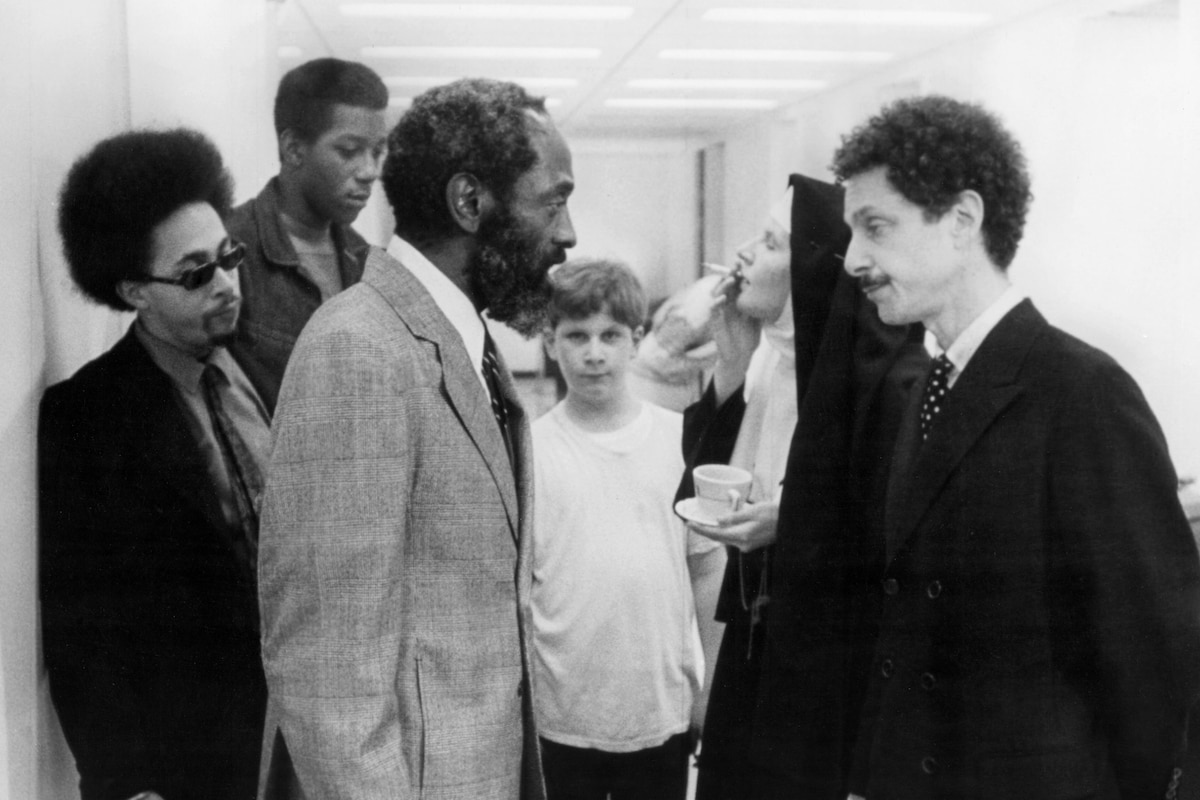
Putney Swope's confabulation of the backstabbing world of advertising with dissention within the ranks of the rising Black Power movement imbues it with a nervous crackle that it retains to this day. What makes the film remarkable forty years on is Downey's disinclination to turn in a recognizable Hollywood feature. Putney Swope served as an apt curtain warmer for the "New Hollywood" of the 1970s. Its laid back, anything for a joke vibe might well have inspired Robert Altman's M*A*S*H (1970), whose poster (a human hand forming the peace symbol) seems inspired by Putney Swope's use of a curled fist raising an arrogant middle finger that has been replaced by a seductive black woman. Shooting guerilla style, with and without permits, Downey's film seems both a product of its time and remarkably fresh and alive (when Downey filmed the boardroom scenes, half of his cast hid under the conference table, awaiting their cues).
The mock commercial spots (the only portion of the film in color) reflect a glib, snarky school of satire that endures on such programs as Saturday Night Live and Mad TV. Among Downey's extended cast are such familiar faces as Antonio Fargas (whose scene in the stall of a men's room may be a cinema first), Allen Garfield (between gigs for Brian De Palma), Shelley Plimpton (who moved on to higher profile roles in Arthur Penn's Alice's Restaurant [1969] and Jim McBride's Glen and Randa [1971]), Allan Arbus (estranged husband of fashion and freak photographer Diane Arbus) and Polish actress Elzbieta Czyzewska, at the time married to journalist David Halberstam and persona non grata in her own country.
Robert Downey continued to follow his bliss through the next two decades, working at his own pace and saying no to offers to direct films more often than yes. (Downey directed second unit on Norman Lear's Cold Turkey [1971] but turned down a chance to take over Mother, Jugs and Speed [1976], a job that was passed to Peter Yates.) Based on his own Off-Off Broadway play, Pound (1970) reteamed many of the actors from Putney Swope in a parable set in a dog shelter. (Paramount bid for distribution rights believing the film would be animated; when Downey turned in his cut, the baffled studio dumped the feature into art house play dates with Fellini's Satyricon [1969].) Greaser's Palace (1972) was an independently financed Christ parable in a spaghetti western setting and Up the Academy (1980) a regrettable Animal House (1978) cash-in that Warner Brothers tried to retrofit in postproduction as a Mad magazine style (which the studio owned) satire. Downey tried unsuccessfully to have his name removed from the credits of America (aka Moonbeam, shot in 1982 but unreleased until 1986) and he has since alternated directing films (Too Much Sun in 1990, Hugo Pool in 1997) with playing small parts in such films as William Friedkin's To Live and Die in LA (1985) and Paul Thomas Anderson's Magnolia (1999). His own accomplishments notwithstanding, Downey is most widely known as the father of film actor Robert Downey, Jr., who made his debut in Pound and is currently the star of such popular box office hits as Ironman and Jungle Heat (both 2008).
Producers: Robert Downey, Henri Pachard
Director: Robert Downey
Writer: Robert Downey
Cinematographer: Gerald Cotts
Editor: Bud S. Smith
Music: Charley Cuva
Art Director: Gary Weist
Cast: Arnold Johnson (Putney Swope), Laura Greene (Mrs. Swope), Stan Gottlieb (Nathan), Allen Garfield (Elias, Jr.), Tom Odachi (Wing Soney), Antonio Fargas (The Arab), Elzbieta Czyzewska (Putney's maid), Allan Arbus (Mr. Bad News), Peter Maloney (Putney's Chauffeur), Ramon Gordon (Bissinger), Shelley Plimpton (Face-Off Girl), Eric Krupnik (Mark Focus), Robert Downey (Voice of Putney).
BW/C-84m.
by Richard Harland Smith
The Gist (Putney Swope) - THE GIST
by Richard Harland Smith | September 02, 2009
SIGN UP FOR OUR NEWSLETTERS

CONNECT WITH TCM