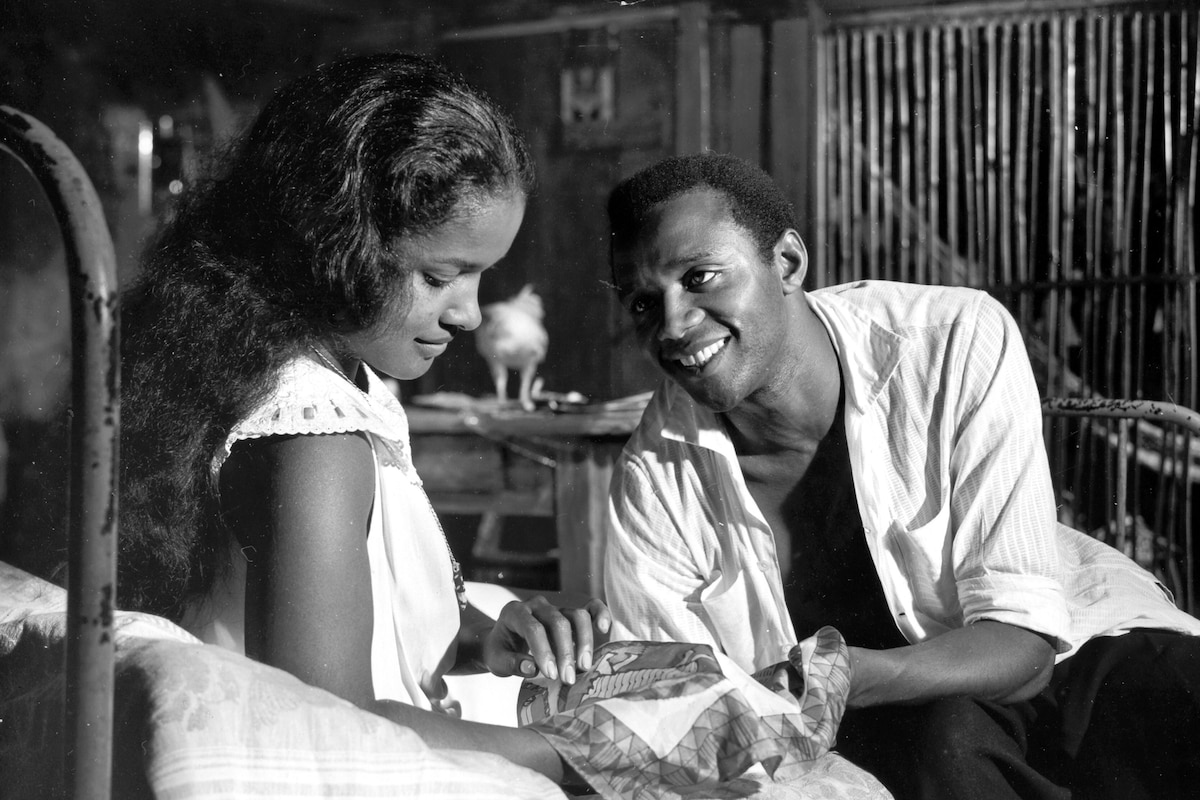
Made in Brazil by a French director, Black Orpheus (1959) burst onto the international scene in a vivid, percussive swirl of music and color, winning the Oscar® for Best Foreign Film and the Palme d'Or at Cannes. The film sets the Orpheus myth in the favelas (slums) of Rio de Janeiro during Carnaval. Orpheus is a streetcar conductor who makes such beautiful music that it's said he makes the sun rise. Eurydice is a country girl who has fled to Rio because a man is stalking her and threatening her life. That man, of course, is Death, and after Orpheus and Eurydice fall in love, they must keep their appointment with Death, with Orpheus descending into the Underworld to attempt to rescue Eurydice.
The Orpheus myth has been the basis for several 20th century plays and films, most notably Jean Cocteau's 1950 film Orphée, Tennessee Williams's play Orpheus Descending (1957), and the film version of that play, The Fugitive Kind (1960). Black Orpheus was loosely based on the 1956 musical play Orfeu da Conceição by Brazilian poet, playwright and lyricist Vinicius de Moraes. The music for the play was written by an up-and-coming composer, Antonio Carlos Jobim. Over the next few years, Moraes and Jobim worked as a songwriting team, and one of their earliest compositions is "Chega de Saudade," which is generally considered to be the seminal bossa nova song.
Black Orpheus was a French-Italian-Brazilian co-production. Although it was based on Moraes's play, French producer Sacha Gordine wanted an entirely new score so he wouldn't have to pay royalties to Brazilian music publishers. He asked Moraes and Jobim to compose new songs, and they came up with three, in that distinctive mix of samba rhythms mixed with a softer, jazzier style that the duo had pioneered, and that would come to be known as bossa nova. Gordine decided he needed additional songs, and guitarist Luiz Bonfá, who had worked with Moraes and Jobim, contributed two more. Gordine published the songs himself, and was able to claim royalties, making more money on them than the composers did.
Neither of the two leads were experienced actors. Breno Mello was a football player, and Marpessa Dawn was an American singer and dancer. She was born Gypsy Marpessa Dawn Menor in Pittsburgh, and moved to Europe as a teenager, where she met and married Camus (they later divorced). Because of her American accent, her vocals and non-singer Mello's were dubbed by Brazilian singers Elizeth Cardoso and Agostinho dos Santos. Dawn and Mello died within weeks of each other in 2008. Neither ever again achieved the kind of success they enjoyed in Black Orpheus.
Neither did French director Marcel Camus, who had previously directed only one feature film. With the help of veteran cinematographer Jean Bourgoin, who had worked with Jean Renoir, Orson Welles, and Jacques Tati, Camus gave the film a stylized realism, mixing in footage they filmed at the 1957 Carnaval parade in Rio with Bourgoin's smoothly elegant cinematography. They also staged a smaller event using thousands of locals as extras. At first, Brazilians were excited about the film and eager to cooperate. But once the film was released, many critics and intellectuals felt it exoticized their country and portrayed a falsely utopian view of life in the favelas. Some compared Black Orpheus's popularity to that of Carmen Miranda in the 1940s. The so-called "Brazilian Bombshell" seen in movies of the era was a parody, a cartoon character with her fruit-salad headdress and mangling of English. Yet there was real talent there, and real affection for her by audiences. Similarly, those who disliked Black Orpheus appreciated its success abroad, and liked the music and visual innovation, but decried how it represented Brazil to the world.
Brazilian singer and composer Caetano Veloso, who in the late 1960s would be one of the founders of Tropicalia-- a music and arts movement which fused Brazilian, African and rock influences -- was a teenager when the film opened. In his book, Tropical Truth, he recalls that "I laughed along with the entire audience and together we were shamed by the shameless lack of authenticity the French filmmaker had permitted himself for the sake of creating a fascinating piece of exoticism." He claims that de Moraes "hated the film so much that he left the theater halfway through the screening, shouting that his Orpheus had been 'disfigured.'" But Veloso admits that the film has had a powerful appeal to non-Brazilians around the world. "The film seemed (to people of the most widely diverse cultural backgrounds) not only a moving modern and popular version of the Greek myth, but also the revelation of the paradisiacal country in which it was staged," he wrote. "Even today there is no end of narratives about foreigners (rock singers, first-rate novelists, French sociologists, budding actresses) discovering Brazil, all touched by Marcel Camus's unforgettable film."
In 1999, director Carlos Diegues, one of the leaders of Brazil's Cinema Novo movement which focused on Brazilian themes and forms of expression, made his own version of the Orpheus legend, Orfeu, set in contemporary Rio. Caetano Veloso was the film's musical director. Diegues told the New York Times, "Black Orpheus is not an exploitative film. You can see that it was made with real affection and enthusiasm. Camus fell in love with Rio and its culture, but he made a superficial film about something he didn't really understand." Diegues's Orfeu reflected the reality of end-of-the century Rio favelas, with drug lords and guns and hip-hop mixed in with the samba and the tragic love story. It was a bigger hit in Brazil than Black Orpheus ever was. But for film lovers around the world, the beauty, the music, and the universal and mythic qualities of Black Orpheus remain indelible half a century after it was made.
Director: Marcel Camus
Producer: Sacha Gordine
Screenplay: Jacques Viot, Marcel Camus, based on the play Orfeu da Conceição by Vinicius de Moraes
Cinematography: Jean Bourgoin
Editor: Andree Feix
Music: Antonio Carlos Jobim, Luiz Bonfá
Cast: Breno Mello (Orfeo), Marpessa Dawn (Eurydice), Lourdes de Oliveira (Mira), Lea Garcia (Serafina), Ademar Da Silva (Death), Alexandro Constantino (Hermes), Waldemar De Souza (Chico), Jorge Dos Santos (Benedito), Aurino Cassiano (Zeca).
C-106m.
by Margarita Landazuri
Black Orpheus
by Margarita Landazuri | August 19, 2009
SIGN UP FOR OUR NEWSLETTERS

CONNECT WITH TCM