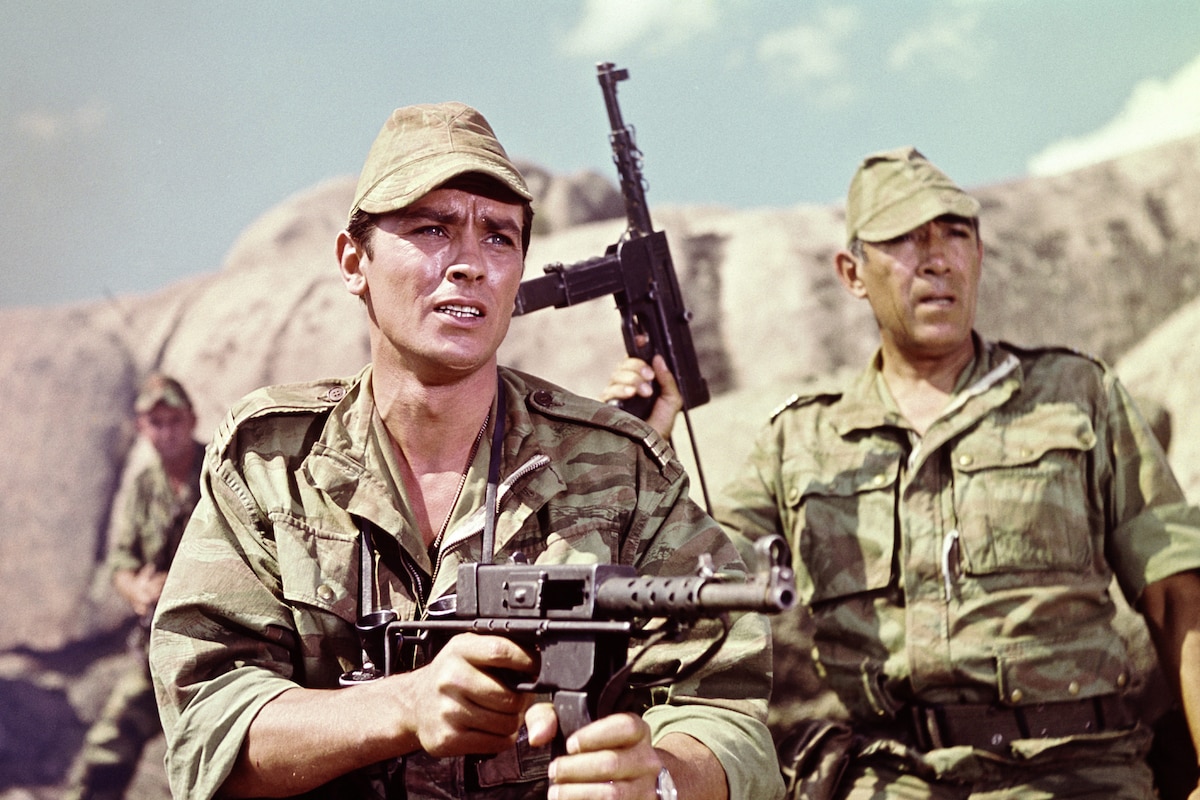
Lost Command (1966) is typical of a number of multinational action movies made in the first half of the 60s, in which Latinos play Frenchmen, American and Italian actors play Algerians, and European locations substitute for North Africa and Southeast Asia. What sets The Lost Command apart from similar war dramas is territory rarely covered on the screen - the efforts of the French government to quell rebellion and hang on to its colonies in Indochina and Algeria. Released when America's involvement in Viet Nam was notably increasing, it may provide some insight into the historical background of the conflict and what the U.S. inherited from France, but as with a majority of action pictures, particularly those produced by Hollywood, it tends to move history into the background in favor of a more personal drama in which the conflicts are more internal than societal. Nevertheless, the story, based on an acclaimed French novel, was praised by experts for hewing fairly closely to historical and military facts, even if it was not a huge success with general audiences.
Mexican-born Anthony Quinn plays a French army officer whose battalion is captured and defeated by Vietnamese rebel forces because reinforcements fail to arrive in time. Heading for forced retirement after a treaty is signed between France and its former colony, he fights for one last chance to redeem himself. He's given that opportunity leading a band of roughneck forces in the Algerian War. The plot pits the determined, often brutal French military against a political establishment that urges them on even as they tie their hands.
Lost Command depicts violent acts of reprisal against civilians by French soldiers after the killing of their own troops by rebels. It also opens up an argument between fellow officer Alain Delon as a moral center against Quinn's more "pragmatic" commander over the use of torture (not directly shown on screen). It never quite comes to grips with the issue, painting torture as something of a necessary evil while hedging bets with the Delon character's distaste for his countrymen's actions. This is in marked contrast to another film released around the same time, The Battle of Algiers (1966), that took a documentary approach to the Algerian conflict, graphically depicting torture and military brutality, for which it was banned in France upon its initial release and rarely seen elsewhere in Europe.
As stated above, ethnicities were often wildly mixed in these multinational productions, but Lost Command surely has one of the strangest bits of such casting with Jewish-American actor George Segal playing an Arab-born officer who leaves the French Army after its defeat in Indochina to fight for his people against Quinn and his forces in North Africa. Italian actress Claudia Cardinale plays his beautiful sister Aicha, who helps smuggle bombs and guns in and out of the Casbah. At least she is explained as an effective infiltration agent because of her ability to look "European."
This was the third time Delon and Cardinale appeared together on film, having been paired previously in Rocco and His Brothers (1960) and The Leopard (1963), both directed by Luchino Visconti.
The film was produced and directed by Mark Robson, whose widely varied career began in the legendary RKO horror unit headed by Val Lewton in the 1940s. After editing some of the finest of that unit's productions, including Cat People (1942) and I Walked with a Zombie (1943) not to mention uncredited work on The Magnificent Ambersons (1942) Robson made an impressive debut under Lewton's command with The Seventh Victim (1943), a story of Satanism set in New York's Greenwich Village. He got his earliest widespread acclaim, including his first of four Directors Guild nominations, for the hard-hitting boxing drama Champion (1949). From there his career meandered through a number of action films, the occasional comedy, and blockbuster melodramas such as Peyton Place (1957), his first Academy Award nomination, and Valley of the Dolls (1967). Robson died of a heart attack at the age of 64 during post-production of his final film, Avalanche Express (1979).
The Lost Command was shot on location in Spain by award-winning cinematographer Robert Surtees (Ben-Hur [1959], The Graduate, [1967], The Last Picture Show, [1971]). Its original title, taken directly from the 1960 novel on which it was based, was "The Centurions." During production the working title was "Not for Honor and Glory."
Director: Mark Robson
Producer: Mark Robson
Screenplay: Nelson Gidding, based on the novel The Centurions by Jean Larteguy
Cinematography: Robert Surtees
Editing: Dorothy Spencer
Art Direction: John Stoll
Original Music: Franz Waxman
Cast: Anthony Quinn (Lt. Col. Pierre Raspeguy), Alain Delon (Capt. Phillipe Esclavier), George Segal (Mahidi), Michele Morgan (Countess de Clairefons), Claudia Cardinale (Aicha).
C-129m. Letterboxed.
by Rob Nixon
Lost Command
by Rob Nixon | August 18, 2009
SIGN UP FOR OUR NEWSLETTERS

CONNECT WITH TCM