When Dorothy Lamour learned in 1941 that she'd been cast in The Fleet's In
(1942), she was thrilled. As a child, she had loved the original 1928 Clara Bow
version so much that she'd been suspended from school after skipping class to see
it. Now that she was to star in a remake, she figured she had a good excuse to watch
it again - and again and again! She lied to Paramount that she'd never seen the
original, and, she later wrote, "for one solid week I told them to screen it for me
whenever I had a free moment. Over and over I made them run that one courtroom
scene where Clara wears a black satin dress with a feather boa and chews gum like
mad. The story was changed somewhat in the remake, but I made up my mind that was
how I'd do it, too."
The Fleet's In is not, in fact, merely a remake of the 1928 film. It's based
equally on a 1933 play entitled Sailor, Beware!, which itself had already
been made into a 1936 film, Lady Be Careful, and would be adapted again in
1952 as the Jerry Lewis/Dean Martin vehicle Sailor Beware.
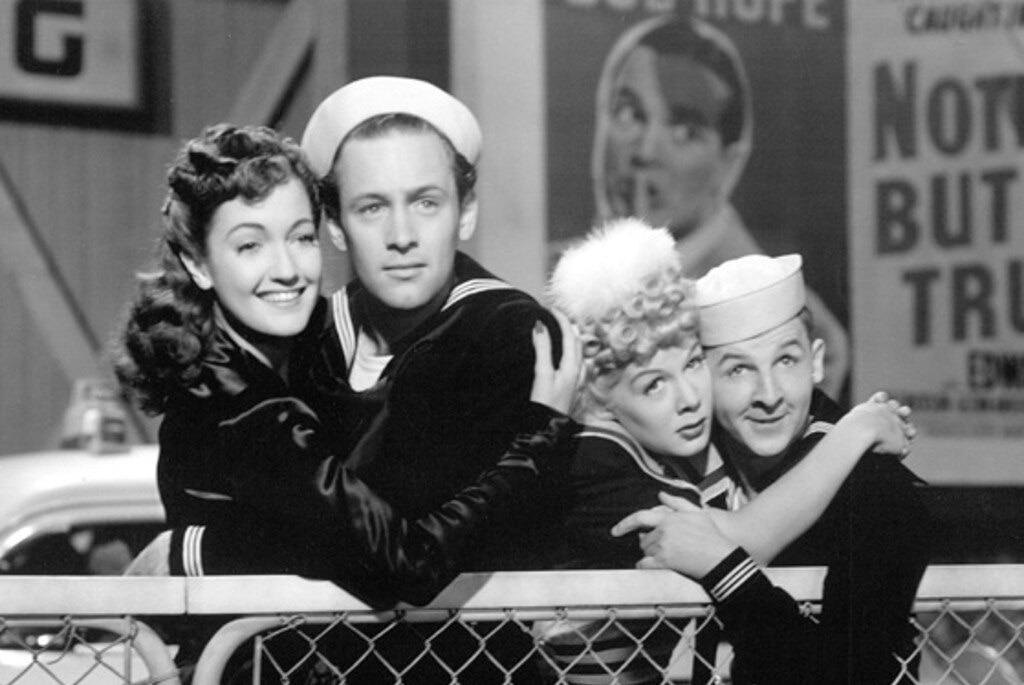
This 1942 version stands as a tuneful, silly-yet-wonderful piece of wartime
escapism. It was shot in September and October 1941 and opened in theaters in March
1942, a different world for Americans. Now that the country was at war, a rousing
and energetic film with sailor characters seemed made to order. Equally appealing
was a fun cast including William Holden, Dorothy Lamour, Eddie Bracken and Betty
Hutton as well as the Jimmy Dorsey big band and a bunch of swell new Johnny Mercer
songs including the soon-to-be standard "Tangerine."
"I don't know why I called it 'Tangerine,'" Mercer said years later, "except that it
had a kind of Latin flavor, the melody." That melody had been composed by Victor
Schertzinger, who collaborated with Mercer on all the film's songs and also directed
the movie itself. Mercer had never worked with Schertzinger before but enjoyed the
collaboration. "He gave you a tune on a lead sheet, and whatever you brought in
pleased him," Mercer recalled. "As they say, a doll to work with."
The Fleet's In did a lot for Mercer's career. His songs were so successful
that they caused his ASCAP ranking to be raised from A to AA - meaning that Mercer
would now receive royalties at the same level as top songwriters like Cole Porter
and Irving Berlin.
Certainly another song that helped him achieve this is "Arthur Murray Taught Me
Dancing in a Hurry," in which one verse goes: Arthur Murray then advised me not
to worry/I'd come out all right/To my way of thinkin'/It came out stinkin'/I don't
know my left foot from my right. (In a PR move when The Fleet's In came
out, the real Arthur Murray offered Mercer and his wife free dance lessons.) The
song was performed by 21-year-old Betty Hutton, making her feature film debut, and
it helped make her a star. "That was a big hit song," Hutton later said. "Johnny
Mercer, who's the greatest songwriter of all time, wrote the score. But I don't
think that alone did it. The role was funny."
One critic of the time wrote of Hutton: "Her facial grimaces, body twists and
man-pummeling gymnastics take wonderfully to the screen." But Hutton's physical
wildness made it very difficult for her to hit her marks. As she later said: "I
don't know from walking in and looking down and all that jazz. They said to me,
'This is a long shot. Take it easy on the medium shots a little more. Close up,
really go.' I don't know from that jazz. Every time I came out I was 'on.' I wanted
to be great."
Director Victor Schertzinger complained to producer Buddy DeSylva that he couldn't
hold Hutton in the frame. "I didn't hire her to stay on the spot," DeSylva replied.
"I hired her because she is wild." The problem was solved when DeSylva set up three
cameras to film Hutton in one take. As he said: "I only want one take from her
because she gives it her all and she will not repeat it... I want the instant
reaction she feels." Buddy DeSylva, incidentally, was a producer and songwriter who
was extremely influential in guiding Hutton's career at Paramount. He was very
protective of her on The Fleet's In when problems arose - so much so that
rumors grew that they were having an affair.
Dorothy Lamour later wrote charmingly about William Holden on this picture: "I was
very pleased that Bill Holden was assigned to be my leading man. Bill is not only
charming, talented and handsome, but also has a great sense of humor. Nobody knew
how much he was going to need it; at the beginning everything went so well that none
of us could have imagined all the troubles that were to follow.
"Bill used to make up his own lyrics to the picture's title song. As written, the
lyrics went like this: Hey, rookie, you'd better hide your cookie, 'cause the
fleet's in. Various Holden versions included Hey, mister, you'd better hide
your sister, or Hey, brother, you'd better hide your mother, or Hey,
rookie, you'd better hide your nookie - and those were just the printable
ones."
Since he'd recently had an appendectomy, Holden had been advised by his doctor not
to strain himself. For one early scene, he had to carry Lamour up a long flight of
stairs. Holden later recalled, "I picked her up and climbed up seven steps before I
felt the strain. Without thinking, I asked, 'How the hell much do you weigh?'"
"Cut!" yelled director Schertzinger. "You are aware, Mr. Holden, that we recorded
that?" In the end the scene was shot in little pieces, with doubles used for the
long shots.
The New York Times said of The Fleet's In: "[It] will not cause any
riots. Shore patrols need not be doubled in Times Square." But the review also
declared the picture to be "a lively farce...full of pep. The late Victor
Schertzinger was a master at musical comedy patch-work, and all he needed was the
bare frame of a story in which to toss together a flashy crazy quilt."
Sadly, Schertzinger died in his sleep during production. "It was a shock because he
hadn't even been ill," Lamour recalled. Assistant director Hal Walker took over and
finished the film. The first shot on the first day after Schertzinger died was of
Lamour lip-synching to a pre-recorded song, "I Remember You." It was, Lamour wrote,
"pretty heavy stuff to sing after you've lost a friend, but I really thought I could
do it... After I finished the first shot, Hal Walker yelled 'Cut,' but the tape kept
on running. Then over the sound system came Victor's voice, 'That was wonderful,
Dorothy. You're just beautiful.' That was his comment when I had pre-recorded the
song. The shock waves could be felt around the set. My eyes filled with tears, and I
ran to my dressing room. Hal was furious with the sound man, but he honestly hadn't
known that Schertzinger's voice was on the track." When Lamour did the next take,
the same thing happened, and they finished the number in bits and pieces so that the
track wouldn't run to the end. Later, Lamour decided that "perhaps Victor
wanted to reassure me. It was fate that his voice came back from the grave
twice that day. We threw ourselves into making a picture that we hoped would have
made him proud, and I think we succeeded."
Director: Victor Schertzinger
Screenplay: Walter DeLeon, Sid Silvers, Ralph Spence; Kenyon Nicholson, Charles
Robinson (play); Monte Brice, J. Walter Ruben (short story)
Cinematography: William C. Mellor
Art Direction: Hans Dreier, Ernst Fegte
Music: Leo Shuken, Victor Young (both uncredited)
Film Editing: Paul Weatherwax
Cast: Dorothy Lamour (The Countess), William Holden (Casey Kirby), Eddie Bracken
(Barney Waters), Betty Hutton (Bessie Day), Cass Daley (Cissie), Gil Lamb (Spike),
Leif Erickson (Jake), Jimmy Dorsey (Himself, Jimmy Dorsey Orchestra Leader), Bob
Eberly (Himself, Dorsey Band Vocalist), Helen O'Connell (Herself - Dorsey Band
Vocalist)
BW-93m.
by Jeremy Arnold
Sources:
Gene Arceri, Rocking Horse: A Personal Biography of Betty Hutton
Philip Furia, Skylark: The Life and Times of Johnny Mercer
Dorothy Lamour, My Side of the Road
The Fleet's In
by Jeremy Arnold | August 17, 2009
SIGN UP FOR OUR NEWSLETTERS

CONNECT WITH TCM