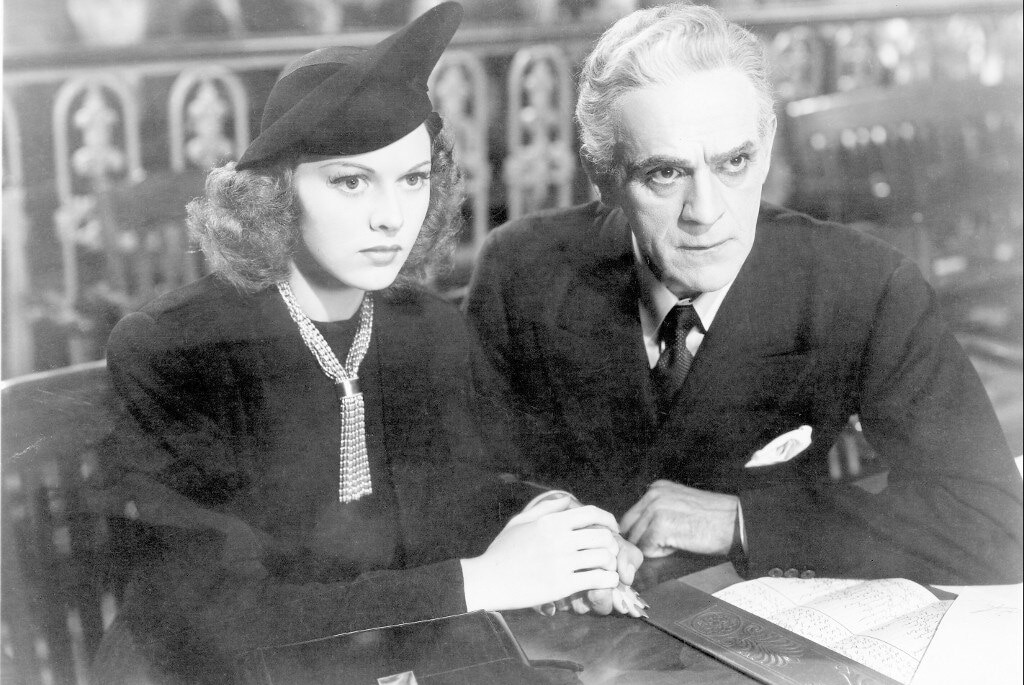
The Man They Could Not Hang (1939) is the first and perhaps the best in a series of four "mad scientist" films that Columbia produced within an eighteen month period. It is a surprisingly prophetic film as well, cloaked unassumingly in the guise of a B-movie horror film. Starring Boris Karloff in what would provide the kick-off to his career as a misunderstood scientist, the film offers some surprising elements for its day and genre.
Karloff plays Dr. Henryk Savaard, who is preparing to resuscitate a student volunteer from an experiment in suspended animation, when his nurse, the volunteer's girlfriend, loses her nerve and runs for the police. Once the authorities arrive, they refuse to let the doctor bring the man back to life. Instead, he is taken to prison, tried and sentenced to death by hanging. Savaard has arranged for his trusty assistant to take custody of his body post mortem for an "interesting experiment", which the authorities don't seem to find peculiar. As the film's title implies, Dr. Savaard returns, though in a much darker mood than the one in which he departed.
The storyline of The Man They Could Not Hang was inspired by the real-life experiments, several years prior, of a biochemist named Robert Cornish, who brought dogs back to life after giving them nitrogen gas. An unfortunate side effect of the process he used, however, is that the dog wasn't quite the same after being revived. With echoes of Pet Sematary (1989) which proved that 'sometimes dead is better', Cornish's dog, Lazarus IV, was put to death a final time after having trouble walking, eating and remembering his earlier training. Similarly, Dr. Savaard isn't the same person he was prior to death. Minus his higher humanitarian goals, he is now bent on retribution and gathers the jurors and others responsible for his conviction to his house for a gruesome finish.
During the '30s, between the experiments of Cornish and the glass heart developed by aviator Charles Lindbergh and French surgeon Alexis Carrel, public interest was high in the possibilities of reanimation, pacemakers and other electrical devices to affect heart rhythm. Hollywood followed suit, and in addition to Frankenstein (1931), a number of films focused on the downside of experiments with life and death which were better left to divine powers. Yet The Man They Could Not Hang is surprising in that it also contains an indictment of small-mindedness for those who scoffed at and feared the doctor's scientific advances, delivered in a well-written address to the jury, given by Savaard.
In a rare-for-its-time presentation of healthy agnosticism, Savaard converses with a minister just before his hanging: "Is it strange that I should have no fear of dying? Well, I've lived for so long questioning the unknown that this plunge into its depths is only the last and, perhaps, the greatest of my experiments." The minister asks, "Have you no faith?" Savaard replies, "As a scientist, I'm afraid I'm a professional skeptic who doubts everything, even the certainties." In 1939, the Production Code included three provisions regarding reverence for religion; characters espousing uncertainty about the hereafter were not frequent-especially those as articulate as Dr. Savaard.
With the series of Karloff laboratory films, Columbia hit on a successful formula and stuck with it, much to Karloff's chagrin. In the book Boris Karloff, by Scott Allen Nollen, the actor remembers: "The scriptwriters had the insane scientist transplant brains, hearts, lungs and other vital organs. The cycle ended when they ran out of parts of anatomy that could be photographed decently."
Producer: Wallace MacDonald
Director: Nick Grinde
Screenplay: Karl Brown; George Wallace Sayre (story); Leslie T. White (story)
Cinematography: Benjamin H. Kline
Film Editing: William A. Lyon
Cast: Boris Karloff (Dr. Henryk Savaard), Lorna Gray (Janet Savaard), Robert Wilcox (Scoop Foley), Roger Pryor (Dist. Atty. Drake), Don Beddoe (Police Lt. Shane), Ann Doran (Betty Crawford), Joe De Stefani (Dr. Stoddard), Charles Trowbridge (Judge Bowman), Byron Foulger (Lang), Dick Curtis (Clifford Kearney), James Craig (Watkins), John Tyrrell (Sutton)
BW-65m.
by Emily Soares
The Man They Could Not Hang
by Emily Soares | August 13, 2009
SIGN UP FOR OUR NEWSLETTERS

CONNECT WITH TCM