Dr. Socrates
ARMED WITH A DOCTOR'S KIT, HE FACED 1000 KILLERS!
Tag line for Dr. Socrates
Armed with formidable acting skills and a dogged determination to better his career, Paul Muni faced a project he didn't really want to make. It's not that the 1935 crime drama Dr. Socrates was an inferior film. It's just that the actor was ready to move his career in a new direction, and Warner Bros. wouldn't even consider it until he made the film they wanted.
Their thinking wasn't that far off the mark commercially. The story of a small town doctor forced to treat a gangster and his mob had come from W.R. Burnett, whose writing had helped launch the gangster cycle of the early '30s with Little Caesar (1931) and Scarface (1932). The latter had been an early triumph for Muni, but by the mid-'30s, he was ready to move on to new things. In particular, he was fired up about filming a biography of medical pioneer Louis Pasteur. Yet he couldn't get studio executives to approve the project. Hal Wallis only agreed to let Pierre Collings and Sheridan Gibney work on a screenplay for the Pasteur film if Muni would make Dr. Socrates first. And even then, Wallis warned the writers, "I don't think we'll ever do it. Jack Warner is dead set against it."
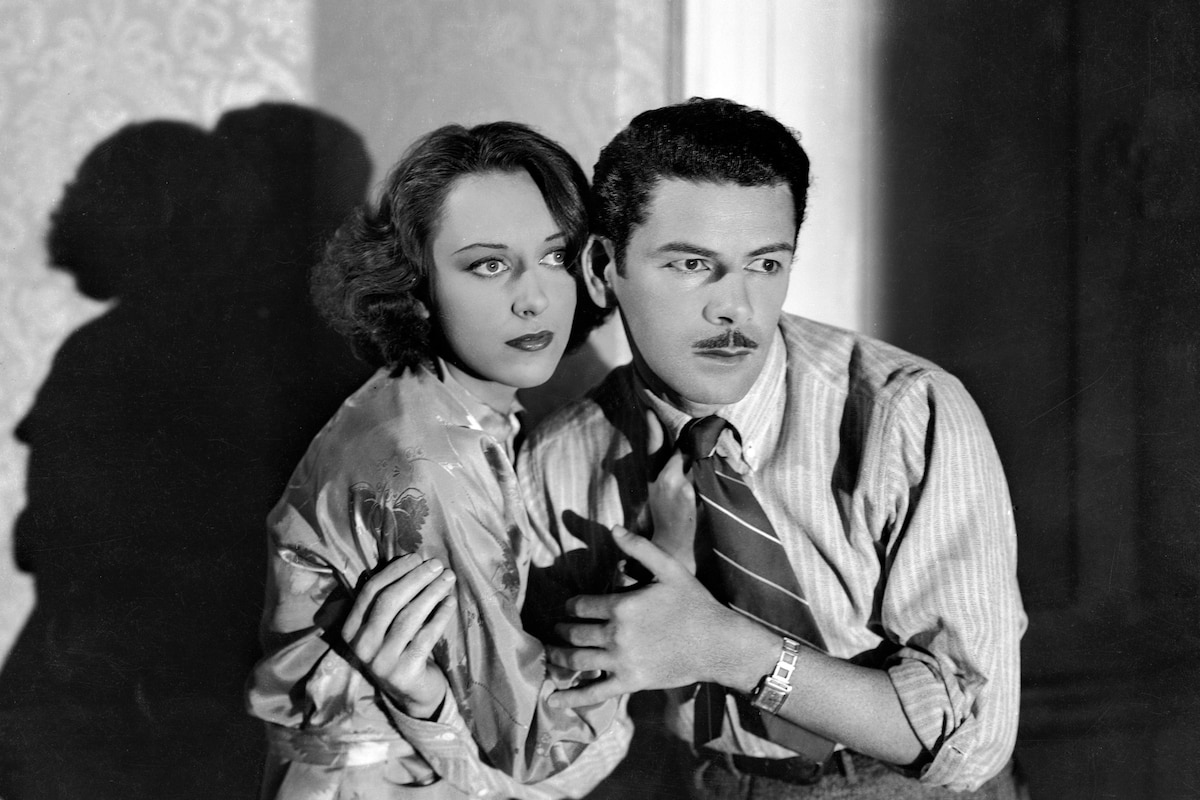
Muni could at least console himself with the chance to act opposite Ann Dvorak, who had played his sister in Scarface, and a script that had some snappy dialogue. Burnett's story had run as a serial in Collier's magazine earlier in the year, at which time Paramount had bought the screen rights. After getting a story treatment from James M. Cain, they sold the property to Warner Bros. The initial screenplay by producer Robert Lord created such a fully dimensional and even sympathetic portrayal of the gangster, Red Bastian, that some at the studio feared they would run into trouble with the Production Code Administration. In fact, Muni briefly considered playing the role himself at first, before deciding that the small-town doctor would give him a chance to play the exact opposite of Tony Camonte in Scarface. Instead the gangster's role went to Barton MacLane, one of the Warner's second-string heavies, since Muni's presence in the lead meant they didn't need another top box-office name like James Cagney or Edward G. Robinson.
Once Muni started filming, he found more to like about Dr. Socrates. For one thing, the studio had assigned his favorite cameraman, Tony Gaudio, who helped give the picture the same gritty atmosphere he had brought to Little Caesar. For another, he soon bonded with director William Dieterle, a cultured German who, like Muni, was hoping for better things. Under Dieterle's influence the script improved tremendously. One sequence historians have credited to him is a tense lynch-mob sequence. The original script had made the film's small town setting, filled with narrow-minded busybodies who want nothing to do with the big-city doctor, a microcosm of banal evil. Originally, the sheriff was to have questioned Muni about a young hitchhiker (Dvorak) he's harboring who's suspected of being involved with the gangsters. At Dieterle's suggestion, the sheriff was accompanied by an angry mob fired up by gossip about the woman. Muni loved the social commentary this added to the film. He and Dieterle would end up working together on three of his most prestigious Warner Bros. films, The Story of Louis Pasteur (1936), The Life of Emile Zola (1937) and Juarez (1939).
One aspect of Dieterle's working methods to which Muni had to adjust was his almost fanatical faith in astrology. Relying on his wife's skill at reading the stars, Dieterle decreed that shooting start at 9:02 a.m. on June 6, 1935. He also scheduled work so that they would finish the last shot at 5:20 p.m. on July 15, which Mrs. Dieterle decreed a lucky day for both director and star.
Beyond the meeting of the future collaborators, Dr. Socrates was insignificant in most regards but at least it received respectful reviews. Although most critics agreed with Andre Sennwald of the New York Times that it was "a bit of minor league melodrama," at least they didn't outright pan the film. It was just at this point in Muni's career they expected more from him as he did himself. In later years, he would rarely even bother to list the film in his credits. For Warner Bros. though, Dr. Socrates proved a profit-maker and to make the most of their investment, they remade it twice. In 1939, Humphrey Bogart took on the gangster's role in King of the Underworld, with Kay Francis as the small-town doctor. Three years later, the story -- not to mention much of the original's footage -- returned in Bullet Scars, with Regis Toomey as the doctor and Howard da Silva as the mob chieftain.
Producer: Robert Lord
Director: William Dieterle
Screenplay: Robert Lord, Mary McCall, Jr.
Based on the story by W.R. Burnett
Cinematography: Tony Gaudio
Art Direction: Anton Grot
Music: Leo F. Forbstein
Principle Cast: Paul Muni (Dr. Lee Caldwell), Ann Dvorak (Josephine Gray), Barton MacLane (Red Bastion), Robert Barrat (Dr. Ginder), John Eldredge (Dr. Burton), Hobart Cavanaugh (Floyd Stevens), Mayo Methot (Muggy), Henry O'Neill (Greer), Samuel Hinds (Dr. McClintock), Olin Howland (Catlett), Grady Sutton (Grocery Clerk).
BW-70m. Closed Captioning.
by Frank Miller
Sources:
Hal Wallis, quoted by Jerome Lawrence in Actor: The Life and Times of Paul Muni)
Dr. Socrates
by Frank Miller | August 13, 2009
SIGN UP FOR OUR NEWSLETTERS

CONNECT WITH TCM