Americans have always loved to laugh, and comedian Red Skelton rightfully earned his place as one of the entertainment world's foremost comic performers. Though probably most famous for his television work over 500 hundred episodes over twenty years or so Red Skelton had done it all, including being a major radio star and enjoying a successful career in motion pictures. From his humble beginnings Red Skelton created a comic legacy that always paid homage to his Vincennes, Indiana, All-American background. His ultra-patriotism was no affectation, and he painted portraits of clowns and little children without a touch of irony. These were things he loved very much, and the audiences loved him for it.
Skelton's father was a working clown, and what could have been an idyllic childhood for little Red turned into a desperately poor one: his father died when Red was two months old. The family, which consisted of his cleaning lady mother and three older brothers, lived in a garret. Red himself entered the workforce while still a youngster, first selling newspapers and then toiling as a stock boy in a department store. His work brought him into contact with a patent medicine salesman who hired the eager young boy as his all-around theatrical assistant, and Red Skelton's show business career officially began. From this medicine show beginning he moved into other traveling performing troupes, where he would sing and do whatever dramatic chores came his way. Red's natural comedic talents would not be ignored, however, and he soon was featured in comic bits which were more popular than anything else he had done.
The rest is entertainment history: Vaudeville, burlesque, a foray into the movies at RKO (Having Wonderful Time, 1938) where he didn't catch fire, more vaudeville, radio work, and then coming to the attention of MGM, where they envisioned him as comedy support for their bigger stars. MGM had a reputation as a studio that didn't know what to do with comedians their inept treatment and squandering of Buster Keaton's talent was legend and they first stuck Skelton into movies as comic relief, but soon tried him out in several solo films. Of course, his bright red hair was a big hit in Technicolor, and he had many supporting roles in lavish musical comedies where he like fellow redhead Lucille Ball had a difficult time breaking out into major stardom. Still, MGM managed to find several vehicles which suited his gifts, and he began to acquire a good reputation at a studio where musicals not comedies ruled the roost.
During this period, Buster Keaton approached MGM studio brass with the concept that he be allowed to work on Skelton's films as a comedy consultant, and this resulted in the successful films A Southern Yankee (1948) and The Yellow Cab Man in 1950. (Keaton is not listed in the production credits although his crony director Edward Sedgwick (they worked together on The Cameraman [1928], Spite Marriage [1929], and other MGM features) gets a screen credit as "comedy consultant" on The Yellow Cab Man). Keaton's pleas to set up a separately functioning comedy film unit didn't fly with MGM, so the brilliant comic had to be content with offering his services as a mere consultant.
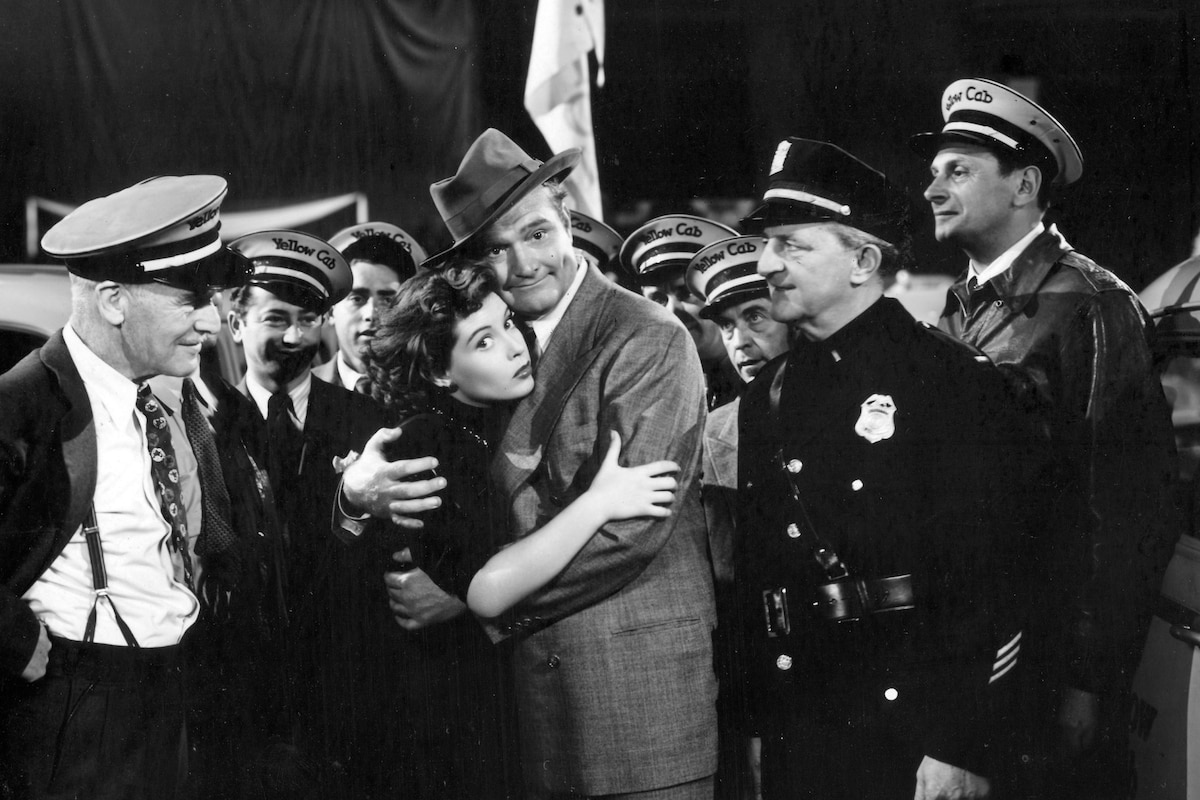
The Yellow Cab Man, in which an inventor's unbreakable glass attracts the attention of businessmen and gangsters, follows the standard slapstick scenario of most of Skelton's clueless rube comedies. But one of the more interesting aspects of the film is a sequence where Skelton's character takes a drug and experiences some unusual hallucinations. These scenes were photographed and supervised by famous crime scene photographer and NYC street life chronicler Weegee. Arthur Fellig the nickname Weegee came from his uncanny ability to show up at propitious moments to capture the perfect photo, likened to the predictive Ouija Board devised the distortion effects which he had first utilized in his own 1948 film Weegee's New York. Through various unique techniques, including using curved glass during printing, making multiple exposures from negatives, and even dropping negatives into boiling water or melting them over fire, Weegee added his brilliant touch to this imaginative part of The Yellow Cab Man.
At the time he made The Yellow Cab Man, Skelton was coming off a series of movie successes, including the aforementioned The Fuller Brush Man, A Southern Yankee, and a co-starring role in the Esther Williams' musical comedy Neptune's Daughter (1949). Skelton's production team and co-stars were equally skilled in their fields. Director Jack Donohue started his show business career as Ziegfeld Follies dancer, eventually transitioning into choreography and teaching dance (to pupils like Eleanor Powell). He became a dance director for movies, and in 1948 he made his directorial debut; The Yellow Cab Man was his second movie as director. The film's female lead was played by veteran actress Gloria DeHaven. She had a list of impressive credits in movies like Broadway Rhythm (1944), Two Girls and a Sailor (1944), Step Lively (1944), Summer Holiday (1948) and many others, and was as adept at comedy as she was at drama and in musicals.
Veteran Hollywood character actor Walter Slezak Lifeboat (1944), The Princess and the Pirate (1944) and many others lent his vibrant and hilarious comic persona to the role of a crook on inventor Red's tail. Edward Arnold Mr. Smith Goes to Washington (1939), Johnny Eager (1942) who could bring to life both comic and dramatic characters, was brought on board to play a crooked attorney. Another screen veteran James Gleason Arsenic and Old Lace (1944), A Tree Grows in Brooklyn (1945) played a Yellow Cab driver who recruits Skelton to come work for the company as a scientist, on the virtue of his invention of a shatterproof glass for windshields.
Movie fans were also thrilled to see Polly Moran, a comedy favorite who had been in the movies since 1915, return to the screen for a small role that was singled out by several movie reviewers. In fact, the critics were fairly kind to The Yellow Cab Man, citing the madcap inventions presented by scientist Skelton's character and the raucous physical comedy that highlighted the film. While it didn't quite the match the high standard of Skelton's previous film A Southern Yankee, The Yellow Cab Man nonetheless showcases Red Skelton doing what Red Skelton does best giving his all to make an audience laugh.
Producer: Richard Goldstone
Director: Jack Donohue
Screenplay: Albert Beich; Devery Freeman (screenplay and story)
Cinematography: Harry Stradling
Art Direction: Cedric Gibbons, Eddie Imazu
Music: Scott Bradley; Adolph Deutsch, Albert Sendrey (both uncredited)
Film Editing: Albert Akst
Cast: Red Skelton (Augustus 'Red' Pirdy), Gloria De Haven (Ellen Goodrich), Walter Slezak (Dr. Byron Dokstedder), Edward Arnold (Martin Creavy), James Gleason (Mickey Corkins), Jay C. Flippen (Hugo), Paul Harvey (Pearson Hendricks), Guy Anderson (Willis Tomlin), John Butler (Gimpy), John Indrisano (Danny), Polly Moran (Bride's Mother).
BW-85m.
by Lisa Mateas
The Yellow Cab Man
by Lisa Mateas | June 19, 2009
SIGN UP FOR OUR NEWSLETTERS

CONNECT WITH TCM