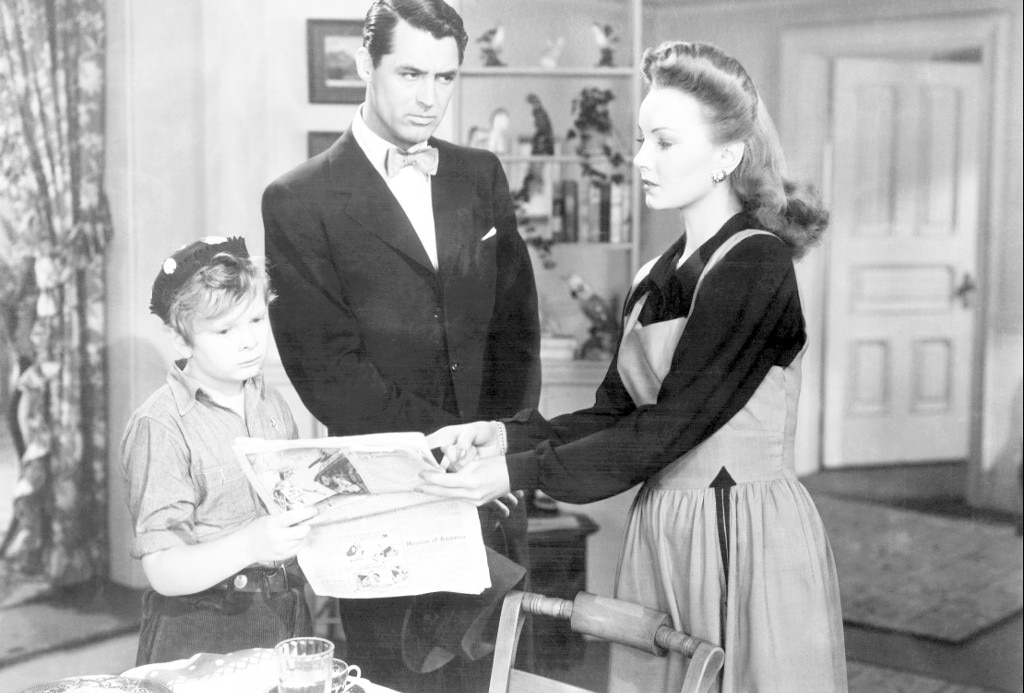
Based on a 1940 radio play by Norman Corwin and Lucille Fletcher Herrmann, Once Upon a Time (1944) is a fantasy about a down-on-his-luck producer who forms an unlikely friendship with a little boy and his dancing caterpillar. Jerry Flynn (Cary Grant) is about to lose his theater because he owes the bank $100,000. His last three plays have been flops, and he's literally down to his last nickel. When he tosses that nickel to nine-year-old Pinky (Ted Donaldson), the boy shows Jerry his pet caterpillar, Curly, who dances when Pinky plays "Yes, Sir, That's My Baby" on the harmonica. The two form a partnership to promote Curly, and once a radio commentator gets hold of the story, Curlymania sweeps the nation. Scientists want to study Curly. Walt Disney expresses interest, and Jerry sees a chance for big money to save his theater - but it would involve betraying Pinky.
Columbia had acquired the rights to the radio play in 1942, and announced that Humphrey Bogart and Rita Hayworth would star. By January of 1943, Brian Donlevy had replaced Bogart, but soon after Hayworth was suspended because she refused to appear in the film. Production on Once Upon a Time finally began in September, with Grant and Janet Blair in the leading roles, and ten-year-old Ted Donaldson making his film debut as Pinky.
What worked as a half hour radio play was less successful as a feature film. Expanding the fanciful premise that played neatly in its half-hour form to a 90-minute film not only added little to the story, but diluted its impact. The radio play had allowed listeners to use their imagination to see the dancing caterpillar. In the film, only the characters see Curly's act - the viewers never do, and the fantasy seems more earthbound, the whimsy a little forced. On the plus side, there are some excellent performances. Critics singled out James Gleason as Grant's sourpuss sidekick, and had praise for young Ted Donaldson. "His round face and boyish treble do a lot to give it charm," according to Bosley Crowther of the New York Times. Grant's jaunty manner is ideal for the producer, and he has real chemistry with Donaldson, who won a Critics Award for his performance.
Perhaps the best thing to come out of Once Upon a Time was Grant's friendship with Donaldson. The film came at a difficult time in Grant's personal life. He had married Woolworth heiress Barbara Hutton in 1942. They were clearly mismatched, and the union was rocky from the start (they would divorce in 1945). But one of the joys of the marriage for Grant was the opportunity to be a father to Hutton's son, Lance Reventlow. That paternal instinct served him well in his relationship with Donaldson. "From the first day on the set of Once Upon a Time, you made everything easy for me," Donaldson recalled in a letter to Grant in 1979. "You didn't wait for me to be brought to you by my agent or a studio representative. You came over to me and my father and introduced yourself." Grant spent time with the boy, playing games, sharing riddles, and singing the popular nonsense song of the era, "Mairzy Doats." He was also generous as a fellow actor. For one important scene, cinematographer Franz Planer had set up a two-shot of Grant and Donaldson. But Grant told director Alexander Hall that the boy should be the focus of the scene, and he should change it to a closeup of Donaldson. Grant kept in touch with Donaldson, and years later, he attended Donaldson's high school graduation. (Grant also kept up a relationship with Lance Reventlow after his divorce from Hutton.) Grant would not become a father until 1966, when his only child, Jennifer, was born to actress Dyan Cannon, his fourth wife. Late in his life, Grant expressed regret that he had not had more children.
Once Upon a Time was not Grant's most successful film, but it provided a cheerful antidote to the grimness of World War II. As the Variety critic wrote, "Once Upon a Time is certainly bizarre - and yet charming. It's unfathomable - and yet intriguing. It is certainly absurd - and yet boxoffice."
Director: Alexander Hall
Producer: Louis F. Edelman
Screenplay: Lewis Meltzer, Oscar Saul, Irving Fineman, based on the radio play "My Client Curly," by Norman Corwin and Lucille Fletcher Herrmann
Cinematography: Franz Planer
Editor: Gene Havlick
Art Direction: Lionel Banks, Edward C. Jewell
Music: Frederick Hollander
Principal Cast: Cary grant (Jerry Flynn), Janet Blair (Jeannie Thompson), James Gleason (The Moke), Ted Donaldson (Arthur "Pinky" Thompson), William Demarest (Brandt), Howard Freeman (McKenzie), Art Baker (Gabriel Heatter), Mickey McGuire (Fatso).
BW-89m.
by Margarita Landazuri
Once Upon a Time
by Margarita Landazuri | June 18, 2009
SIGN UP FOR OUR NEWSLETTERS

CONNECT WITH TCM