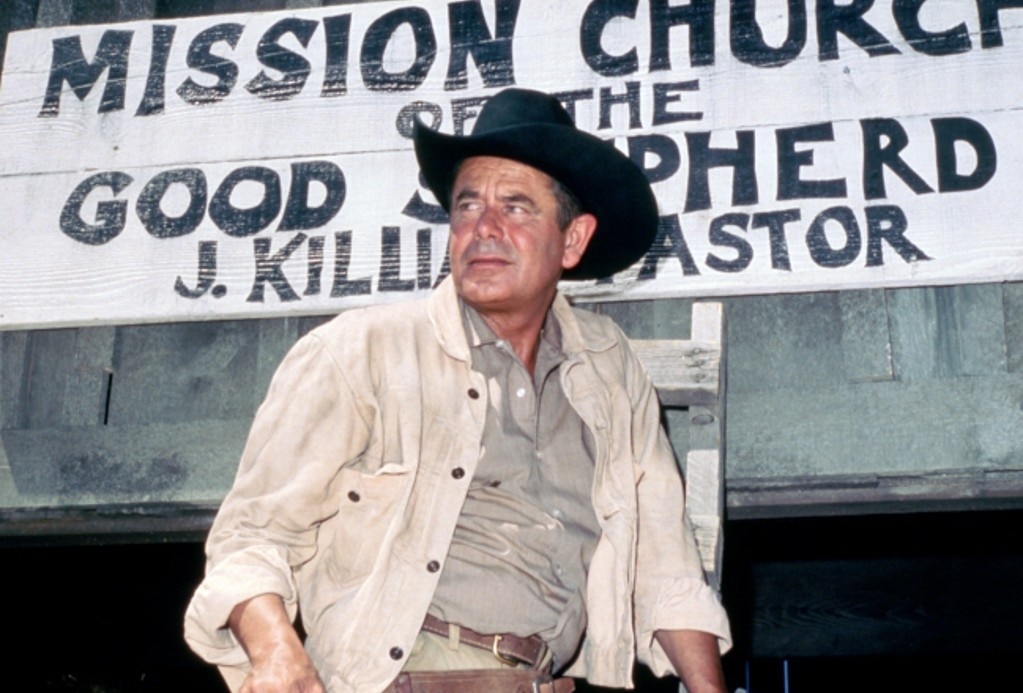
With a tip of its Stetson to Victor Hugos Les Miserables, MGMs Heaven with a Gun (1969) drops reformed gunslinger turned frontier parson Glenn Ford into a Shane (1953) style range war between cattlemen and sheep rangers, to whom he must minister without yielding to the temptation to slap leather. An argument for nonviolent coexistence couched in the context of a horse opera, the film seemed incongruous and old fashioned in the company of the revisionist westerns that were becoming the norm by 1969. The project had originated with blacklisted writer Dalton Trumbo, author of the acclaimed 1939-war novel Johnny Got His Gun. A staunch supporter of labor unions, Trumbo had joined the Communist Party in 1943 and was one of the Hollywood Ten, who accepted jail time rather than testify before the House on Un-American Activities Committee in 1947. Fired by MGM (who had paid him $75,000 a script), Trumbo served a ten-month prison sentence in Ashland, Kentucky. After his release, the writer decamped to Mexico, where he banged out a variety of screenplays for a fraction of his former asking price, selling them under the byline of colleagues unaffected by HUAC with whom he agreed to split the profits. Trumbo sold 18 such screenplays before he was able to see his name again on the big screen in 1960.
Heaven with a Gun was written by Trumbo for the King Brothers. Maurice, Herman and Frank King (formerly Kozinsky) had made a fortune renting jukeboxes, slot machines and pinball machines from their home in Los Angeles predominately Jewish Boyle Heights section. Getting into the film business with more enthusiasm than hands-on knowledge, the brothers hired smart, reliable technicians to crank out their first film, Paper Bullets (1941), an early credit for Alan Ladd, made for a paltry $20,000. (The savvy Kings capitalized on Ladds subsequent success by re-releasing Paper Bullets with Ladds billing moved from sixth place to first). Aligned with Monogram Studios, the Kings purportedly never lost a dime turning out their cheapies and even their more expensive pictures turned a profit.
For the Kings, Trumbo wrote Joseph H. Lewis Gun Crazy (1950, credited to Millard Kaufman) and the Academy Award® winning The Brave One (1956, credited to Robert Rich, a nephew of the King Brothers). By the time that Heaven with a Gun came to fruition, Trumbo had been reinstated as a big ticket screenwriter and his disinclination to be associated with what amounted to a B-picture forced the Kings to bring in another writer to update the property.
Twenty odd years after his seminal roles in Charles Vidors Gilda (1946) and Fritz Langs The Big Heat (1953), 53 year-old Glenn Ford had settled comfortably into westerns, which suited his creased, time-worn appearance. He had played Henry Fondas cowpoke compañero in Burt Kennedys The Rounders (1965) but, while Fonda went on to an atypically villainous turn in Sergio Leones immortal Once Upon a Time in the West (1968), Ford continued to ply his stock-in-trade of decent men pushed to the limits of law abiding behavior. Ford is supported by an able cast of jobbing middle-aged character actors such as John Anderson, J.D. Cannon, Noah Beery, Jr., and Harry Townes (who retired from acting to become an Episcopalian minister).
While westerns were so often the last hurrah for fading Hollywood stars of the 40s and 50s, they provided early work for younger actors (e.g. Jack Nicholson, Dennis Hopper) destined for stardom in the 70s. Meeting for the first time on the Arizona location, cast members David Carradine and Barbara Hershey fell in love mid-production. Glenn Ford approved of the couples off-screen romance but got the wrong idea when he saw Carradine and actress Angelique Pettyjohn slip away to smoke a joint. Thinking Carradine was stepping out on Hershey, Ford gave the actor the cold shoulder for the duration of the shoot.
Despite being shot on the back lot, on location and in widescreen, Heaven with a Gun retains an aura of cost-consciousness, extending to the hiring of TV director Lee H. Katzin and rewrite man Richard Carr. Katzin had honed his craft as a production manager and later assistant director on such weekly series as The Rebel, Rawhide and The Wild Wild West; he was later brought in to replace John Sturges at the helm of Le Mans (1971) when Steve McQueens movie star caprices sent Sturges packing. Carr also benefited from the caprices of Steve McQueen. A reliable writer of teleplays for Racket Squad, Johnny Staccato and Alfred Hitchcock Presents, Carr was called in to write new scenes for Don Siegels Hell Is for Heroes (1962) after McQueen had orchestrated the firing of original writer Robert Pirosh. During principal photography of Heaven with a Gun, Carr pitched a screenplay idea, an adaptation of Henry Norton Robinsons 1945 novel The Perfect Round, to Carradine and Hershey. Carradine bought the pitch and optioned the rights from the Robinson estate. Shot over the course of ten years, with Carradine taking on a myriad of other film assignments for completion funds, Americana received a limited theatrical release in 1983, after winning the Peoples Choice Award at the Directors Fortnight of the 1981 Cannes Film Festival.
Producer: Frank King, Maurice King (producer)
Director: Lee H. Katzin
Screenplay: Richard Carr
Cinematography: Fred J. Koenekamp
Art Direction: George W. Davis, Frank Sylos
Music: Johnny Mandel
Film Editing: Dann Cahn
Cast: Glenn Ford (Jim Killian/Pastor Jim), Carolyn Jones (Madge McCloud (saloon owner)), Barbara Hershey (Leloopa (Indian girl)), John Anderson (Asa Beck (cattleman)), David Carradine (Coke Beck (Asa's son)), J.D. Cannon (Mace (Beck's gunman)), Noah Beery, Jr. (Garvey (Beck Ranch ramrod)), Harry Townes (Gus Sampson (storekeeper)), William Bryant (Bart Paterson (cattleman)), Virginia Gregg (Mrs. Patterson).
C-101m. Closed Captioning.
by Richard Harland Smith
Sources:
Dalton Trumbo, Hollywood Rebel: A Critical Survey and Filmography by Peter Hanson (McFarland Publishing, 2007)
Endless Highway by David Carradine (Journey Editions, 1995)
Roundtable discussion on You and Me and Americana by Chris Poggiali, John Charles and Marty McKee, Temple of Schlock, www.templeofschlock.blogspot.com
David Carradine interview by Dan Skye, High Times, December 2002
Barbara Hershey interview by Karen G. Jackovich, People, May 1979
Steve McQueen, King of Cool: Takes of a Lurid Life by Darwin Porter (Blood Moon Productions, 2009)
The King Brothers: Ex-pinball kings move into the big movie money as makers of crude, popular cheapies, Life, November 22, 1948
The Philip Yordan Story by Alan K. Rode, Noir City Sentinel, November/December 200
Heaven With a Gun
by Richard Harland Smith | June 17, 2009
SIGN UP FOR OUR NEWSLETTERS

CONNECT WITH TCM