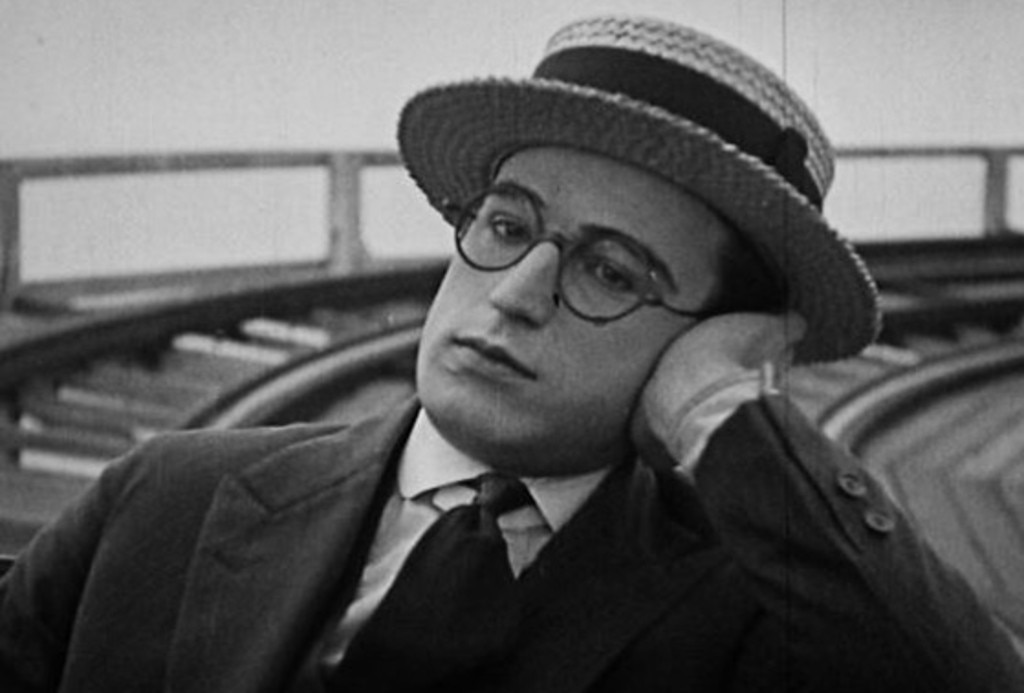
Slapstick master Harold Lloyd demonstrates his gift for breezy comedy in the 1920 two-reel short Number, Please?
It begins as the tale of faded romance -- "an old, old story of men who have loved, lost and tried to forget," according to a solemn introductory title. But the dour tone suddenly shifts when the Boy (Lloyd) spots the Girl who spurned him (Mildred Davis) promenading at a seaside amusement park. The Boy launches a last-ditch effort to win the Girl back from the Rival (Roy Brooks), and the boardwalk attractions (roller coaster, games of skill, funhouse mirrors, and carousel) all provide springboards for Lloyd's trademark brand of congenial comedy.
The Girl promises to share a balloon ride with whichever suitor can win her mother's consent, which sparks a madcap race to reach the would-be mother-in-law. The Rival travels by motorcar while the tech-savvy protagonist opts for the telephone, which leads to a series of telecommunication snafus and frustrating encounters with disinterested operators (phenomena to which 21st-century viewers can still relate). In Harold Lloyd's universe, the laws of nature and the wonders of technology may pose pitfalls, but these are minor obstacles in the face of the wit and determination of a love-happy all-American youth.
Just before the romantic rivals cross the finish line to the Girl's heart, a sneak-thief pinches her purse, which undergoes a rapid-fire changing of hands that brings the rollicking comedy to a rousing conclusion.
The amusement park scenes were shot on the boardwalk of Ernest Pickering's Ocean Park (aka Pickering Pier, later known as Pacific Ocean Park) in Santa Monica.
Number, Please? was one of the last Lloyd films directed by comedy producer Hal Roach. The success of the Lloyd comedies (earning upwards of $200,000) enabled Roach to negotiate higher advances from the distributor (Pathé). This, in turn, allowed him to transition from a hands-on-the-camera approach to filmmaking to a more supervisory -- almost curatorial -- role at his independent production company. As studio head (not mere director), Roach was able to cultivate the talents of Charley Chase, Harry Langdon, Laurel and Hardy, and the Our Gang kids.
The film was co-directed by Fred Newmeyer, who went on to helm a number of other Lloyd pictures, including the classic Safety Last! (1923) and The Freshman (1925), both co-directed with Sam Taylor.
In his biography Harold Lloyd: The Man on the Clock Tom Dardis observed that Lloyd tended to downplay the contributions of his behind-the-scenes collaborators, and implied that he essentially directed the films himself. In discussing directorial credit, Lloyd told an audience, decades later, at the American Film Institute, "My thinking was this: that I was getting all the credit I needed by being the main comic, and the audience was giving me the full credit. Why did I have to have the credit for doing the direction?... So it was good for the boys; it helped them."
This was not mere vanity. In the book The Parade's Gone By, silent film historian Kevin Brownlow concurred that the actor's role was greater than it appeared: "Harold Lloyd, with Chaplin and Keaton, was one of the three supreme masters of the comedy film. And like Chaplin and Keaton, he was not merely an actor but a creator. He closely supervised every stage of his productions and was responsible for much of the direction."
Dardis revealed a little-known detail about Lloyd's off-camera psychology: that he was plagued by particular compulsion. "He believed that he had to leave a building, any building, by the door through which he had entered; this was just as applicable to a sports stadium as to a private house. In the years of his great mansion, Greenacres, if his car of the day was parked in the front drive, his chauffeur knew that he would have to back it around the center fountain; only then could he drive away. Whenever Harold went somewhere by car, he had to return by precisely the same route. He was inflexible about these matters."
Lloyd continued to co-star with Mildred Davis in such films as Grandma's Boy (1922) and Safety Last!. On February 10, 1923, they were married at St. John's Episcopal Church in Los Angeles. Although writer Annette D'Agostino Lloyd (no relation) noted that "there was absolutely no hint of any romantic involvement between the two" prior to the announcement, Lloyd and Davis remained married until Davis's death on August 18, 1969.
Being Lloyd's wife apparently disqualified Davis from being his co-star. The "Girl" role was promptly handed over to twenty-three-year-old Jobyna Ralston, who played the love interest in six of his features. Davis appeared in a handful of non-Lloyd films, but soon disappeared from the screen.
The African-American who serves as the Boy's accomplice at the climax of Number, Please? was Ernest Morrison. Known to viewers of the day as "Sunshine Sammy," Morrison was one of the original Our Gang kids, and later became one of the East Side Kids, a low-budget spin-off of the Dead End Kids.
Director: Hal Roach, Fred Newmeyer
Producer: Hal Roach
Screenplay: H.M. Walker (titles)
Music: Robert Israel
Cinematography: Walter Lundin
Cast: Harold Lloyd (The Boy), Mildred Davis (The Girl), Roy Brooks (The Rival), Ernest "Sunshine Sammy" Morrison (accomplice).
BW-25m.
by Bret Wood
Number, Please?
by Bret Wood | June 16, 2009
SIGN UP FOR OUR NEWSLETTERS

CONNECT WITH TCM