Earlier films inspired by Bonnie Parker and Clyde Barrow include
You Only Live Once (1937), starring Henry Fonda and Sylvia Sidney;
Gun Crazy (1949), with John Dall and Peggy Cummins; and The
Bonnie Parker Story (1958), with Dorothy Provine and Jack Hogan. The
story also inspired Edward Anderson's novel Thieves Like Us, which
was filmed in 1949 as They Live by Night, with Farley Granger and
Cathy O'Donnell, and re-made by Robert Altman in 1974, under its original title, with
Keith Carradine and Shelley Duvall.
A year after Bonnie and Clyde's release, American International
Pictures attempted to cash in on its success with Killers Three,
starring Robert Walker, Jr. and Diane Varsi as married killers on the run
with criminal cohort Dick Clark. The film played mostly in
drive-ins.
Bonnie and Clyde was heavily influenced by the films of the
French New Wave, particularly Francois Truffaut and Jean-Luc Godard, both
of whom were approached about directing the feature before Arthur Penn
signed on. Screenwriters David Newman and Robert Benton had been inspired
to write the screenplay after seeing Godard's Breathless (1959),
while their repeated viewings of Truffaut's Jules and Jim (1962)
influenced both the film's abrupt shifts in tone from comic to serious and
the psychology of Bonnie Parker's character.
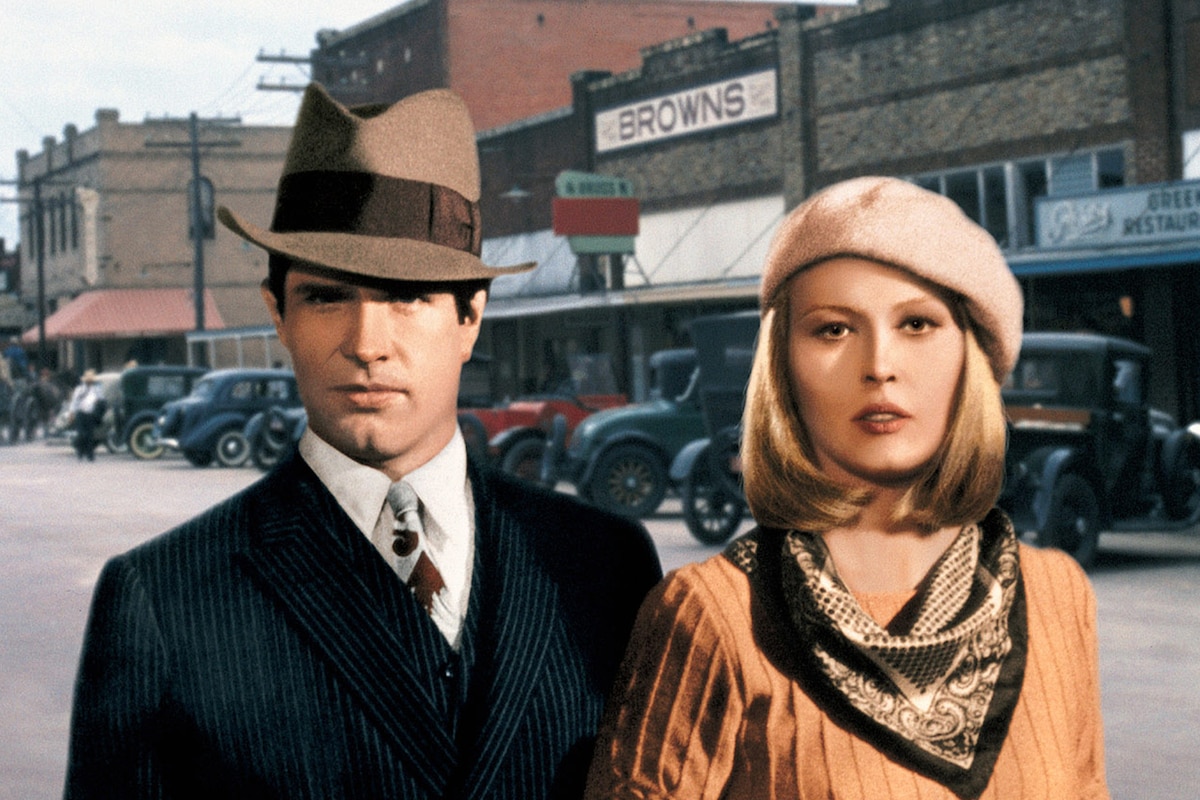
Bonnie and Clyde triggered a fashion revolution. It
single-handedly brought berets back into style and triggered the move from
the mini-skirts of the mid-'60s to the maxi.
Like the stars at Andy Warhol's Factory, Bonnie and Clyde, as depicted
in the film, were famous for being famous. In fact, Bonnie and
Clyde was one of the first pictures to deal with America's fascination
with celebrity.
For many members of the American counter-culture, Bonnie and
Clyde was a rallying cry. The main characters' bank robbing was seen
as a form of revolution, while the film's moral paradox, in which the
criminals were more sympathetic than their law-abiding killers, seemed to
legitimize violence against the establishment.
The film's soundtrack brought country bluegrass mainstream popularity.
In particular, it boosted demand for the recordings of Lester Flatt and
Earl Scruggs, featured on the soundtrack playing "Foggy Mountain
Breakdown," "My Cabin in Carolina," "Bouquet in Heaven," "My Little Girl in
Tennessee," "Why Don't You Tell Me So?" and "No Mom or
Dad."
by Frank Miller
Pop Culture 101 - Bonnie and Clyde
by Frank Miller | March 11, 2010
SIGN UP FOR OUR NEWSLETTERS

CONNECT WITH TCM