Originally, Warren Beatty hoped to cast French actress Leslie
Caron, his girlfriend at the time, as Bonnie Parker. When he decided she
wasn't right for the role, it led to the end of their
relationship.
Other actresses considered for the female lead included Natalie Wood,
Jane Fonda, Carol Lynley, Tuesday Weld and even Beatty's sister, Shirley
MacLaine. Weld was almost set to do the film when she learned she was
pregnant and decided she couldn't handle the location shoot in
Texas.
Faye Dunaway had tried to get an interview with Arthur Penn when he was
directing The Chase, but was rebuffed by a casting director who
didn't think she had the right face for the movies. When Penn saw her in
scenes from her first picture (The Happening, 1967) before its release, he
decided to let her read for the role of Bonnie Parker.
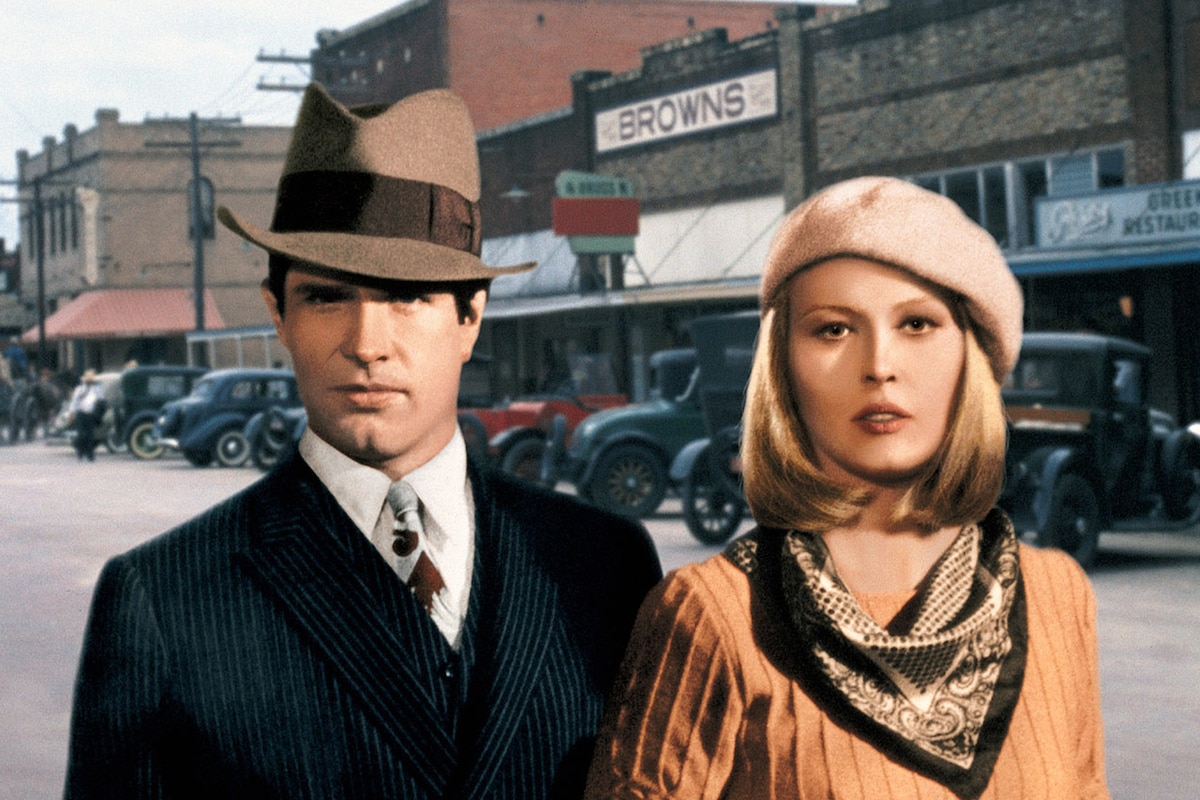
In planning her performance, Faye Dunaway wanted to wear slacks as
Bonnie Parker, since the character would need to move freely to race in and
out of getaway cars. In contrast, designer Theadora Van Runkle suggested a
more glamorous look with long skirts, a beret and a short jacket. The
"Bonnie and Clyde Look" became a fashion rage, and for years afterwards
Dunaway would insist on having Van Runkle design her costumes.
Beatty and Penn rounded out the cast with actors they had worked with
during their days on Broadway, in live television and at the Actor's
Studio. Beatty had been impressed with Gene Hackman -- who played Clyde's
brother, Buck Barrow -- when they had worked together on Lilith
in 1964.
Beatty fought to shoot the film on locations around Texas, partly to
create an authentic image of the Barrow Gang's exploits, but also to avoid
interference from Warner Bros. executives.
Writer Robert Towne accompanied the crew during the location shoot. In
part, he was there to do last minute re-writes during filming. But he was
also working with Beatty on a script that would later become their hit
comedy Shampoo (1975).
Beatty and Penn quarreled constantly during filming, as the star
questioned almost every one of the director's choices. As a result, the
rest of the cast spent hours waiting for them to settle their differences.
One major bone of contention was Penn's insistence, early on, that they add
a scene in which Bonnie and Clyde pretend to be dead. Beatty insisted the
idea was ridiculously pretentious, but Towne tried to write it anyway. The
writer soon realized that Beatty was right, but cautioned him to avoid a
confrontation on the matter. In his opinion, Penn was only holding onto
the idea out of insecurity -- he couldn't admit he was wrong. After a few
weeks of filming bolstered Penn's confidence, Towne was sure he'd drop the
idea, which is exactly what happened.
Initially, director Arthur Penn went for a realistic depiction of rural
life in the '30s. Many scenes were modeled on Walker Evans' photographs
and NRA posters. When he shot Bonnie's reunion with her family, however,
he was entranced by the more romantic aspects of the story and used slow
motion and hazy photography to create a dreamlike feeling he would return
to for other scenes.
While they were shooting Bonnie and Clyde's confrontation in the fields
after she tries to run away from the gang, a cloud passed over the sun,
casting an unexpected shadow over Faye Dunaway's face. Rather than
re-shoot the scene, Penn kept it in as a means of foreshadowing the
character's tragic end.
On the day the company shot the scene in which Bonnie and Clyde wade
through a river after they're shot, a cold front hit Texas. It took three
days to film the scene as the actors fought not to shiver while the cameras
were rolling.
For the climactic ambush, Beatty and Dunaway were covered with dozens
of squibs embedded in their costumes and makeup and wired to a central
control that made them explode in sequence to create the illusion that they
were being shot.
The idea of shooting the final ambush in slow motion came from Penn,
who wanted to make something more "balletic" out of their death scene. The
scene as written depicted the shoot-out as a series of stills with screams
and machine-gun fire played in the background. Penn also insisted that one
squib be placed to make it look as if the back of Clyde's head had been
blown away in a reference to the John F. Kennedy
assassination.
Initially, Warren Beatty refused to have Faye Dunaway billed above the
title with him. Even during shooting, he fought efforts to raise her
billing. Finally, after the film was shot, he realized how strong an
impact she was going to make in the role and agreed to give her star
billing.
When Beatty and Penn showed the finished picture to studio head Jack L.
Warner, he called it "the longest two hours and ten minutes I ever spent."
A few weeks later, he sold his share in the studio to Seven Arts
Productions for almost $200 million dollars, but the new management was no
more interested in selling the film. They decided to premiere it at a
Texas drive-in, then dump it in second-string theatres. Even when the
film had a triumphant preview for industry insiders at the Directors Guild,
they refused to change their plans. Finally, Beatty convinced them to
premiere the film at the Montreal Film Festival, where the stars were given
14 curtain calls and a standing ovation. And still studio management stuck
to their original distribution plan.
To avoid censorship problems, Beatty held off sending a script to the
Production Code Administration (PCA), the industry's self-censorship
organization, until just before shooting began. Even so, PCA head Geoffrey
Shurlock fought, unsuccessfully, to remove the intimation that Bonnie was
nude in the first scene, the suggestion of oral sex in one bedroom scene
and the scene in which a bank teller is shot in the face when he jumps on
the getaway car's running board. Later Beatty had another fight to
convince the head of the National Catholic Office of Motion Pictures (the
successor to the Legion of Decency) that Faye Dunaway was properly covered
when she runs downstairs to meet Beatty in the film's first scene. The official kept
insisting that he could see her breasts.
After bad notices in The New York Times, Time and
Newsweek, what turned things around for Bonnie and Clyde was
a 9,000-word rave by Pauline Kael, who was just starting her career as a
film reviewer. When the magazine for which she regularly wrote, The New
Republic, refused to print the lengthy review, she sold it to The
New Yorker, which marked the start of her long tenure there. According
to rumor, she also got Joe Morgenstern to reevaluate the film in
Newsweek. After initially panning the film, he reported that he had
totally missed the point and gave it a rave.
With positive attention from the press and the critics, Beatty
pressured Warner Bros. to re-release the film. This was an unprecedented
move at the time. At first, studio CEO Elliot Hyman said he would only do
it if Beatty agreed to a cut in his profit participation. When Beatty
threatened to sue, hinting that he knew more about Hyman's business
dealings than he did, the bluff worked. The film went back into theaters a
few weeks later.
Bonnie and Clyde reopened the day the Oscar® nominations
were announced. The film received 10 nominations, including Best Picture,
Best Director and Best Screenplay. The second release was a huge success.
In some theatres, the film grossed 10 times what it had during it first
release.
by Frank Miller
Behind the Camera - Bonnie and Clyde
by Frank Miller | March 11, 2010
SIGN UP FOR OUR NEWSLETTERS

CONNECT WITH TCM