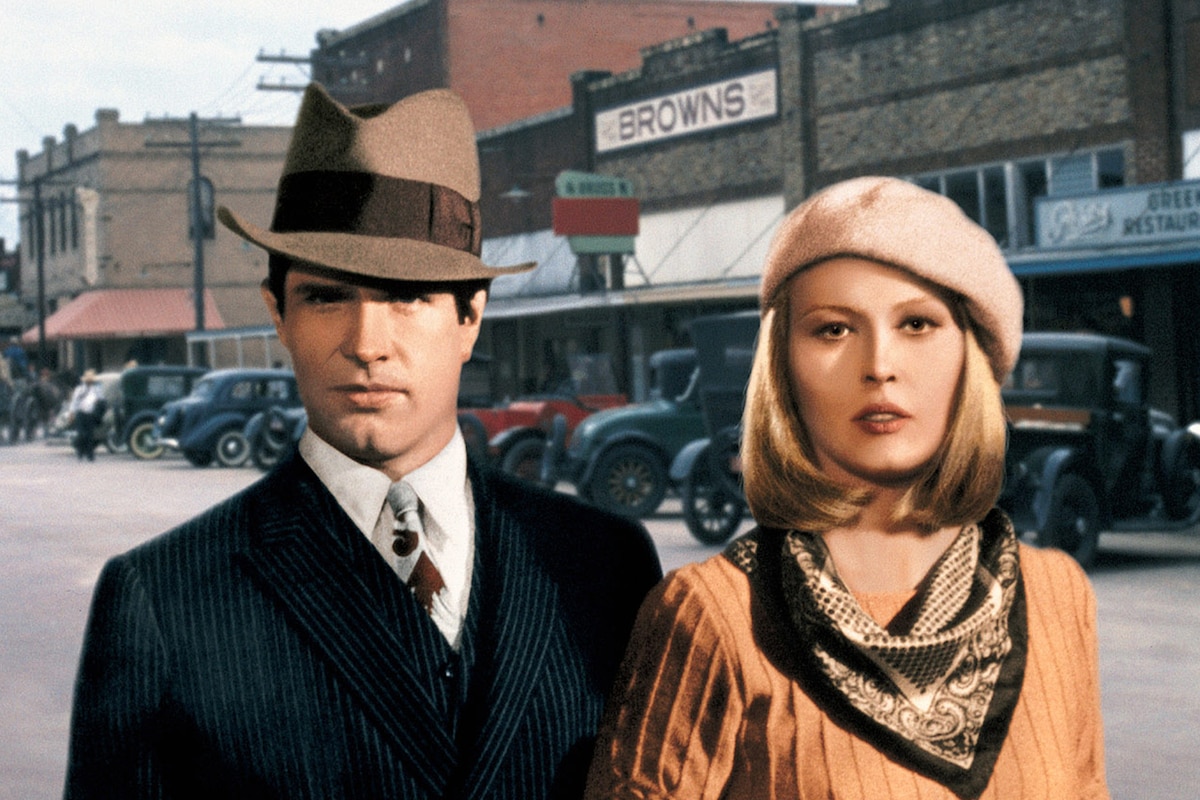
Robert Benton and David Newman got the idea for Bonnie and
Clyde when they were both working for Esquire magazine in 1963.
They had fallen in love with the work of French New Wave directors Francois
Truffaut and Jean-Luc Godard and realized they wanted to follow in their
footsteps. Then they read John Toland's The Dillinger Days, an
account of the great outlaws of the Depression. In particular, they were
fascinated with the stories about Bonnie Parker and Clyde Barrow, whom
Benton had heard about as a child in East Texas.
Benton and Newman worked on the script late at night while listening to
Lester Flatt and Earl Scruggs' recording of "Foggy Mountain Breakdown,"
which would eventually become part of the film's score.
After finishing the script, the writers sent it to Truffaut, their
first choice to direct. He was interested, but eventually passed on the
film, suggesting they offer it to Godard, who also turned them
down.
When the script was making the rounds of Hollywood studios, the biggest
objection was a sequence in which Clyde Barrow invites C.W. Moss to join him in a sexual menage a trois with Bonnie. The suggestion that Barrow might have been gay was inspired by the sexual revolution of the '60s, but it was too much for most studio executives to
handle.
Warren Beatty's career was in the doldrums when he decided to try
producing his own film. His first experience came with What's New,
Pussycat? (1965), a film whose title was inspired by one of his favorite ways
of greeting female telephone callers. During scripting, however, his role
kept getting smaller. When co-producer Charles Feldman broke a promise not
to put his protegee, model-turned-actress Capucine, in a leading role,
Beatty walked on the film, which went on to become a big hit. Determined
to keep himself from being edged out again, Beatty decided that he had to
produce his own films. Ironically, Woody Allen, who wrote What's New,
Pussycat? and made his screen debut in it (his role kept shrinking as Feldman decided to showcase other performers), also decided to produce
his own work after that experience.
Beatty learned about Bonnie and Clyde when he and
then-girlfriend Leslie Caron had dinner with French director Fran¿s
Truffaut in an effort to convince him to direct a film biography of Edith
Piaf for Caron. Truffaut passed on that project, then suggested that a
script he had just received had a great part for Beatty. The role was
Clyde Barrow.
When Beatty called Benton and Newman about reading the script, they
didn't believe it was really him. When he showed up a few minutes later to
pick up the script, they were shocked. Half an hour later, Beatty called
again to say he wanted to make the film. They warned him to hold off until
he'd read the entire script, including the menage involving Bonnie, Clyde
and C.W. Beatty called again after he'd finished the script, to say he
still wanted to do it. He optioned the script for $7,500. When the film
went into production, he paid the writers $75,000.
Beatty had worked with director Arthur Penn on Mickey One, a
small, surrealistic film that had failed at the box office in 1965. But
Benton and Newman thought the film had a distinct European-American flavor
and suggested they offer Bonnie and Clyde to him. Penn's career was
at a standstill after the failure of Mickey One. He had just been fired
from The Train (1964) by that film's star, Burt Lancaster, and shortly after that, producer
Sam Spiegel seized control of The Chase, (1966) another film Penn was directing.
Naturally, he was depressed and turned down Bonnie and Clyde at first,
complaining that he didn't like the script. Beatty almost had to browbeat
Penn into taking the job.
Beatty then pitched the project to Warner Bros. According to legend,
he offered to kiss studio head Jack Warner's shoes to get him to finance
the picture, though Beatty denies it. Although the studio had little faith
in the film, his offer to make it for a small salary and 40 percent of the
gross made it seem like a safe investment. The deal would make him extremely wealthy.
Shortly before filming began, Penn tried to back out again. Beatty got
him to stick with the project by bringing in writer Robert Towne to
re-write the script. His contributions included moving some scenes around
for greater dramatic impact. The comic sequence in which the gang kidnaps
a young man and his fiancee, only to let them go in a panic when they learn
he's a mortician, was originally set near the end. Towne moved it up to
just before the reunion with Bonnie's mother to deepen the sense of
foreboding in that scene. He also added a line at the end of the reunion
scene. When Clyde suggests that he and Bonnie could move closer to her
family after they retire from robbing banks, Towne had her mother say, "You
try to live three miles from me, and you won't live long,
honey."
Over Benton and Newman's objections, Towne also cut the homosexual
angle from the script. Instead, he made Clyde impotent, suggesting that
his violent behavior grew out of his sexual inadequacy.
by Frank Miller
The Big Idea - Bonnie and Clyde
by Frank Miller | March 11, 2010
SIGN UP FOR OUR NEWSLETTERS

CONNECT WITH TCM