BONNIE AND CLYDE (1967)
SYNOPSIS
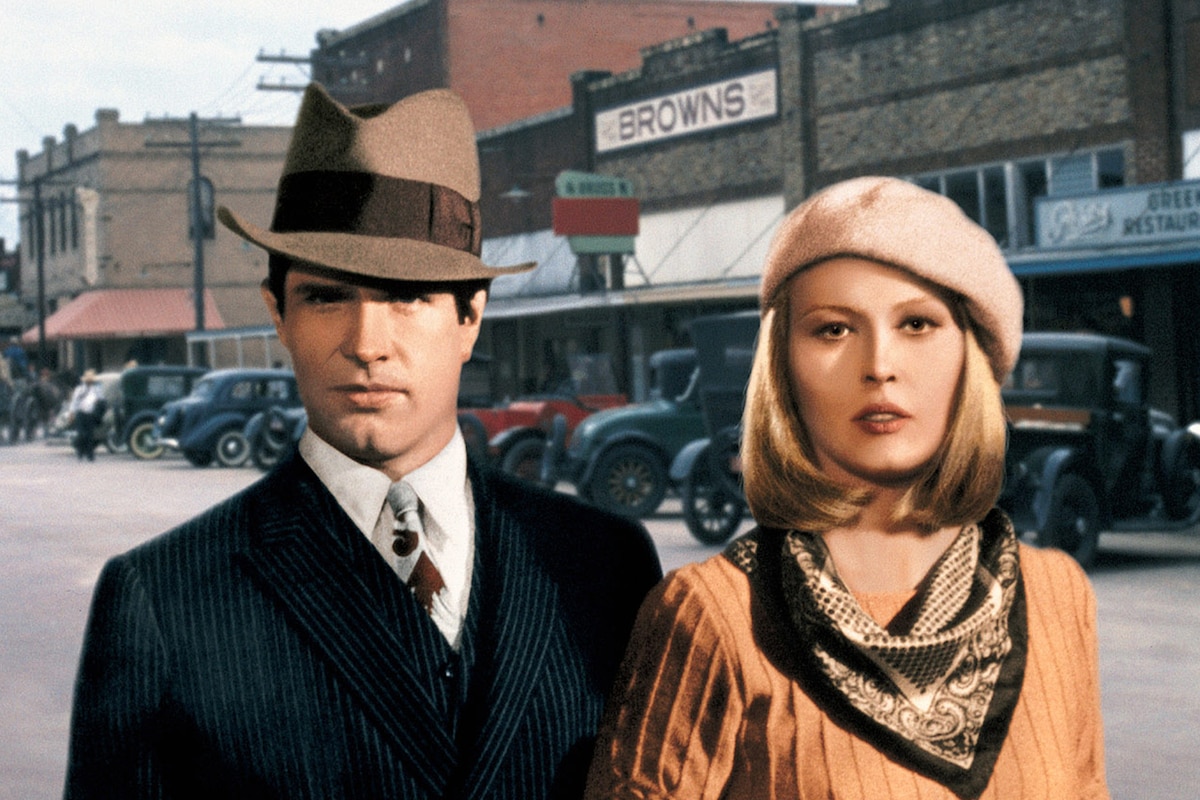
Bonnie Parker feels an excitement she's never known when Clyde Barrow enters her life (they meet while he's stealing her mother's car!). Almost immediately, Bonnie abandons her dreams of becoming a movie star and takes off on a whirlwind tour of Depression-era Texas, where they become legendary bank robbers. As their fame grows, so does their gang with the addition of gas station attendant C.W. Moss and Clyde's brother and sister-in-law. But with their growing notoriety as modern-day Robin Hoods and murderers comes the increasing threat of a fatal run-in with the law. After a heart-breaking visit with Bonnie's family, in which she realizes that she literally can't go home again, they are caught in a series of ever-more-deadly ambushes that decimate the Barrow Gang and threaten to end the legend of Bonnie and Clyde.
Director: Arthur Penn
Producer: Warren Beatty
Screenplay: David Newman, Robert Benton
Cinematography: Burnett Guffey
Editing: Dede Allen
Art Direction: Dean Tavoularis
Music: Charles Strouse
Cast: Warren Beatty (Clyde Barrow), Faye Dunaway (Bonnie Parker), Michael
J. Pollard (C.W. Moss), Gene Hackman (Buck Barrow), Estelle Parsons
(Blanche Barrow), Denver Pyle (Frank Hamer), Dub Taylor (Ivan Moss), Evans
Evans (Velma Davis), Gene Wilder (Eugene Grizzard).
C-118m.
Why BONNIE AND CLYDE is Essential
Film historians credit Bonnie and Clyde with inaugurating a new era in American film in the late sixties which resulted in a Hollywood renaissance that reached its peak in the mid-seventies. Suddenly directors were the center of the American filmmaking industry, and several studios, including Warner Bros. and Columbia, responded by creating low-budget production units dedicated to producing the work of exciting new talents like Francis Ford Coppola, Martin Scorsese and Peter Bogdanovich. To many, this is one of the most exciting periods in American film history. After more than a decade of amazing creativity, the movement came to an end with the rise of box-office blockbusters like Jaws (1975) and Star
Wars (1977) and the colossal box office failure of director Michael Cimino's
Heaven's Gate (1980).
With its glorification of a team of bank robbers and depiction of the
lawmen on their trail as villains, Bonnie and Clyde captured the
imaginations of the counter-culture audience in the late '60s as no film
had done before. Some historians credit it with awakening film executives
to the existence of a youth audience that would patronize films that
reflected their own anti-establishment values.
In a December 1967 article in Time magazine, "The New Cinema:
Violence...Sex...Art," critic Stefan Kanfer hailed Bonnie and Clyde
as the harbinger of a new type of filmmaking characterized by a disregard
for conventional plotting, the jarring mixture of comedy and tragedy,
sexual boldness and an ironic approach to moral issues.
Bonnie and Clyde set new standards for screen violence. It was
one of the first films to show blood splattering from bullet wounds and
capture the body's physical reaction to being shot (particularly in the
film's shocking finale, in which Bonnie Parker and Clyde Barrow jerk around
like marionettes when hit with a barrage of bullets). Where previous films
had rarely shown shooter and victim in the same frame, Bonnie and
Clyde presented the results of violence in graphic detail. In one
indelible image, a bank teller jumps on their running board as the gang
escapes after a robbery, only to be shot in the face.
With Bonnie and Clyde, Warren Beatty became a new kind of
star-producer, packaging his own film as a way of taking control of his
career and insuring the artistic integrity of his work. Although he was
derided for producing the film before it came out, afterwards dozens of
other stars imitated him. Today, the star-producer is a fact of Hollywood
life.
Like The Graduate, which came out the same year, Bonnie and
Clyde sparked a revolution in film casting. Although stars Warren
Beatty and Faye Dunaway were both highly attractive, the film's supporting
cast was chosen for their unglamorous but individualistic appearance. Actors like
Michael J. Pollard, Gene Hackman, Estelle Parsons and Gene Wilder in
Bonnie and Clyde and Dustin Hoffman in The Graduate changed
the face of American film as they inspired producers to search out more
authentic-looking American types. And costumer Theadora Van Runkle's clothes for the main characters became a fashion craze after the film's release.
by Frank Miller
The Essentials - Bonnie and Clyde
by Frank Miller | March 11, 2010
SIGN UP FOR OUR NEWSLETTERS

CONNECT WITH TCM