A celebrated singer, civil rights activist, athlete and actor, Paul Robeson was undoubtedly among the most influential African Americans of the 20th Century. A star of the international stage, he largely resisted the lure of Hollywood, making only a handful of films in the United States, where the kinds of roles offered to black men in the 1930s were extremely limited. Just as Josephine Baker found acceptance and adulation on the stages and screens of France, Robeson made several films for British studios, including Jericho (1937) and The Proud Valley (1940).
Jericho opens in the midst of World War I, as a ship loaded with African-American soldiers is torpedoed by a German U-boat. As water floods the engine room, Corporal "Jericho" Jackson (Robeson) defies the command of a sadistic sergeant (Rufus Fennell) and remains behind to save the men trapped within. Jericho succeeds in rescuing his fellow soldiers, but Sgt. Gamey is accidentally killed. Despite the attempts of his superior officers, in particular Captain Mack (Henry Wilcoxon), to defend him, Jericho is assigned the blame. Allowed to attend a Christmas ceremony, Jericho flees the guards and escapes on a small sailboat.
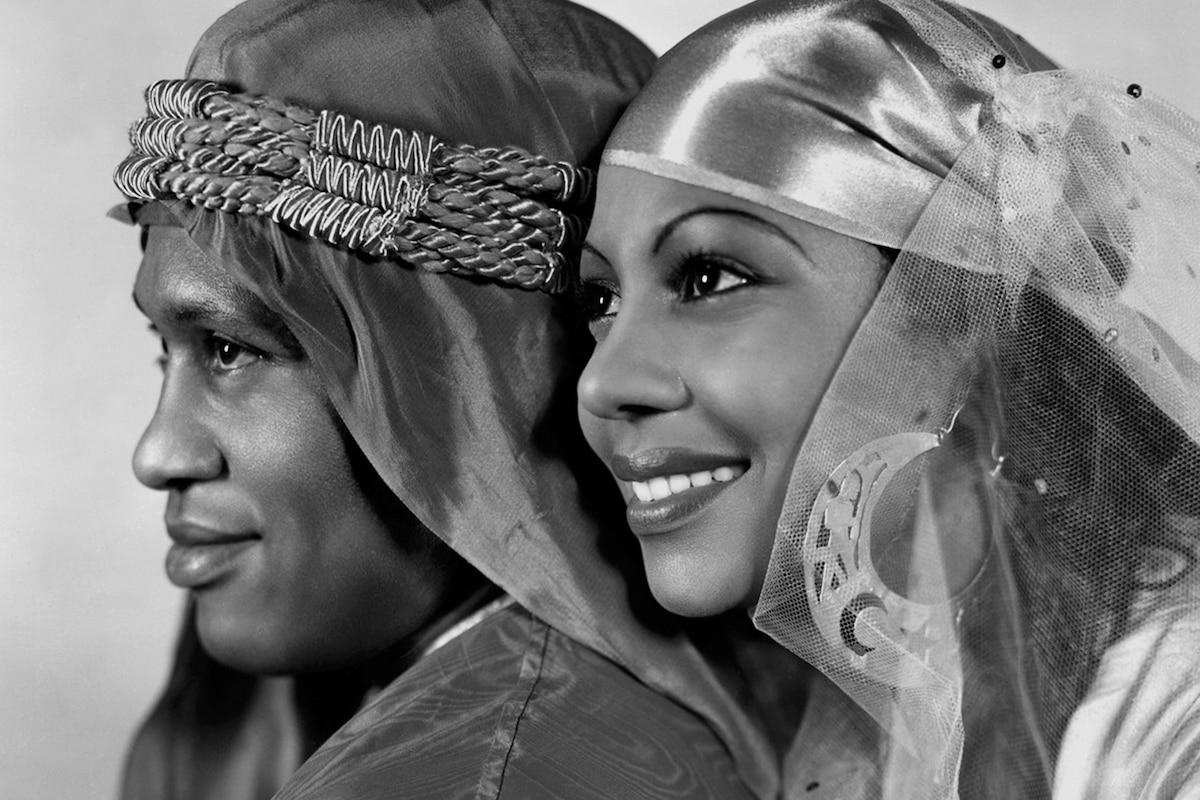
Stowed away on the craft is Mike Clancy (Wallace Ford) a small-time hustler who joins forces with Jericho, fleeing the authorities and struggling for survival in the arid desert and bustling bazaars of Northern Africa. When they encounter an injured sheik (John Laurie), Jericho uses his medical training to heal Hassan's leg and thereby earns his trust and protection. The broad-shouldered, barrel-chested Jericho quickly demonstrates his leadership skills, uniting the nomadic tribes into one well-protected caravan, and defending them against bands of marauding bandits.
Back in London, Captain Mack, who had been imprisoned for aiding Jericho's escape, glimpses Jericho's face in a newsreel, and travels to Africa, vowing to bring the fugitive to justice.
Born on April 9, 1898, Robeson gained entry to Rutgers University through an athletic scholarship, lettering in four different sports and being named to the All-American football squad (in 1995, he was inducted into the College Football Hall of Fame). Not satisfied with athletic excellence, Robeson distinguished himself academically, earning a Phi Beta Kappa key his junior year, graduating valedictorian in 1919 and pursuing an advanced degree at Columbia Law School. It was while studying law that Robeson began appearing on the stage, strictly as a hobby. But he quickly realized that acting and singing were his true calling, and began performing classical and contemporary works in the U.S. and abroad.
Robeson was an outspoken proponent of peace and an opponent to all forms of racial intolerance. As the world slipped into the Cold War in the late 1940s, the celebrated actor was frequently attacked by the conservative press because of his socialist leanings. The FBI continued to investigate Robeson throughout his life, as late as 1974, years after he had retired from the public eye due to ill health.
Robeson would have surely prospered had he remained in the United States and accepted the parts offered him. He later wrote, "For a Negro actor to be offered a starring role -- well, that was a rare stroke of fortune indeed!" However, Robeson felt a stronger obligation to set a new standard for African-American actors. "Later I came to understand that the Negro artist could not view the matter simply in terms of his individual interests, and that he had a responsibility to his people who rightfully resented the traditional stereotyped portrayals of Negroes on stage and screen."
Jericho clearly illustrates why Robeson chose to make films in England. The film avoids the stereotype of the subservient black man, and depicts Jericho as a proud, strong, educated leader. In one remarkably progressive scene, Jericho denounces the madness of war to his (white) superior officer, questioning the logic of sending a man with three years of medical training into battle.
"Did I want to learn how to kill? No. But they taught me and taught me until my arms ached from sticking steel into sandbags. These hands that I want to use to heal, to save life, to give life, turned into hands for killing."
Robeson was so insistent that Jericho offer a positive racial message that he convinced the filmmakers to change the ending of the film. Instead of returning to England to be placed at the mercy of the military court, Jericho faces his fate on the sands of the desert, defending the happiness of his wife (Princess Kouka) and child.
Robeson performs six musical numbers in the course of the film, the most effective being "My Way," which he sings twice: first to calm the nerves of his fellow soldiers, and again while alone in the desert, readying himself for battle. This latter version, performed against a backdrop of ominous dark clouds and smouldering fires, provides an apt representation of Robeson's simmering strength and resolve. Director Thornton Freeland (Flying Down to Rio, 1933) resisted the urge to "enliven" the musical number by cutting away to scenic vistas or the advancing bandits. Instead, he keeps the camera fixed on Robeson, whose personal charisma and thundering baritone voice are far more enthralling than the exotic action that swirls around him.
Director: Thornton Freeland
Producer: Walter Futter
Screenplay: George Barraud
Adapted by Robert N. Lee and Peter Ruric
From a story by Walter Futter
Cinematography: John W. Boyle
Production Design: Edward Carrick
Original songs: Michael Carr and Jimmy Kennedy
Musical Direction: Van Phillips
Cast: Paul Robeson ("Jericho" Jackson), Henry Wilcoxon (Captain Mack), Wallace Ford (Mike Clancy), Princess Kouka (Gara), John Laurie (Hassan), James Carew (Major J.R. Barnes).
BW-75m.
Jericho
by Bret Wood | March 26, 2003
SIGN UP FOR OUR NEWSLETTERS

CONNECT WITH TCM