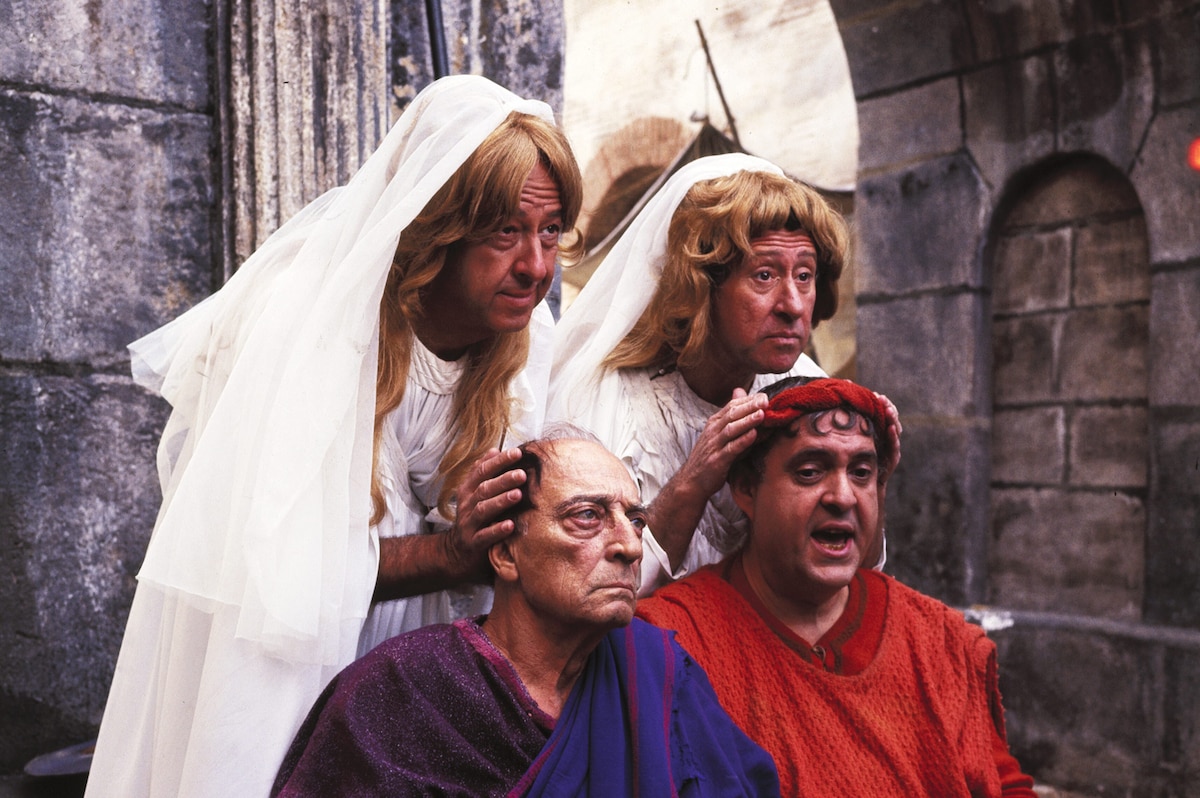
Madrid, Spain stands in for Italian locations in A Funny Thing Happened on the Way to the Forum (1966), directed by Richard Lester (A Hard Day's Night (1964), The Three Musketeers, 1974). Gleefully zany wordplay peppers the action, with Stephen Sondheim's libretto rhyming "eunuchs" with "tunics", and Zero Mostel, starring as scheming slave Pseudolos, examining a bottle of wine; "was One a good year?" Crammed with stellar comedic talent of its era, the film stars Zero Mostel, Jack Gilford, Phil Silvers and Buster Keaton (in one of his last performances). Larry Gelbart (Tootsie, 1982) and Bert Shevelove wrote the Broadway hit on which the film was based, adapting it from a trilogy of comedies by 3rd century BC Roman playwright Plautus.
Set in "a less fashionable suburb of Rome" and swirling with swinging sixties treatments of soothsayers, public baths, and ancient Roman go-go girls, the glory - or chaos - that was Rome is handled with Richard Lester's signature frenetic directorial style. The film's elaborate sets were strewn with actual fruits and vegetables, which were often left to rot in the Castillian sun at the end of the shooting day. The flies that plagued the production became a motif in the film and are a memorable feature of the animated end credits designed by Richard Williams (he was later recognized for his 1971 television special A Christmas Carol). Lester was selected by star Zero Mostel to direct the motion picture although other names originally under consideration for director included Charlie Chaplin, Orson Welles and Mike Nichols. Cinematographer Nicholas Roeg would later graduate to director and reap acclaim for such films as Walkabout (1971), Don't Look Now (1973), and The Man Who Fell To Earth (1976).
But the most significant aspect of A Funny Thing Happened on the Way to the Forum is the musical score by Stephen Sondheim which was adapted for the screen by Ken Thorne. The latter would snatch the only Oscar for the film - Best Adapted Music Score - in the 1966 Academy Award race against such competitors as Harry Sukman (The Singing Nun), Elmer Bernstein (Return of the Seven), and Al Ham (Stop the World-I Want to Get Off). Thorne, who had previously worked with The Beatles on their score for Help! (1965), would go on to compose music for such films as Head (1968), the Monkees' film debut, The Magic Christian (1969), and Superman II (1980).
Director: Richard Lester
Producer: Melvin Frank
Screenplay: Melvin Frank, Michael Pertwee (based on the play by Burt Shevelove & Larry Gelbart)
Cinematography: Nicholas Roeg
Editor: John Victor-Smith
Production Design: Tony Walton
Music: Ken Thorne, Stephen Sondheim
Cast: Zero Mostel (Pseudolus), Phil Silvers (Lycus), Michael Crawford (Hero), Jack Gilford (Hysterium), Buster Keaton (Erronius), Michael Hordern (Senex), Annette Andre (Philia).
C-97m. Letterboxed.
by Jessica Handler
A Funny Thing Happened on the Way to the Forum
by Jessica Handler | March 26, 2003
SIGN UP FOR OUR NEWSLETTERS

CONNECT WITH TCM