Sometimes your biggest failure can also become your biggest success. Case
in point: Yolanda and the Thief. The 1945 film lost almost $1.7
million at the box office, ended the career of its leading lady and almost
put Fred Astaire out of the movies, all because its whimsical tale of a
South American girl in search of her guardian angel was just too different
for '40s audiences. But the very things that made it fail at the box
office have kept it alive in the hearts of its fans over the years.
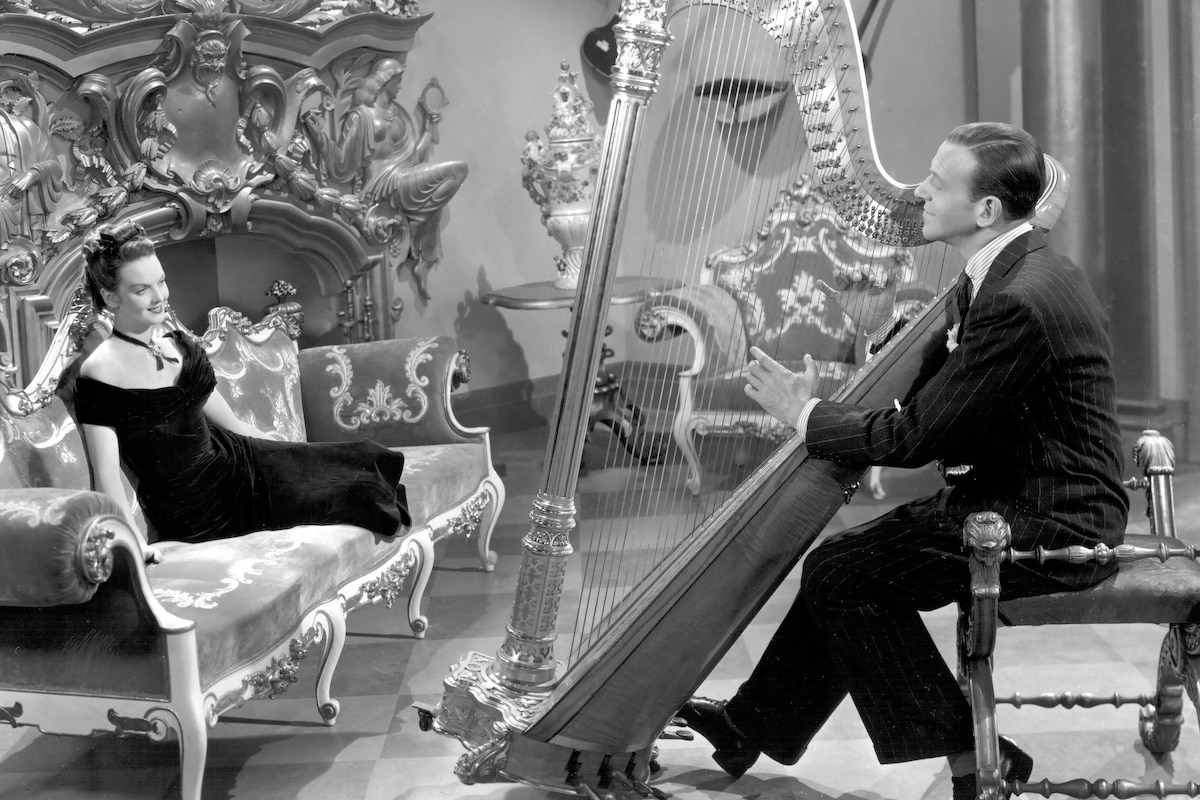
Conceived as a surrealistic musical, complete with a 16-minute dream ballet
modeled on the work of Salvador Dali and Jean Cocteau, Yolanda and the
Thief was decades ahead of its time stylistically. Today, it seems a
harbinger of the more personal work of filmmakers like Peter Greenaway and
David Lynch.
MGM's top musical producer Arthur Freed had been intrigued by a magazine
story by children's author Ludwig Bemelmans, best known for his classic
Madeline. He brought the Tyrolean author to MGM and set him up in a
writer's office, where Bemelmans stared at the walls for a few weeks, then
covered them with paintings. They were so surreal that studio head Louis
B. Mayer ordered them scraped off the walls immediately. Finally, Bemelmans came up with a
film treatment, though it would take four screenplay drafts to get it ready
for filming.
The whimsical production was a natural for Vincente Minnelli, the most
visually minded of all the studio's musical directors. Fred Astaire, who
had just worked with Minnelli on the studio's all-star musical
revue Ziegfeld Follies (1946) was a natural for the con man -- what other
dancer could possibly be mistaken for an angel? Minnelli's wife, Judy
Garland, wanted the female lead, hoping for another chance to work with her
husband, but Freed wanted this to be more of a dancer's musical and cast
his protege, Lucille Bremer. Bremer had scored as Garland's older sister
in Meet Me in St. Louis (1944), then had been a solid dancing partner for
Astaire in Ziegfeld Follies. And there may have been another reason
for the casting: she was strongly rumored to be romantically involved with
Freed.
Two other collaborators played an invaluable role in shaping Yolanda and
the Thief. Costume designer Irene Sharaff always seemed on the same
wavelength with Minnelli. They modeled the film's opening sequence, set in
a convent, on Bemelmans' own paintings, particularly his illustrations for
Madeline. For one of the film's two musical highlights, "Coffee
Time," she developed a stylized fusion of costumes and decor. She had
already created a set of coffee-colored costumes for the scene's extras.
To set the costumes off, she created a design of undulating black and white
lines for the floor. She even got down on her hands and knees to sketch
them out for the studio painters.
The other key collaborator was choreographer Eugene Loring, who suggested
the "Coffee Time" number. He didn't like the song producer Freed and
composer Harry Warren had originally written for that point in the film, so
he and Astaire developed a dance based on the slow jazz rhythms they
thought would work best. They performed it for Warren, who immediately
started playing an old song of his, "Java Time," that fit the dance steps
perfectly. Then Freed created a new lyric for the old tune.
Loring also came up with the idea for the film's 16-minute dream ballet, in
which Astaire struggles through the conflict between his attraction to
Yolanda and his plan to steal her fortune. Minnelli suggested using
landscapes in the style of Salvador Dali, while Loring contributed the idea
of having Astaire surrounded by washerwomen who tangle him in the bed
sheets they're cleaning. He would later say he got the idea from the
laundry scene in Jean Cocteau's classic Beauty and the
Beast (1946).
Making the dream a reality posed some problems, however. Sharaff wanted
Bremer's costume for the number to combine seashells molded to her torso
with a scarf lined with coins. But once they glued the shells to Bremer's
rather ample bosom, she looked as if she had elephantiasis, and even the
lightest plastic coins made her sound like a speeding garbage truck.
Instead, Sharaff had to settle for a stole with gold sequins. For Bremer's
first appearance in the dream, Minnelli wanted her to rise out of a pool
with scarves billowing around her. To get the right effect, he had to have
an air hose wired to her stand-in's back, then shoot the sequence in
reverse. But this also required Astaire to enter the scene walking
backwards while looking as though he were walking forwards. And just to
make matters worse, he had to angle his approach (retreat?) so the camera
wouldn't pick up the air hose. After numerous ruined takes, Astaire blew
up and screamed, "I am a very slow learner. Take the goddamn camera, and
just shoot it!"
Yolanda and the Thief had an enthusiastic first preview, so the
studio released it without major changes. Unfortunately, the mass
audience was more inclined towards boisterous jitterbugs danced by girls in
tight sweaters and didn't have much patience with the film's fantasy plot. As
a result, Freed and MGM lost interest in Bremer's career; they dropped her
option in 1947. Astaire announced his retirement from the screen while
working on his next film, Blue Skies (1946), only to come back to replace
Gene Kelly in Easter Parade (1948). Over time, however, Yolanda and
the Thief has picked up a devoted cult following among admirers of
Minnelli's more ambitious work and those who consider the film's
stylization ahead of its time.
Producer: Arthur Freed
Director: Vincente Minnelli
Screenplay: Irving Brecher
Based on a story by Jacques Thiery and Ludwig Bemelmans
Cinematography: Charles Rosher
Art Direction: Cedric Gibbons, Jack Martin Smith
Music: Lennie Hayton
Principal Cast: Fred Astaire (Jack Parkson Riggs), Lucille Bremer (Yolanda), Frank Morgan (Victor Budlow Trout), Mildred Natwick (Aunt Amarilla), Mary Nash (Duenna), Leon Ames (Mr. Candle), Remo Bufano (Puppeteer).
C-109m. Closed Captioning.
by Frank Miller
Yolanda and the Thief
by Frank Miller | July 28, 2003
SIGN UP FOR OUR NEWSLETTERS

CONNECT WITH TCM