"Even the lies about Gershwin were being distorted."
- Oscar Levant's comment on how far the film Rhapsody in Blue veered
from the truth about George Gershwin's life.
Hollywood had expressed interest in doing a biography of America's most
influential modern composer ever since his untimely death in 1937, but it
took eight years to finally get the story on the screen. Part of that time
was consumed in legal affairs, obtaining the rights to the Gershwin musical
library, but it was just as difficult coming up with a screenplay from a
life that was notably devoid of conflict. If what they ended up with was a
fiction with the Gershwin name attached, at least Rhapsody in Blue (1945)
featured 22 of his greatest songs and excerpts from five of his instrumental pieces,
performed by such noted Gershwin interpreters as pianist Oscar Levant,
singers Al Jolson and Anne Brown and conductor Paul Whiteman.
Various writers on the Warner Bros. lot labored over the story for years.
When playwright Clifford Odets took over the project, he drove his fellow
writers crazy playing recordings of Gershwin's music all day to get in the
mood. The result was an 800-page screenplay about class struggle,
featuring the young Gershwin's battle to rise from poverty to gain
international acceptance as a composer. Most readers thought it was more
about Odets than Gershwin, so Warners assigned another writer to the
project and used portions of Odets' screenplay a year later for another
picture with a musical background, Humoresque.
What stymied most of the writers was the lack of dramatic material in
Gershwin's life. It wasn't that his life was devoid of romance. He was
rumored to have had flings with everyone from Adele Astaire to Fay Wray.
Friends noticed that he was always proposing to beautiful women, none of
whom took him seriously. After his death, a gold-plated key to French
actress Simone Simon's Hollywood home was found among his possessions. None
of that was considered screen-worthy, so writers Sonya Levien, Elliot Paul
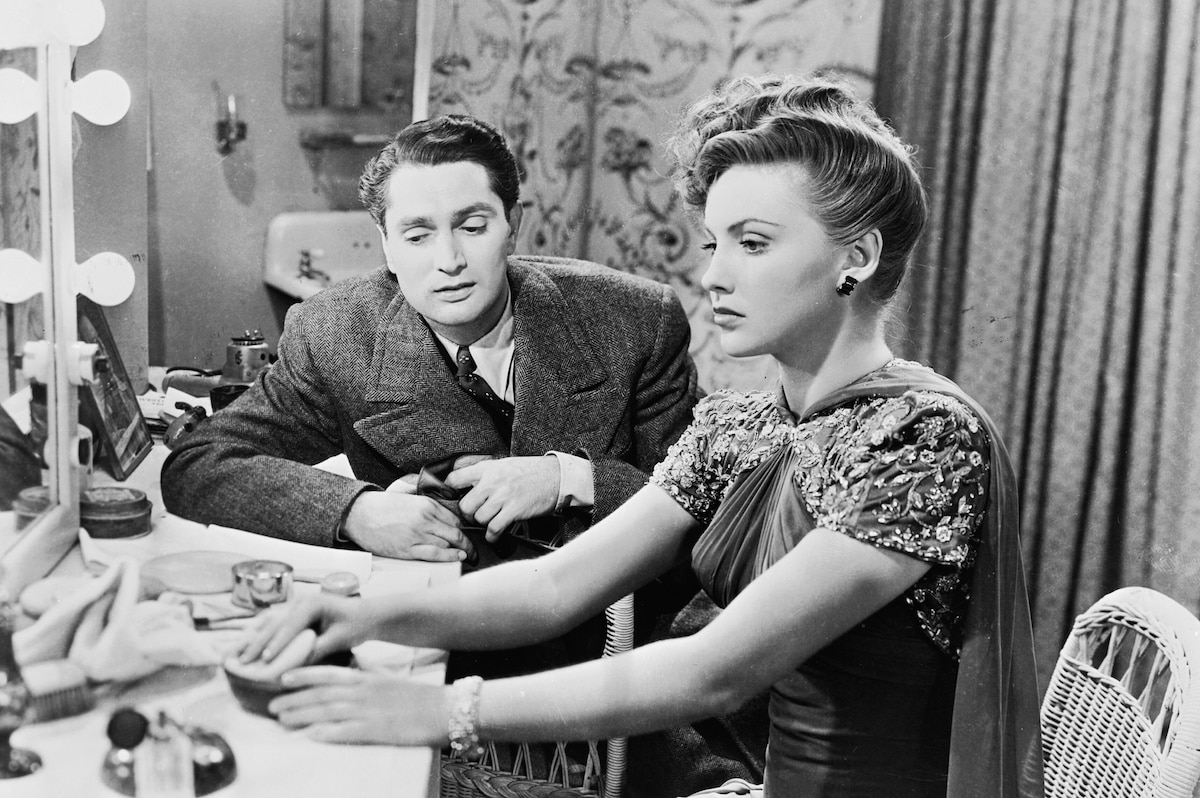
and Howard Koch created two fictional romances for the film, one with a
young singer (Joan Leslie), the other with a society woman (Alexis Smith),
both of whom leave the driven Gershwin rather than compete with his
career. With no major setbacks in his career, the writers magnified the
importance of "Blue Monday Blues," a one-act opera dropped from George
White's Scandals in 1924, and used it as motivation for Gershwin's
first serious piece, "Rhapsody in Blue."
To make up for all the fiction in the screenplay, the studio spared no
expense on creating the trappings of authenticity. They borrowed several
of Gershwin's personal belongings -- including his worktable, a silent
piano keyboard he used when he traveled and even some of his paintings --
from his brother, lyricist Ira Gershwin, who also served as a consultant on
the production. The art department re-created some of the most famous
theatres and concert venues in Gershwin's career, including Aeolian Hall,
where "Rhapsody in Blue" premiered; the Los Angeles Philharmonic
Auditorium, the Comedie-Francaise and the Winter Garden, Music Box and
Apollo Theatres. For the Porgy and Bess sequence they built an
exact reproduction of the opera's original stage setting. They also hired
several performers who had introduced Gershwin's music to the world,
including Anne Brown, who had sung in both "Blue Monday Blues" and the
premiere of Porgy and Bess. Al Jolson, who had introduced
Gershwin's first hit, "Swanee," in the musical Sinbad, performed the
number in the same costume he had worn in that 1917 show. When band leader
Paul Whiteman, who had commissioned and conducted the first performance of
"Rhapsody in Blue," showed up for his scenes, the makeup department had to
shave off his mustache to put on a fake one more like the style he wore in
1924. Since he'd lost weight recently, the costume department added
padding to his clothing so he would look more like himself.
The wisest choice Warners made in seeking authenticity was hiring longtime
Gershwin friend Oscar Levant, who at the time was considered the premier
interpreter of his works. Not only did Levant record the performance of
"Rhapsody in Blue" and "Concerto in F" used in the film, but also he played
himself. Some critics even suggested that he had written his own lines.
Certainly, his presence -- and his acerbic one-liners -- helped capture the
sophistication of the era in which Gershwin reached the height of his
fame.
Rhapsody in Blue was one of Warner Brothers' biggest hits of 1945. It
did so well, the studio followed much the same formula in filming their 1946
Cole Porter biography, Night and Day (even down to casting a friend
of the composer's, this time Monty Woolley, to provide comic relief). It
also provided a smashing screen debut for its star, Robert Alda, who
delivered a strong performance as Gershwin. Alda would go on to still
greater fame as a Broadway musical star, particularly as the original Skye
Masterson in Guys and Dolls, before watching his son, Alan Alda,
rise to even greater heights.
Producer: Jesse L. Lasky
Director: Irving Rapper
Screenplay: Howard Koch, Elliot Paul
Based on a story by Sonya Levien
Cinematography: Sol Polito
Art Direction: John Hughes, Anton Grot
Music: Ray Heindorf, Max Steiner
Principal Cast: Robert Alda (George Gershwin), Joan Leslie (Julie Adams),
Alexis Smith (Christine Gilbert), Julie Bishop (Lee Gershwin), Albert
Bassermann (Prof. Frank), Morris Carnovsky (Poppa Gershwin), Rosemary DeCamp
(Momma Gershwin), Herbert Rudley (Ira Gershwin), Darryl Hickman (Ira
Gershwin as a Boy), Oscar Levant, Al Jolson, Anne Brown, Paul Whiteman,
George White, Hazel Scott (Themselves).
BW-142m. Closed captioning.
by Frank Miller
Rhapsody in Blue
by Frank Miller | March 26, 2003
SIGN UP FOR OUR NEWSLETTERS

CONNECT WITH TCM