Rarely has a film's title so perfectly described its leading lady as when
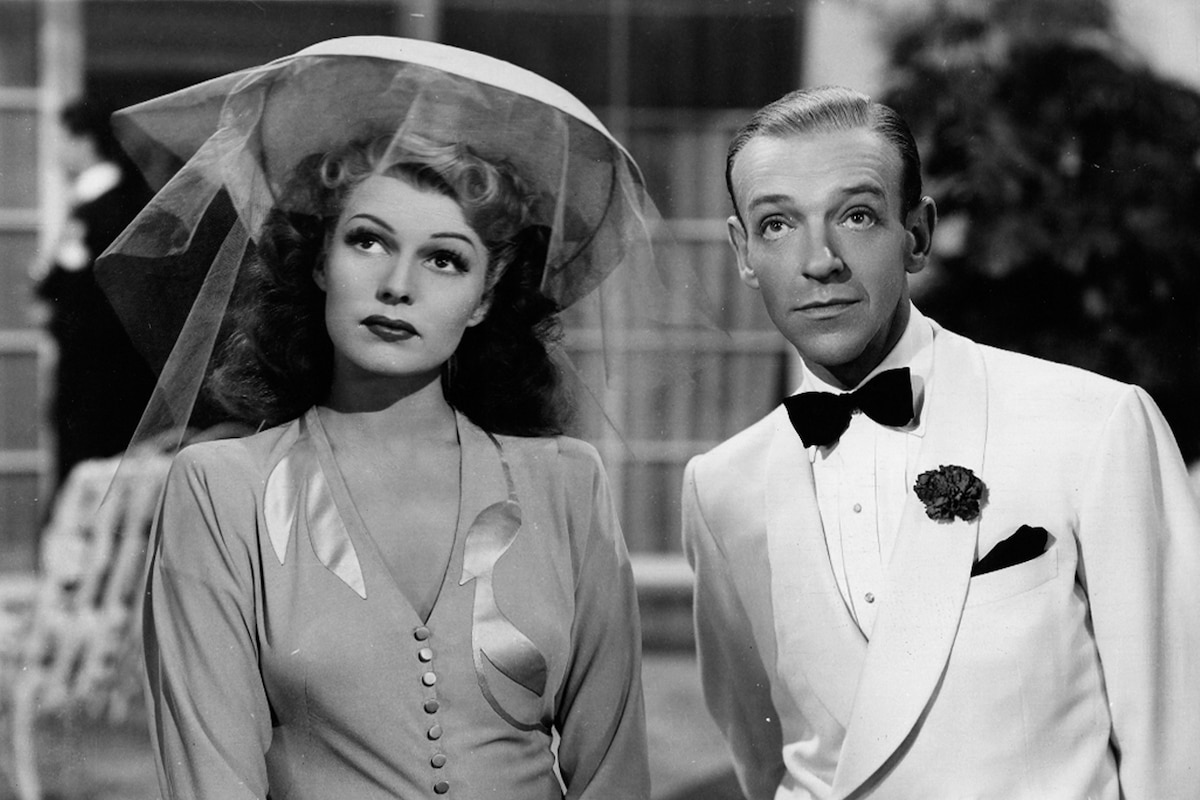
Rita Hayworth put on her dancing shoes for You Were Never Lovelier (1942), the follow-up film to her first teaming with Fred Astaire, You'll Never Get Rich (1941). But where she had been an up-and-coming leading lady when they made their first film
together, she was a full-fledged star by the time she danced with him a
second time. And just as Margarita Cansino had been Hollywood-ized into
Rita Hayworth, so the film was set in a Hollywood version of Buenos Aires,
complete with bandleader Xavier Cugat and his band playing the Latin music
of all-American composer Jerome Kern. In typical Hollywood fashion, all
Latin countries were one. The film was originally titled Carnival in
Rio before the setting was changed to Argentina, and the Argentine
natives were played by a leading lady of Spanish descent and a Cuban
bandleader. Cugat wasn't the most famous Cuban on screen either. The
15-year-old Fidel Castro appeared as an unbilled extra.
Astaire had performed with Hayworth's father, Latin dancer Eduardo Cansino.
That family connection had helped him overcome his doubts about working
with an actress almost as tall as he and 20 years his junior. From their
first rehearsal for You'll Never Get Rich, he would dub her the
first natural dancer he had worked with since his sister, Adele, had
retired from their stage act. Years later, he would call Hayworth his
favorite on-screen dancing partner.
When their first film together became a hit, Columbia Studios, which had
released the film, quickly got to work developing another vehicle for the
dancing stars. Latin subjects were in vogue at the time and Columbia, like other Hollywood studios, began marketing to South American moviegoers. Besides, European movie ticket sales had drastically dropped off ever since the start of World War II so Columbia decided to adapt an
Argentinean film, The Gay Senorita. Astaire was cast as a dancer
whose gambling losses strand him in Buenos Aires. When night club owner
Adolphe Menjou's second daughter (Hayworth) refuses to marry, leaving her
younger sisters with no chance of tying the knot until she gives in, Menjou
starts sending the girl gifts from a secret admirer she mistakenly decides
is Astaire. The situation created ample opportunities for dance numbers as
Astaire performs with Cugat's orchestra in Menjou's club and first
reluctantly, then amorously courts Hayworth.
The studio relied on Cugat to supply the Latin music, then assigned the
rest of the score to Kern, a composer who had never been comfortable
working in that style. Instead, he and lyricist Johnny Mercer supplied the
classic "I'm Old Fashioned" as a perfect expression of Hayworth's
character, the hit "Dearly Beloved" for Astaire's pose as her secret
admirer and "The Shorty George" for an athletic rehearsal number. "Dearly
Beloved" would reach the hit parade in recordings by Glenn Miller's
orchestra and Dinah Shore. It even became a standard wedding piece for a
while. A few years later, Mercer would paraphrase the lyrics, particularly
"I know that I'll be yours come shower or shine," for an even bigger hit
with music by Harold Arlen, "Come Rain or Come Shine." But then, the
melody had already been recycled; Kern had borrowed it from a Puccini
opera.
Space was at a premium on the lot during production, so Astaire found a
room over a funeral parlor for dance rehearsals. Unlike many of his
earlier partners, including Ginger Rogers, Hayworth was there for all the
rehearsals while he was developing their routines. But every time a
funeral procession went by the hall, they had to stop so the music and
tapping feet wouldn't disrupt the proceedings. When that made the
rehearsals too somber, Astaire distracted Hayworth with little jokes. They
were using an ice bucket to cool soft drinks, and one time he dipped his
hand in the ice before taking her in his arms for a romantic pas de
deux.
Hayworth had scored solidly in several films the year before, including
The Strawberry Blonde, with James Cagney, and Blood and Sand,
with Tyrone Power. This helped make You Were Never Lovelier a major
hit for the studio, and the film's success made her Columbia's top female
star. The picture scored Oscar® nominations for its score, sound
recording and the song "Dearly Beloved," though it lost in all three
categories. Sadly it would mark Astaire's last teaming with Hayworth.
Columbia kept her too busy for such elaborate musicals in the future, while
his career carried him to MGM, where he would find new success dancing with
such co-stars as Judy Garland, Vera-Ellen and Cyd Charisse.
Producer: Louis F. Edelman
Director: William A. Seiter
Screenplay: Michael Fessier, Ernest Pagano, Delmer Davies
Based on the Story and Screenplay The Gay Senorita by Carlos A. Olivari
and Sixto Pondal Rios
Cinematography: Ted Tetzlaff
Art Direction: Lionel Banks, Rudolph Sternad
Music: Jerome Kern
Principal Cast: Fred Astaire (Robert Davis), Rita Hayworth (Maria Acuna),
Adolphe Menjou (Eduardo Acuna), Leslie Brooks (Cecy Acuna), Adele Mara
(Lita Acuna), Isobel Elsom (Mrs. Maria Castro), Xavier Cugat and His
Orchestra (Themselves), Lina Romay (Herself).
BW-98m.
by Frank Miller
You Were Never Lovelier
by Frank Miller | March 26, 2003
SIGN UP FOR OUR NEWSLETTERS

CONNECT WITH TCM