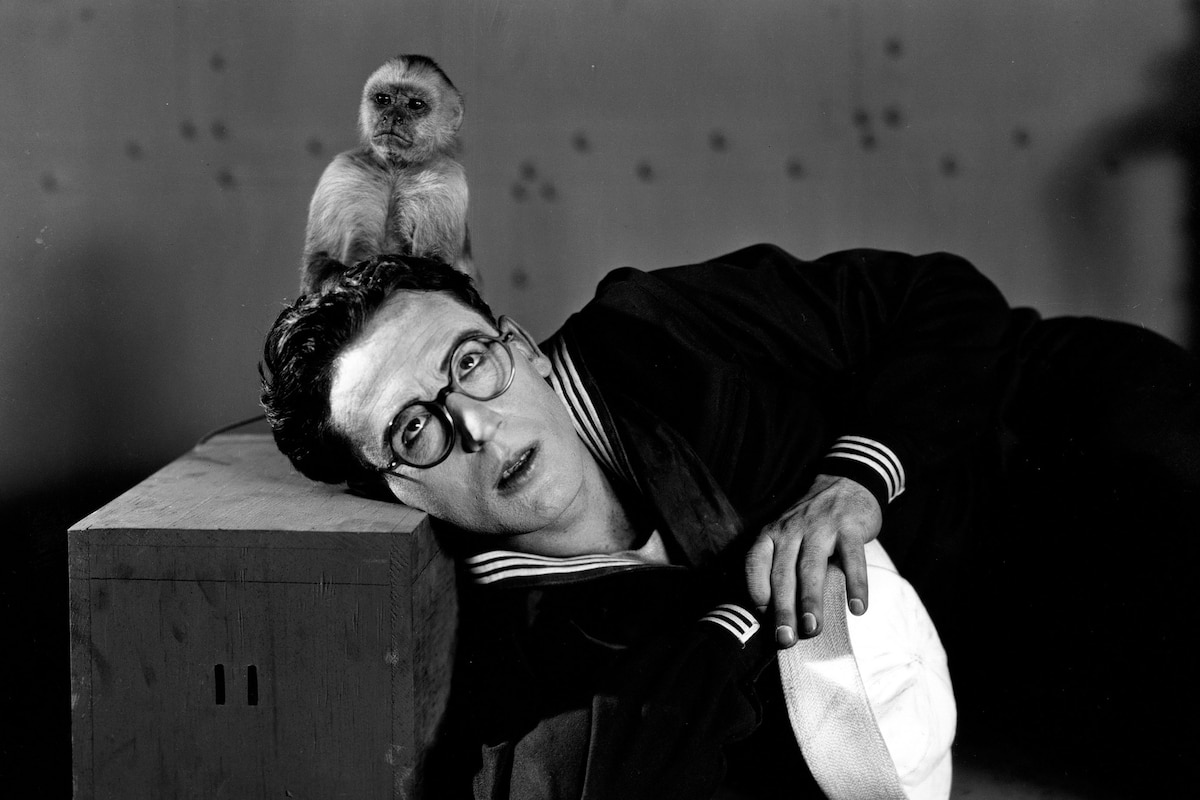
Harold Lloyd achieved a milestone in 1921 when he made A
Sailor-Made Man, his first feature-length comedy. He was only the second
of the great silent clowns to move into features, following Charles
Chaplin's
success with The Kid earlier the same year. But he didn't
make the
move to keep up with Chaplin or even in response to growing
audience demand
for feature-length comedies. Some have suggested that he was
actually
competing with Bebe Daniels, the co-star who had deserted him in
1920 to
break out on her own. Certainly that may have fueled his desire
to work in
longer forms, but the truth is, A Sailor-Made Man became a
feature
by accident.
From the start, the film had been conceived on a large scale.
The plot concerned a young millionaire who joins the Navy to prove to his
sweetheart's father that he can make something of himself. He
does so just
in time to rescue the girl when she's kidnapped by an evil
maharajah. All
this required filming on a grander scale than Lloyd and his
producer, Hal
Roach, had previously attempted. For early scenes at Lloyd's
country club,
they shot on location at the lavish Beverly Hills Hotel. The
shipboard
scenes were filmed on the U.S.S. Fredrick, with actual
sailors as
extras. For the scenes in which Lloyd sneaks into the royal
palace to
rescue his leading lady, they used Roach's sound stages at Culver
City.
But it wasn't the sets that made the film longer than usual. It
was
Lloyd's gags. He and his writers kept coming up with great ideas
for
routines involving his profligate ways, his enlistment, his
gradual coming
of age at sea and, most importantly, the daredevil rescue. After
pole
vaulting into the castle, he dons a variety of disguises and
pulls numerous
tricks to elude the guards and get to the girl. When it became
apparent
that the film would be longer than the customary 20-minute
running time of
most silent shorts, Roach decided they should just go ahead and
shoot
everything they had come up with. They could always cut what
didn't work
after the previews.
When they previewed A Sailor-Made Man, however, everything
worked, so they kept it
all in. The releasing company, Pathe, which had only contracted
for a
short film, was so impressed they paid Lloyd and Roach more than
their
contract demanded. The success of the gags and the film's
ability to hold
an audience for 40 minutes are largely due to Lloyd's
perfectionism.
Actress Jobyna Ralston -- who would become Lloyd's leading lady
when he
married this film's star, Mildred Davis -- was just starting her
career
when she got a bit part in A Sailor-Made Man that gave her
a chance
to observe Lloyd firsthand. In a 1926 interview, she described
how he took
more than five hours on one shot that would last less than a
minute.
Thinking he's defeated a crew of enemy soldiers single-handedly, he
sits on
their unconscious bodies and casually lights a cigarette. For
over five
hours, he experimented with different places to sit, different
camera
angles, different places to light the match and even different
ways of
holding the cigarette until he got it just right.
Thanks to all that hard work, A Sailor-Made Man became a
huge hit with
critics and fans. The film premiered on Christmas Day 1921 and
took in
almost half a million dollars at the box office on an investment
of just
$77,000. Lloyd was thrilled with his move into longer films,
later saying,
"I felt at last that I had arrived somewhere." But he was also
well aware
that at 40 minutes the film barely qualified as a feature. In
later years,
he would refer to his next film, Grandma's Boy (1922) as his
first feature length movie,
describing A Sailor-Made Man as his last short
film.
Producer: Hal Roach
Director: Fred C. Newmeyer
Screenplay: Hal Roach, Jean Havez, Sam Taylor, H.M. Walker
Cinematography: Walter Lundin
Music: Robert Israel
Principal Cast: Harold Lloyd (The Boy), Mildred Davis (The Girl),
Noah
Young (Rough-House O’Rafferty), Dick Sutherland (Maharajah), Leo
Willis
(Recruiting Officer), Gus Leonard (Lawyer), Jobyna Ralston
(Extra).
BW-40m.
by Frank Miller
A Sailor-Made Man
by Frank Miller | March 27, 2003
SIGN UP FOR OUR NEWSLETTERS

CONNECT WITH TCM