It took Harold Lloyd and his writers nine months to come up with Feet First (1930), his second feature with sound. They had been severely disappointed
with his first sound film, Welcome Danger (1929). Even though it
had done well at the box office, Lloyd felt he had let it become too talky,
with lame jokes replacing his usually brilliant sight gags grounded in
character. To get back on track, they constructed a plot that would let
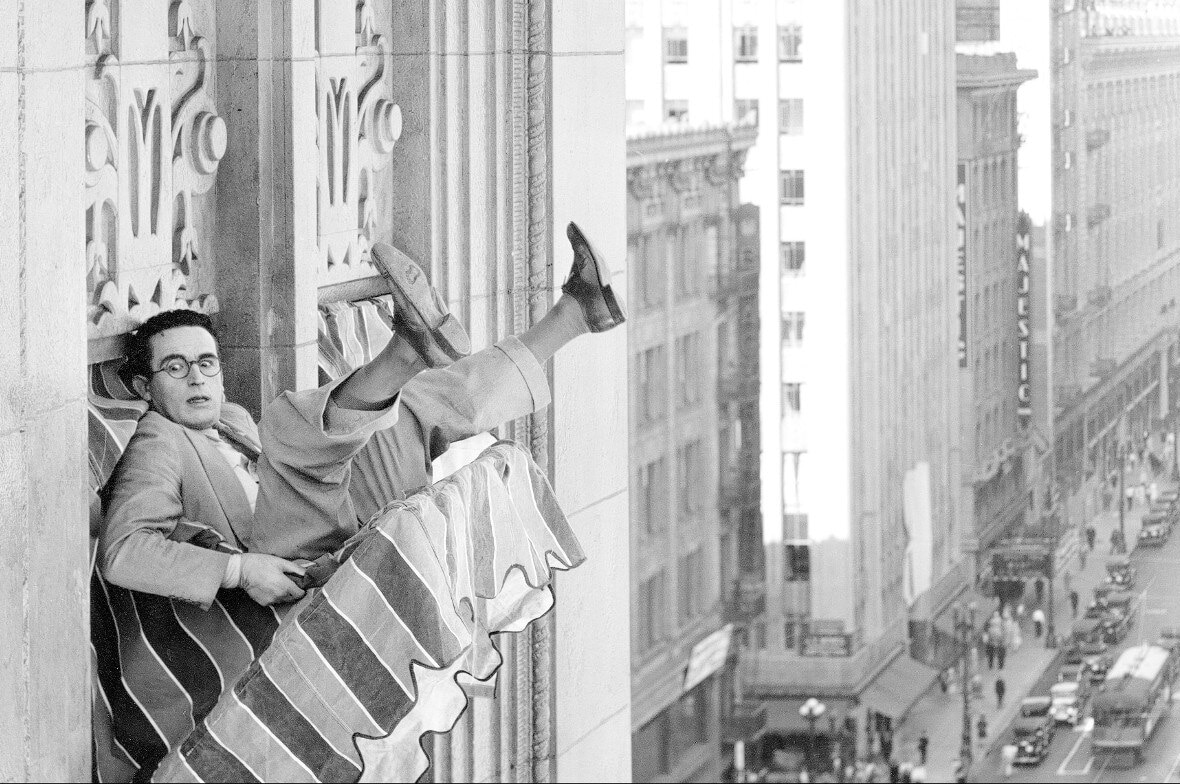
him re-create one of his most famous silent routines, the perilous climb up
a skyscraper in 1923's Safety Last. Whereas in the previous film he
had climbed up a skyscraper to win a fortune, in Feet First
he was forced to climb down a building after a series of contrived
accidents left him stranded near the roof on a painter's scaffold.
As in most of his films, Lloyd plays a bespectacled, gung-ho boy-next-door
type out to make his fortune and win the girl. This time out, he's an
ambitious shoe store clerk who pretends to be a millionaire to impress the
girl (Barbara Kent) he thinks is the boss's daughter. She isn't, but in
the course of carrying off his masquerade, he stows away aboard a ship
headed to Hawaii, ending up in a mail sack that gets transported to the top
of a skyscraper.
Using Kent was probably Lloyd's first mistake. Although she
had scored as the good girl in Garbo's silent Flesh and the Devil (1926),
she had been wooden if beautiful in Welcome Danger. She hadn't
improved much by her second (and last) film with Lloyd. Perhaps he was
determined to re-capture his magical teamwork with earlier leading ladies
Bebe Daniels, Mildred Davis and Jobyna Ralston, all of whom had worked with
him on several films. The one thing she had in common with them was that
she gave up her career in American films for marriage, though she wasn't as
fortunate as Davis, who married the boss and remained Mrs. Lloyd until her
death in 1969.
Lloyd shot the building-scaling scene just as he had for Safety
Last, creating the illusion that he was about to tumble to his death
while the actor was really in no danger. Various parts of the building's
facade were built on a Los Angeles rooftop, so that he actually was
towering above the city although he had only a few feet to fall. In a
departure from the earlier film, for long shots, stuntman Harvey Parry
filled in for the star, something he had been doing for years. There was
little attempt to keep these precautions from the press at the time.
Publicity for the film even featured shots of the false facade, though
Parry was asked to be discreet about his contribution. As Lloyd's legend grew
in later years, however, the myth that he had performed all his own stunts
grew with it. In deference to the star, Parry did not claim any credit
until after Lloyd's death in 1971.
Duplicating Lloyd's Safety Last stunts with sound seemed like a
great idea at the time -- at least until audiences got a look at it. As
was often the case with Lloyd's films, he previewed Feet First at a
greater length than he intended for the final cut, allowing the audience to
show him what gags needed to stay in and what could be cut. As a result,
the climbing sequence ran 30 minutes at the first preview, where it died.
For audiences just becoming accustomed to sound films, the addition of
Lloyd's panting and cries for help made the scene more excruciating than
funny, and they stopped laughing quickly. Ultimately, Lloyd cut the
sequence to ten minutes, but it only worked in a German theatre, where the
manager had the brilliant idea of playing it without sound. The audience's
laughter more than filled the silence. For later generations, however, the
sequence stands as one of the funniest in Lloyd's oeuvre.
At the time, however, he considered Feet First another disappointment.
It made a profit, bringing in $1.5 million on a $650,000 investment, but
that marked a decline of $750,000 from Lloyd's first talking film. Like
fellow silent clowns Buster Keaton and Harry Langdon, Lloyd was finding the
world of talking films far from nurturing. He would make only four more
features before retiring from acting, though unlike many of his
contemporaries he had invested wisely enough to rank as one of Hollywood's
richest stars.
When Lloyd sold Feet First to television in 1953, the film became a
victim of changing times in another way. The picture had marked the screen
debut of black comic Willie Best, an accomplished stage actor forced to
play demeaning roles in Hollywood films. He was initially billed as Sleep
'N' Eat to play up the studio's insulting claim that he actually enjoyed
humiliating himself and didn't want money for his work, just three square
meals and a warm place to sleep. By 1953, this type of stereotyping was fast
falling out of favor. As a result, Lloyd cut almost 20 minutes out of
Feet First to eliminate much of its by-then dated racist
humor. However, TCM will broadcast the UCLA Film and Television Archive's newly-restored print of the complete 1930 version of Feet First, enabling audiences to see the film in its original form, regardless of its flaws.
Producer: Harold Lloyd
Director: Clyde Bruckman
Screenplay: Felix Adler, Clyde Bruckman, Alfred A. Cohn, John Grey, Lex
Neal, Paul Girard Smith
Cinematography: Henry Kohler, Walter Lundin
Principal Cast: Harold Lloyd (Harold Horne), Robert McWade (John Tanner),
Lillian Leighton (Mrs. Tanner), Barbara Kent (Barbara), Alec B. Francis (Mr.
Carson, old-timer), Noah Beery, Sr. (Shoe Store Bit), Sleep 'N' Eat/Willie
Best (Janitor).
BW-70m.
by Frank Miller
Feet First
by Frank Miller | March 27, 2003
SIGN UP FOR OUR NEWSLETTERS

CONNECT WITH TCM