Steven Spielberg was only 26 when filming commenced on his first theatrical feature, The Sugarland Express (1974). With several years of episode TV and the much-lauded suspense telefilm Duel (1971) on his resume, the young director had successfully pitched Universal on a chase comedy that offered up plenty of arresting visuals and oddball bits of Americana.
Spielberg's screenplay, which received an extensive reworking by Hal Barwood and Matthew Robbins, drew its inspiration from a 1969 incident where a Texas ex-con took a highway patrolman hostage in order to ensure one last free moment with his children. The pain of his parents' divorce while he was in his teens was still all too fresh in the director's mind, and The Sugarland Express would merely be the first of many projects where he would explore the theme of the fragmented family.
When the Universal brass demanded a bankable female star to anchor the project, Spielberg found no takers until his sit-down with Goldie Hawn. The actress, who had been rejecting scripts for a year in search of something that would demonstrate a range beyond her familiarly ditzy screen persona, agreed to a substantial pay cut in order to come on board. "I always thought she was a dramatic actress, for she took her comedy very seriously," the director recounted for Joseph McBride's Steven Spielberg: A Biography. "[Y]ou could tell she was thousands of kilowatts smarter than the people of Laugh-In had ever allowed her to demonstrate."
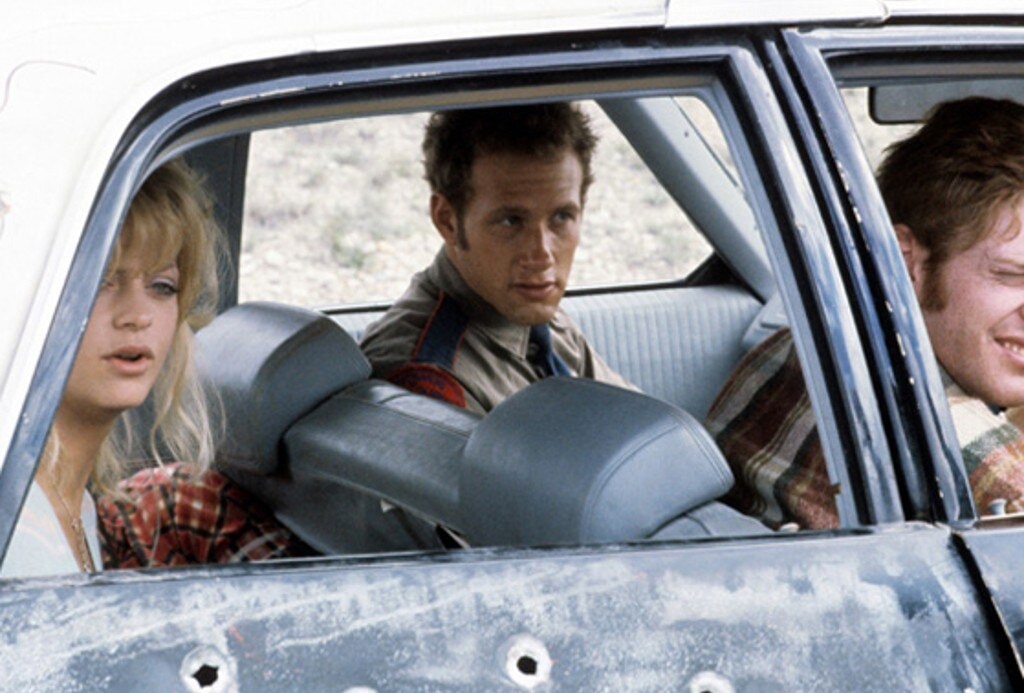
The story opens on Lou Jean Poplin (Hawn), a part-time beautician and occasional check-kiter, as she debarks at a low-security state penitentiary for a conjugal visit with her amiable if somewhat vacant husband Clovis (William Atherton). She informs him that the state child welfare board has placed their two-year-old son with a foster family in light of her own criminal record, and lets him know in no uncertain terms that they'll be retrieving the baby together.
With the benefit of smuggled-in civvies, Clovis walks out the front gate, and circumstances bring the Poplins into the grasp of a straight-arrow young trooper named Slide (Michael Sacks). The fugitives get the drop on the novice lawman, and commandeer his patrol car for a cross-state run to their child's foster home in Sugarland, TX. Slide's paternally patient commanding officer (Ben Johnson) is loathe to escalate the tension, and opts to maintain a constant tail in lieu of confrontation.
However, the situation winds up piquing the posse mentality of nearly every peace officer within radio range, and the Poplins presently find themselves heading a caravan of dozens of speeding police cruisers stretching past the horizon. A media circus springs up just as quickly, as sympathetic Texans start lining highways and main streets, treating the criminal couple and their hostage like passing royalty.
Producer Richard Zanuck, who made a show of faith in assuming the project (and whose two-year-old son appeared as the Poplins' toddler), recalled for biographer Joseph McBride how his young director demonstrated a veteran's poise on set. "He was in command. I could sense it, because I had been around long enough with a lot of great directors-the Robert Wises, the William Wylers, the John Hustons-and I knew almost immediately that he had knowledge and command and ability, and an innate, intimate sense of the visual mechanics of how you put all these pieces together so that the final result is very striking...[H]e knew the capacity of all the lenses and equipment. He knew how to move the camera, when to move it, when not to move it, how to have it move in different ways, how to move people around-he just knew it."
While the critics by and large heaped praise on The Sugarland Express, the film ultimately did little more than break even at the box office. Multiple theories have been advanced as to why general audiences failed to patronize it, from discomfort with the darker tone of the script's third act to reluctance to accept Hawn in such a relatively unsympathetic role. Spielberg's disappointment at the movies' receipts was marked, but film devotees presciently recognized that this was a young filmmaker blessed with a strong grasp of his craft, and from whom much could be expected in the future.
Producer: David Brown, Richard Zanuck
Director: Steven Spielberg
Screenplay: Hal Barwood, Matthew Robbins, based on a story by Steven Spielberg
Art Direction: Joseph Alves, Jr.
Cinematography: Vilmos Zsigmond
Editing: Edward M. Abroms, Verna Fields
Music: John Williams
Cast: Goldie Hawn (Lou Jean Poplin), Ben Johnson (Capt. Tanner), Michael Sacks (Officer Slide), William Atherton (Clovis Poplin),Gregory Walcott (Patrolman Ernie Mashburn), Louise Latham (Mrs. Looby), Steve Kanaly (Patrolman Jessup).
C-110m. Letterboxed. Closed captioning.
by Jay Steinberg
The Sugarland Express
by Jay Steinberg | September 24, 2003
SIGN UP FOR OUR NEWSLETTERS

CONNECT WITH TCM