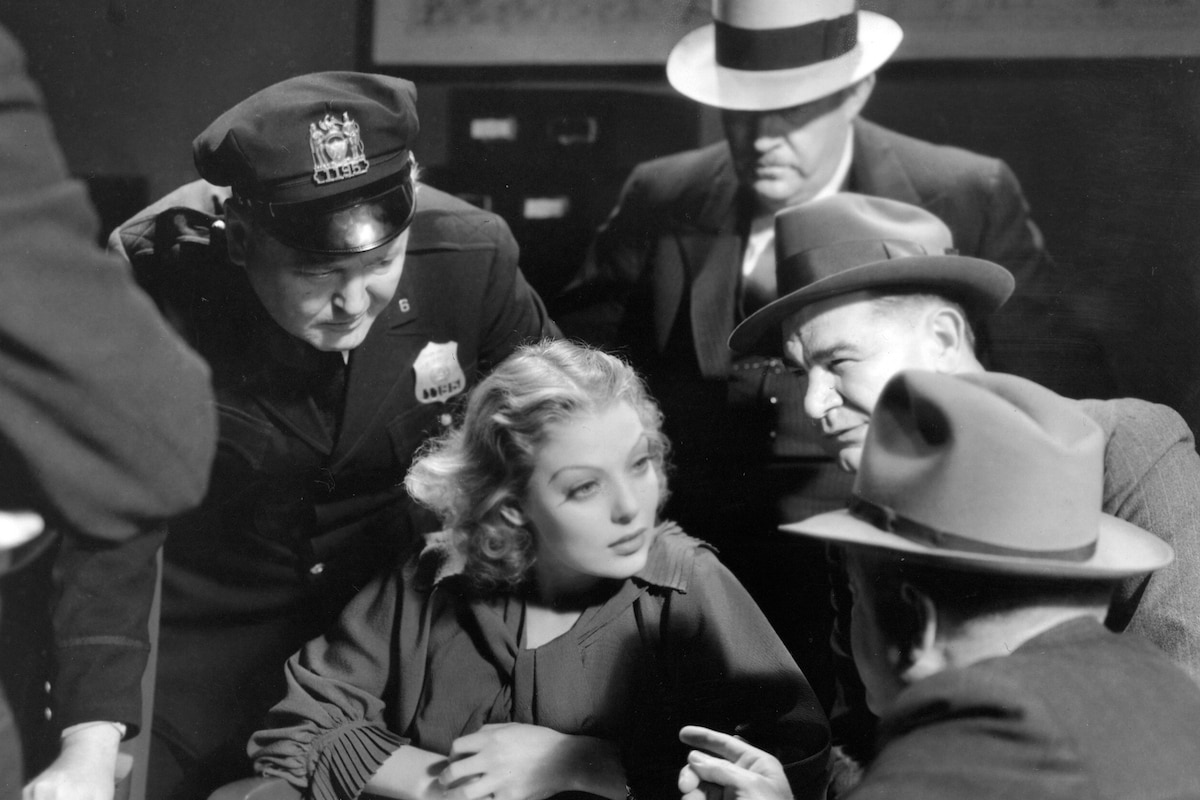
When we first meet Loretta Young in Midnight Mary (1933), she is sitting at her own trial,
casually reading Cosmo as a prosecutor vigorously argues to a jury that she is guilty of murder.
She may be bored, but Midnight Mary is anything but. Director William Wellman quickly has
Young's character shepherded into a clerk's office to await the verdict, and as she waits she thinks
back on her life and the story that got her to this point, all of which unfolds in a series of
flashbacks.
A superbly executed montage starts with her at age 9, when she learns her mother has just died.
Amazingly, 19-year-old Young plays herself here. It's only for a few shots. She is costumed in a
child's dress, some dirt on her face, her hair in braids, and she flails around the frame, all arms and
legs. (Supporting actress Una Merkel, as Young's best friend, does the same -- and she was 29!) For one
shot, Wellman has Young push open an exaggerated, oversized door in order to make her look small and
help the trick work. It's a pretty audacious choice by Wellman, but Young carries it off surprisingly
convincingly.
At age 13, Young is sent to juvenile prison for a crime she didn't commit. Three years later, free
again, she and Merkel are out looking for a good time and hook up with a couple of sleazy guys in a car
moments after meeting them -- the first of many entertainingly frank scenes regarding sex. Penniless,
Young falls into prostitution and then becomes a moll and unwitting accomplice to gangster Ricardo
Cortez, who leads a gang of robbers.
While Young may get one tough break after another, she is really a good girl underneath who longs to
make an honest living. She tries to do so multiple times, only the conditions of the Depression work
against her and she finds herself sheepishly going back to Cortez over and over again. When she meets
rich, kind, eligible lawyer Franchot Tone, she is able with his help to turn her life around and start
a real job as secretary. The problem is, her past catches up to her and the old pattern reasserts
itself.
The picture is a time capsule in the best way, illustrating the gritty Depression landscape without
hitting us over the head about it in a self-important way. The fact that times are so tough Young can't
get a job is treated as a matter-of-fact ingredient in what is basically a melodrama; it's not
presented as a "message movie." Viewed decades later, this has the paradoxical effect of making the
tough times on display even more vivid.
Midnight Mary is also an excellent vehicle for Loretta Young, luminously beautiful as she
delivers a powerhouse performance that demonstrates a nice range of emotion. Under contract to Warner
Bros. at the time, she was borrowed by MGM for this film, as was director Wellman. MGM also borrowed
Ricardo Cortez from Paramount and supporting player Andy Devine from Universal, leaving only Franchot
Tone and Una Merkel as home-team players. Anyone entering the movie after the credits, however, would
be forgiven for assuming this to be a Warner Brothers film, such is the grittiness and luridness on
display. Midnight Mary was very atypical for MGM.
Also in the cast and deserving of mention are the very fine Robert Greig and Halliwell Hobbes, each
beloved by movie audiences for their character roles in so many films. Greig and Hobbes were
archetypical butlers in movie after movie during this era, and to see them both in the same picture is
a treat. (Surprisingly, they appeared in seven films together.)
Cortez plays his mobster character really intriguingly. He's not all bad; he has a heart and a sense of
loyalty and responsibility that soften his toughness and make him more fully dimensional than he might
have appeared on paper. This also makes it much more devastating when Cortez's full bad-guy nature
comes out in force at the end of the story.
Cortez has fun with many of the pre-code elements of the film, in one scene slapping Young around quite
brazenly. In another, Young whispers something obviously very, very naughty into Cortez's ear, in a
desperate attempt to keep him from leaving the apartment and murdering Tone. Young is clearly listing
the dirty things she will do for him if he stays; Cortez lights up sleazily, and the ploy almost works.
This is one of the racier moments in any pre-code film this viewer has ever seen, and all the more
impressive because it is still more implied than shown. Isn't it fascinating how even in a pre-code
movie, something which is merely implied ends up standing out as so deliciously shocking?
Wellman started his career in silent film, and his techniques from that era are on great view here. He
is able through careful framing to convey the clearest and most vivid emotions and story advancement
without relying on dialogue. Young's descent into prostitution and her ensuing guilt are shown with
incredible economy and visual storytelling; there's no need to even hear the word "prostitute" for us
to know what's going on. The sequences of Young pounding the pavement doggedly looking for work are
also pretty impressive. Wellman gives us shots of her legs walking, walking, walking... interspersed
with inserts of want ads, and ending with Young on a park bench looking at a hole in her shoe. Now
that's telling a story with pictures!
Midnight Mary is one of six pre-code features in Warner Home Video's essential new collection
Forbidden Hollywood Volume 3. The rest are also all directed by William Wellman: Other Men's
Women (1931), Frisco Jenny (1932), The Purchase Price (1932), Heroes For Sale
(1933) and Wild Boys of the Road (1933). In addition, Warner has thrown in two documentaries on
the director -- Richard Schickel's 1973 The Men Who Made the Movies: William A. Wellman, which
has extensive interview footage with Wellman, and the longer 1995 documentary Wild Bill: Hollywood
Maverick, executive produced by Wellman's son and featuring interviews with dozens of famous
admirers. There are also cartoons, short subjects and trailers throughout, and the packaging follows
in the attractive footsteps of the first two Forbidden Hollywood volumes. Three of the films come with
commentary tracks (including a good one on Midnight Mary from Jeffrey Vance and Tony Maietta),
and the overall technical quality is very good, though print quality varies from title to
title.
All in all, this is a superb collection and a must-see for classic movie fans.
For more information about Midnight Mary, visit Warner
Video. To order Midnight Mary (available only with the Forbidden Hollywood Vol. 3
set), go to
TCM Shopping.
by Jeremy Arnold
Midnight Mary - Loretta Young is MIDNIGHT MARY - One of the Pre-Code Delights in "Forbidden Hollywood Vol.3"
by Jeremy Arnold | March 18, 2009
SIGN UP FOR OUR NEWSLETTERS

CONNECT WITH TCM